3-Butanolal;3-hydroxy-butana
ISO FDA 1 Inquiries
107-89-1
99%
45kg
2022-12-13
Chemical Pesticides,Food Additives,Agrochemicals,Active Pharm Ingredients,Flavors and Fragrances,Chemical Catalyst
-
Product Description
-
Seller Information
-
Inquiry History
-
DescriptionCertificatesBasic Info
-
Product Name:
3-Hydroxybutanal
Other Name:Butanal,3-hydroxy-;Butyraldehyde,3-hydroxy-;Aldol;3-Hydroxybutanal;Acetaldol;3-Butanolal;β-Hydroxybutyraldehyde;3-Hydroxybutyraldehyde;NSC 7610;115827-11-7
CAS No.:107-89-1
Molecular Formula:C4H8O2
InChIKeys:InChIKey=HSJKGGMUJITCBW-UHFFFAOYSA-N
Molecular Weight:88.11
Exact Mass:88.11
EC Number:203-530-2
NSC Number:7610
UN Number:2839
DSSTox ID:DTXSID2050407
Color/Form:Clear, white-to-yellow syrupy liquid|Colorless, thick liquid
HScode:2912491000
Categories:
Characteristics-
PSA:
37.3
XLogP3:-0.77
Appearance:Aldol appears as a clear white to yellow syrupy liquid. Denser than water. Contact may irritate skin and eyes. Moderately toxic by ingestion, inhalation and skin absorption.
Density:1.103 g/cm3 @ Temp: 20 °C
Melting Point:<25 °C
Boiling Point:83 °C @ Press: 20 Torr
Flash Point:150 DEG F OC
Refractive Index:1.4238
Water Solubility:MISCIBLE WITH ORGANIC SOLVENTS
Storage Conditions:Store at RT.
Vapor Pressure:21 MM HG @ 20 DEG C
Vapor Density:3.00 (AIR= 1)
Toxicity:Oral-Rat LD50: 2180 mg/kg
Flammability characteristics:Combustible in case of open flame, high temperature and strong oxidant; decomposes toxic crotonaldehyde gas when heated; burning emits irritating smoke
Henrys Law Constant:Henry's Law constant = 4.37X10⁻⁹ atm-cu m/mol at 25 °C (est)
Experimental Properties:Decomposes at 85 °C to produce crotonaldehyde|Conversion factors: 1 mg/L = 278 ppm; 1 ppm = 3.6 mg/cu m|Hydroxyl radical reaction rate constant = 4.84X10⁻¹¹ cu cm/mole-sec at 25 °C (est)
Air and Water Reactions:Soluble in water.
Reactive Group:Alcohols and Polyols
Reactivity Profile:An aldehyde and alcohol. Aldehydes are frequently involved in self-condensation or polymerization reactions. These reactions are exothermic; they are often catalyzed by acid. Aldehydes are readily oxidized to give carboxylic acids. Flammable and/or toxic gases are generated by the combination of aldehydes with azo, diazo compounds, dithiocarbamates, nitrides, and strong reducing agents. Aldehydes can react with air to give first peroxo acids, and ultimately carboxylic acids. These autoxidation reactions are activated by light, catalyzed by salts of transition metals, and are autocatalytic (catalyzed by the products of the reaction). The addition of stabilizers (antioxidants) to shipments of aldehydes retards autoxidation. Flammable and/or toxic gases are generated by the combination of alcohols with alkali metals, nitrides, and strong reducing agents. They react with oxoacids and carboxylic acids to form esters plus water. Oxidizing agents convert them to aldehydes or ketones. Alcohols exhibit both weak acid and weak base behavior. They may initiate the polymerization of isocyanates and epoxides.
Autoignition Temperature:482 °F (250 °C)
Hazard IdentificationClassification of the substance or mixture
Acute toxicity - Category 2, Dermal
Eye irritation, Category 2
GHS label elements, including precautionary statements
Pictogram(s) 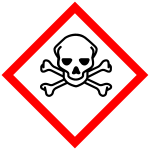
Signal word Danger
Hazard statement(s) H310 Fatal in contact with skin
H319 Causes serious eye irritation
Precautionary statement(s) Prevention P262 Do not get in eyes, on skin, or on clothing.
P264 Wash ... thoroughly after handling.
P270 Do not eat, drink or smoke when using this product.
P280 Wear protective gloves/protective clothing/eye protection/face protection/hearing protection/...
Response P302+P352 IF ON SKIN: Wash with plenty of water/...
P316 Get emergency medical help immediately.
P321 Specific treatment (see ... on this label).
P361+P364 Take off immediately all contaminated clothing and wash it before reuse.
P305+P351+P338 IF IN EYES: Rinse cautiously with water for several minutes. Remove contact lenses, if present and easy to do. Continue rinsing.
Storage P405 Store locked up.
Disposal P501 Dispose of contents/container to an appropriate treatment and disposal facility in accordance with applicable laws and regulations, and product characteristics at time of disposal.
Other hazards which do not result in classification
no data available
Handling and StoragePrecautions for safe handling
Handling in a well ventilated place. Wear suitable protective clothing. Avoid contact with skin and eyes. Avoid formation of dust and aerosols. Use non-sparking tools. Prevent fire caused by electrostatic discharge steam.
Conditions for safe storage, including any incompatibilities
Store the container tightly closed in a dry, cool and well-ventilated place. Store apart from foodstuff containers or incompatible materials.
-
-
Seller Information
-
Business Type:
Manufactory
-
Main Products:
Chemical Pesticides,Food Additives,Agrochemicals,Active Pharm Ingredients,Flavors and Fragrances,Chemical Catalyst
-
Location:
https://www.dideu.com/en/
-
Payment Terms:
TT against copy of documents,D/P,L/C,D/A,O/A,TT against B/L draft before shipment,100% TT in advance
-
Average lead Time:
7
-
Total Annual Revenue:
Above $100 million
-
Total Employees:
Above 1000
-
Year of Establishment:
2016
-
Certifications:
ISO Certificate,REACH
-
-
Inquiry History1 Inquiries
Country Product Purchase Quantity Date Posted  Malaysia
4-Hydroxybutanal
1 KG Jan 20, 2024 Post an enquiry for this product