Product
Supplier
Encyclopedia
Inquiry
Home > Catalyst and Auxiliary > Polymer > Diphenylmethane diisocyanate for Sale > 4,4'-Diphenylmethane diisocyanate101-68-8
4,4'-Diphenylmethane diisocyanate101-68-8 buy - large image1
4,4'-Diphenylmethane diisocyanate101-68-8 buy - image1
4,4'-Diphenylmethane diisocyanate101-68-8 buy - image2
4,4'-Diphenylmethane diisocyanate101-68-8 buy - image3
4,4'-Diphenylmethane diisocyanate101-68-8 buy - image4
4,4'-Diphenylmethane diisocyanate101-68-8 buy - image5
4,4'-Diphenylmethane diisocyanate101-68-8 buy - image6

4,4'-Diphenylmethane diisocyanate101-68-8

25 Inquiries

Unit Price:

$33-34/MT FOB

Get Latest Price
CAS No.:

101-68-8

Grade:

Industrial Grade

Content:

99.5%

Port:

上海

Brand:

OORENT

Packaging:

Vial/Bottle/Bag/Carton

Price valid (until):

2026-07-16

Company Type:
Trader
Location:
China
Qualification:
Main Products:

pharmaceutical intermediates,peptides,electronic chemicals

  • Product Description

  • Seller Information

  • Inquiry History

  • Description

    Product Detail  

    4,4'-Diphenylmethane diisocyanate Basic information
    Product Name: 4,4'-Diphenylmethane diisocyanate
    Synonyms: 1,1’-methylenebis(4-isocyanato)-benzene;para,para’-diphenylmethanediisocyanate;para,para’-methylenebis(phenylisocyanate);Rubinate 44;Rubinate LF-168;rubinate44;METHYLENEBIS(P-PHENYL ISOCYANATE);METHYLENEDIPHENYL 4,4'-DIISOCYANATE
    CAS: 101-68-8
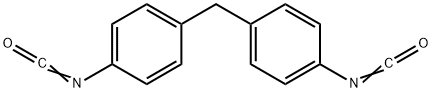
    MF: C15H10N2O2
    MW: 250.25
    EINECS: 202-966-0
    Product Categories: Pyridines ,Halogenated Heterocycles;Diphenylmethanes (for High-Performance Polymer Research);Functional Materials;Reagent for High-Performance Polymer Research;Alphabetic;M;META - METH;MDI;1
    Mol File: 101-68-8.mol
    Shop 4,4'-Diphenylmethane diisocyanate101-68-8-Detailed Image 1

    4,4'-Diphenylmethane diisocyanate Chemical Properties
    Melting point  38-44 °C
    Boiling point  392 °C
    density  1.19
    vapor pressure  0.066 hPa (20 °C)
    refractive index  1.5906 (estimate)
    Fp  196 °C
    storage temp.  -20°C
    solubility  2g/l (decomposition)
    form  solid
    color  White to Almost white
    Specific Gravity 1.180
    explosive limit 0.4%(V)
    Water Solubility  decomposes
    FreezingPoint  37℃
    Sensitive  Moisture Sensitive/Lachrymatory
    BRN  797662
    Dielectric constant 10.0(Ambient)
    Exposure limits ACGIH:TLV-TWA 0.005 ppm (0.051 mg/m3)
    OSHA:PEL-Ceiling 0.02 ppm (0.2 mg/m3)
    NIOSH:REL-TWA 0.05 mg/m3; REL-Ceiling 0.2 mg/m3[10-min]
    Stability: Stable. Combustible. Incompatible with strong oxidizing agents. Reacts violently with alcohols.
    InChI 1S/C15H10N2O2/c18-10-16-14-5-1-12(2-6-14)9-13-3-7-15(8-4-13)17-11-19/h1-8H,9H2
    InChIKey UPMLOUAZCHDJJD-UHFFFAOYSA-N
    SMILES O=C=Nc1ccc(Cc2ccc(cc2)N=C=O)cc1
    CAS DataBase Reference 101-68-8(CAS DataBase Reference)
    NIST Chemistry Reference Benzene, 1,1'-methylenebis[4-isocyanato-(101-68-8)
    IARC 3 (Vol. 19, Sup 7, 71) 1999
    EPA Substance Registry System 4,4'-Methylenedi(phenyl isocyanate) (101-68-8)

    Safety Information
    Hazard Codes  Xn,T,C
    Risk Statements  42/43-36/37/38-20-48/20-40
    Safety Statements  45-36/37-23
    RIDADR  2206
    OEB D
    OEL TWA: 0.05 mg/m3 (0.005 ppm), Ceiling: 0.2 mg/m3 (0.020 ppm) [10-minute]
    WGK Germany  1
    RTECS  NQ9350000
    Autoignition Temperature >600 °C
    Hazard Note  Toxic/Corrosive/Lachrymatory/Moisture Sensitive
    TSCA  TSCA listed
    HazardClass  6.1
    PackingGroup  II
    HS Code  29291090
    Storage Class 11 - Combustible Solids
    Hazard Classifications Acute Tox. 4 Inhalation
    Carc. 2
    Eye Irrit. 2
    Resp. Sens. 1
    Skin Irrit. 2
    Skin Sens. 1
    STOT RE 2 Inhalation
    STOT SE 3
    Hazardous Substances Data 101-68-8(Hazardous Substances Data)
    Toxicity LD50 orally in Rabbit: > 5000 mg/kg LD50 dermal Rabbit > 9000 mg/kg
    IDLH 75 mg/m3
    MSDS Information
    Provider Language
    1,1'-Methylenebis(4-isocyanatobenzene) English
    ACROS English
    ALFA English

    4,4'-Diphenylmethane diisocyanate Usage And Synthesis
    Description 4,4'-Diphenylmethane-diisocyanate (MDI) is used in the manufacture of various polyurethane products - elastic and rigid foams, paints, lacquers, adhesives, binding agents, synthetics rubbers, and elastomeric fibers.
    Chemical Properties white to light yellow flakes or crystals
    Chemical Properties MDI is a white to light-yellow, odorless flakes. A liquid above 37C.
    Uses Diphenylmethane-4,4-diisocyanate (MDI)is widely used in the production ofrigid urethane foam products, coatings, andelastomers..
    Uses Diphenyl methane diisocyanate (MDI) is widely used in polyurethane coatings, this product is made of polyurethane foam used as a warm (cold), building materials, vehicle, ship parts; masterwork can made car Block, buffer, synthetic leather, non plastic polyurethane, polyurethane elastic fiber, no plastic elastic fibers, films, adhesives.
    Uses Diphenylmethane-4,4-diisocyanate is used in the preparation of polyurethane resin and Spandex fibers; bonding of rubber to rayon; diisoeyanate in the production of polyurethane lacquers, foam plastics, rubber, and glues.
    Definition ChEBI: A diisocyanate consisting of diphenylmethane with two isocyanate groups at the 4- and 4'-positions.
    Preparation Phosgene (800 g, 8 mol) (for a safe source) was dissolved in o-dichlorobenzene (2000 mL), and the resulting solution was cooled in an ice-salt bath. To the stirred solution, a hot solution of 4,4'-diaminodiphenylmethane (200 g, 1.01 mol) in o-dichlorobenzene (1000 mL) was slowly added through a heated dropping funnel. The rate of addition was regulated so that the temperature of the phosgene solution did not rise substantially above 0°C. The fine suspension that resulted was slowly heated and additional phosgene (700 g, 7.1 mol) was added at 130 °C until a clear solution appeared. After purging with carbon dioxide, the solvent was removed in vacuo and the product was purified by vacuum distillation. At 156–158 °C (0.1 mmHg), 215 g (0.85 mol, 84%) of 4,4’-diphenylmethane diisocyanate was obtained. Several procedures for the preparation of isocyanates with phosgene have been described. Nevertheless, many of them require the delivery of gaseous phosgene from an external source, such as a pressurized cylinder.
    General Description Diphenylmethane-4,4-diisocyanate is a light yellow colored solid. 4,4'-Diphenylmethane diisocyanate is not soluble in water. 4,4'-Diphenylmethane diisocyanate may be toxic by ingestion, inhalation, or skin absorption. If in a solution 4,4'-Diphenylmethane diisocyanate may or may not burn depending on the nature of the material and/or the solvent. It's used to make plastics.
    Air & Water Reactions 4,4'-Diphenylmethane diisocyanate is not soluble in water.
    Reactivity Profile Isocyanates and thioisocyanates, such as 4,4'-Diphenylmethane diisocyanate, are incompatible with many classes of compounds, reacting exothermically to release toxic gases. Reactions with amines, aldehydes, alcohols, alkali metals, ketones, mercaptans, strong oxidizers, hydrides, phenols, and peroxides can cause vigorous releases of heat. Acids and bases initiate polymerization reactions in these materials. Some isocyanates react with water to form amines and liberate carbon dioxide. Base-catalysed reactions of isocyanates with alcohols should be carried out in inert solvents. Such reactions in the absence of solvents often occur with explosive violence, [Wischmeyer(1969)].
    Health Hazard Breathlessness, chest discomfort, and reduced pulmonary function.
    Health Hazard MDI can present a moderate to severe healthhazard, because of respiration of its vapors and particulates. It can contaminate the environment during foam application; concentrations in air were measured as high as5 mg/m3, mostly as particulates (ACGIH1986).
    The toxic route is primarily inhalation.The vapor pressure of this compound atambient temperature is very low, 0.00014torr at 25°C. However, when heated to about75°C, the acute health hazard is greatlyenhanced (Hadengue and Philbert 1983). Theacute toxic symptoms were found to besimilar to those of toluene-2,4-diisocyanateand other aromatic isocyanates. Inhalation ofits vapors or particulates can cause bronchitis, coughing, fever, and an asthma-likesyndrome. Other symptoms were nausea,shortness of breath, chest pain, insomnia,and irritation of the eyes, nose, and throat.The immunologic response, however, variedamong humans. Exposure to 0.1–0.2 ppmfor 30 minutes is likely to manifest the acutetoxic effects in humans.
    MDI is an eye and skin irritant. Contactwith skin can produce eczema. The acuteoral toxicity of this compound is very low,considerably lower than that of toluene-2,4-diisocyanate. The lethal dose for rats was31.7 g/kg.
    MDI showed positive in mutagenic testingon Salmonella typhimurium. There is noreport that indicates its carcinogenicity.
    Fire Hazard Noncombustible; flash point (open cup) 202°C (395°F). MDI reactions with strong oxidizers, acids, and bases can be vigorous.
    Flammability and Explosibility Non flammable
    reaction suitability reagent type: cross-linking reagent
    Contact allergens MDI is used in the manufacture of various polyurethane products: elastic and rigid foams, paints, lacquers, adhesives, binding agents, synthetic rubbers, and elastomeric fibers.
    Safety Profile Poison by inhalation. Mildly toxic by ingestion. Human systemic effects by inhalation: increased immune response and body temperature. A skin and eye irritant. An allergic sensitizer. Questionable carcinogen. Mutation data reported. A flammable liquid. When heated to decomposition it emits toxic fumes of NOx and SOx.
    Potential Exposure MDI is used in the production of polyurethane foams and plastics; polyurethane coatings; elastomers, and thermoplastic resins.
    First aid If this chemical gets into the eyes, remove anycontact lenses at once and irrigate immediately for at least15 min, occasionally lifting upper and lower lids. Seek med-ical attention immediately. If this chemical contacts theskin, remove contaminated clothing and wash immediatelywith soap and water. Seek medical attention immediately. Ifthis chemical has been inhaled, remove from exposure,begin rescue breathing (using universal precautions, includ-ing resuscitation mask) if breathing has stopped and CPR ifheart action has stopped. Transfer promptly to a medicalfacility. When this chemical has been swallowed, get medi-cal attention. Give large quantities of water and inducevomiting. Do not make an unconscious person vomit.Medical observation is recommended for 24- -48 h afterbreathing overexposure, as pulmonary edema may bedelayed. As first aid for pulmonary edema, a doctor orauthorized paramedic may consider administering a corticosteroid spray.
    Environmental Fate Due to its low vapor pressure (0.000 62 Pa at 20 ℃), MDI partitioning to the atmosphere is limited; and vapors are rapidly eliminated by reaction with hydroxyl radicals (22 h half-life). Degradation by either direct photolysis or hydrolysis by water vapor to methylenedianiline (MDA) does not play a significant role in the atmospheric fate of MDI. In water, the isocyanate group of MDI can be rapidly hydrolyzed to an amine (<1 min half-life) that in turn reacts at a much faster rate with another isocyanate group to yield urea. Because MDI has two isocyanate groups, these reactions lead to cross-linked polyureas, which are inert, insoluble solids. Unless MDI is well dispersed in water, these processes result in the formation of a solid polyurea crust that encases the unreacted material, restricts both water ingress and amine egress, and leads to higher yields of polyurea. Under stirred aqueous conditions, the fraction of 4,4'-MDI converted to 4,4'-MDA is less than 1%; unstirred, the fraction is 0.005%. MDI released to soil will not exhibit significant transport to other environmental media due to the favored reaction with water to form inert polyureas and binding to the soil biomass. As expected, pMDI and the waterinsoluble oligo- and polyureas that form when pMDI enters an aqueous environment showed no biodegradation over 28 days in a guideline study.
    storage Color Code—Blue: Health Hazard/Poison: Storein a secure poison location. Prior to working with thischemical you should be trained on its proper handling andstorage. Store at temperatures indicated on labels, separatelyfrom acids, bases, amines, alcohols and ammonia, and withventilation along the floor. Since MDI will react with moisture in the air, the storage area should be a dry place, awayfrom all sources of fire or ignition.
    Shipping UN2811 Toxic solids, organic, n.o.s., Hazard Class: 6.1; Labels: 6.1-Poisonous materials, Technical Name Required
    Toxicity evaluation The primary health concern with exposure to MDI is dermal and respiratory sensitization. Both are initiated by conjugation of MDI isocyanate groups with macromolecules at the point of contact, which forms a hapten that subsequently activates immunologic processes resulting in sensitization. Data in animals indicate dermal contact with MDI can lead to respiratory sensitization. However, the human relevance of these observations is unclear since there are no validated animal models that accurately reflect the respiratory sensitization process and responses seen in humans. The low incidence of pulmonary tumors observed in chronic inhalation studies at maximum tolerated concentrations of pMDI is most likely the result of nongenotoxic cell proliferation associated with chronic inflammation and/or hyperplasia rather than a direct effect on DNA.
    Incompatibilities May form explosive mixture with air. Isocyanates are highly flammable and reactive with many compounds, even with themselves. Incompatible with oxidizers (chlorates, nitrates, peroxides, permanganates, perchlorates, chlorine, bromine, fluorine, etc.); contact may cause fires or explosions. Reaction with moist air, water or alcohols may form amines and insoluble polyureas and react exothermically, releasing toxic, corrosive or flammable gases, including carbon dioxide; and, at the same time, may generate a violent release of heat increasing the concentration of fumes in the air. Incompatible with amines, aldehydes, alkali metals, ammonia, carboxylic acids, caprolactum, alkaline materials, glycols, ketones, mercaptans, hydrides, organotin catalysts, phenols, strong acids, strong bases, strong reducing agents such as hydrides, urethanes, ureas. Elevated temperatures or contact with acids, bases, tertiary amines, and acylchlorides may cause explosive polymerization. Attacks some plastics, rubber and coatings. May accumulate static electrical charges, and may cause ignition of its vapors. Unstable above 100F/38C. Polymerizes at temperatures above 204C. Contact with metals may evolve flammable hydrogen gas.
    Toxics Screening Level The initial threshold screening level (ITSL) for methylene diphenyl diisocyanate is 0.6 μg/m3 based on an annual averaging time.
    Waste Disposal Controlled incineration (oxides of nitrogen are removed from the effluent gas by scrubbers and/or thermal devices).

    4,4'-Diphenylmethane diisocyanate Preparation Products And Raw materials
    Raw materials Sodium hydroxide-->Nitric acid-->Chlorine-->Formaldehyde-->Aniline-->CARBON MONOXIDE
    Preparation Products Polyurethane-->TRIPHENYLTIN HYDRIDE-->2-BIPHENYLYL ISOCYANATE


        Shop Hypophosphorous acid6303-21-5-Detailed Image 3 Shop Hypophosphorous acid6303-21-5-Detailed Image 4 Shop Hypophosphorous acid6303-21-5-Detailed Image 5 Shop Hypophosphorous acid6303-21-5-Detailed Image 6 Shop Hypophosphorous acid6303-21-5-Detailed Image 7 Shop Hypophosphorous acid6303-21-5-Detailed Image 8


    Basic Info
    Product Name:

    Diphenylmethane diisocyanate

    Other Name:

    Benzene,1,1′-methylenebis[4-isocyanato-;Isocyanic acid,methylenedi-p-phenylene ester;1,1′-Methylenebis[4-isocyanatobenzene];Bis(4-isocyanatophenyl)methane;Diphenylmethane 4,4′-diisocyanate;Methylenebis(4-isocyanatobenzene);Bis(p-isocyanatophenyl)methane;p,p′-Methylenebis(phenyl isocyanate);4,4′-Methylenebis(phenyl isocyanate);Methylenebis(4-phenyl isocyanate);Diphenylmethylene 4,4′-diisocyanate;Methylenedi-p-phenylene diisocyanate;Methylenedi-p-phenylene isocyanate;4,4′-Methylenediphenyl diisocyanate;4,4′-Diisocyanatodiphenylmethane;Methylenebis(p-phenylene isocyanate);Methylbis(4-phenylisocyanate);4,4′-Methylenediphenylene isocyanate;Methylenebis(4-phenylene isocyanate);Methylenebis(p-phenyl isocyanate);Bis(1,4-isocyanatophenyl)methane;MDI;Methylenebis-p-phenylene diisocyanate;Methyldi-p-phenylene isocyanate;4,4′-Diphenylmethane diisocyanate;p,p′-Diphenylmethane diisocyanate;4,4′-Methylenedi-p-phenylene diisocyanate;Diisocyanatodiphenylmethane;Methylenebis(phenyl isocyanate);Diphenylmethane diisocyanate;Di(4-isocyanatophenyl)methane;4,4′-Methylenebis(isocyanatobenzene);Methylenebisphenylene diisocyanate;4,4′-MDI;Isocyanic acid,diphenylmethylene ester;Diphenylmethylene diisocyanate;4,4′-Methylenedi(phenyl isocyanate);4,4′-Bis(isocyanatophenyl)methane;Methylene diphenyl diisocyanate;NSC 9596;Diphenylmethyl diisocyanate;Methylene diisocyanate;Bis(isocyanatophenyl)methane;53633-14-0;55157-41-0;57460-66-9;77090-48-3;88001-94-9;97568-33-7;142690-07-1;153986-89-1;201528-77-0;1211266-59-9;1211316-64-1;1220313-65-4;1400594-70-8;1533423-48-1;1588489-56-8;2031250-39-0;2056146-02-0

    CAS No.:

    101-68-8

    Molecular Formula:

    C15H10N2O2

    InChIKeys:

    InChIKey=UPMLOUAZCHDJJD-UHFFFAOYSA-N

    Molecular Weight:

    250.25200

    Exact Mass:

    250.25

    EC Number:

    202-966-0

    HScode:

    29291090

    Categories:

    Polymer

    Characteristics
    PSA:

    58.86000

    XLogP3:

    3.21200

    Appearance:

    Diphenylmethane-4,4-diisocyanate is a light yellow colored solid. It is not soluble in water. It may be toxic by ingestion, inhalation, or skin absorption. If in a solution it may or may not burn depending on the nature of the material and/or the solvent. It is used to make plastics.

    Density:

    1.197 g/cm3 @ Temp: 70 °C

    Melting Point:

    37 °C

    Boiling Point:

    196 °C @ Press: 5 Torr

    Flash Point:

    196ºC

    Refractive Index:

    1.5906 (50ºC)

    Water Solubility:

    Decomposes in water

    Storage Conditions:

    Refrigerator

    Vapor Pressure:

    9.02E-06mmHg at 25°C

    Vapor Density:

    Relative vapour density (air = 1): 8.6

    Flammability characteristics:

    Combustible Solid

    Odor:

    Odorless

    Hazard Identification

    Classification of the substance or mixture

    Skin irritation, Category 2

    Eye irritation, Category 2

    Skin sensitization, Category 1

    Acute toxicity - Category 4, Inhalation

    Specific target organ toxicity – single exposure, Category 3

    Respiratory sensitization, Category 1

    Carcinogenicity, Category 2

    Specific target organ toxicity – repeated exposure, Category 2

    GHS label elements, including precautionary statements

    Pictogram(s)

    Signal word

    Danger

    Hazard statement(s)

    H315 Causes skin irritation

    H319 Causes serious eye irritation

    H317 May cause an allergic skin reaction

    H332 Harmful if inhaled

    H335 May cause respiratory irritation

    H334 May cause allergy or asthma symptoms or breathing difficulties if inhaled

    H351 Suspected of causing cancer

    H373 May cause damage to organs through prolonged or repeated exposure

    Precautionary statement(s)
    Prevention

    P264 Wash ... thoroughly after handling.

    P280 Wear protective gloves/protective clothing/eye protection/face protection/hearing protection/...

    P261 Avoid breathing dust/fume/gas/mist/vapours/spray.

    P272 Contaminated work clothing should not be allowed out of the workplace.

    P271 Use only outdoors or in a well-ventilated area.

    P284 [In case of inadequate ventilation] wear respiratory protection.

    P203 Obtain, read and follow all safety instructions before use.

    P260 Do not breathe dust/fume/gas/mist/vapours/spray.

    Response

    P302+P352 IF ON SKIN: Wash with plenty of water/...

    P321 Specific treatment (see ... on this label).

    P332+P317 If skin irritation occurs: Get medical help.

    P362+P364 Take off contaminated clothing and wash it before reuse.

    P305+P351+P338 IF IN EYES: Rinse cautiously with water for several minutes. Remove contact lenses, if present and easy to do. Continue rinsing.

    P333+P317 If skin irritation or rash occurs: Get medical help.

    P304+P340 IF INHALED: Remove person to fresh air and keep comfortable for breathing.

    P317 Get medical help.

    P319 Get medical help if you feel unwell.

    P342+P316 If experiencing respiratory symptoms: Get emergency medical help immediately.

    P318 IF exposed or concerned, get medical advice.

    Storage

    P403+P233 Store in a well-ventilated place. Keep container tightly closed.

    P405 Store locked up.

    Disposal

    P501 Dispose of contents/container to an appropriate treatment and disposal facility in accordance with applicable laws and regulations, and product characteristics at time of disposal.

    Other hazards which do not result in classification

    no data available

    Handling and Storage

    Precautions for safe handling

    NO open flames. Handling in a well ventilated place. Wear suitable protective clothing. Avoid contact with skin and eyes. Avoid formation of dust and aerosols. Use non-sparking tools. Prevent fire caused by electrostatic discharge steam.

    Conditions for safe storage, including any incompatibilities

    Separated from food and feedstuffs and incompatible materials. See Chemical Dangers. Cool. Dry. Keep in the dark.Isocyanates are transported in railroad tank cars, tank trucks, tanks in ships, containers, and drums. They are stored in steel tanks and processed in steel equipment. For long-term storage stainless steel is recommended. To avoid contamination by atmospheric moisture, a dry air or inert gas blanket is essential. Isocyanates

  • Seller Information
    Business Type:

    Trader

    Main Products:

    pharmaceutical intermediates,peptides,electronic chemicals

    Location:

    Room 102, 1st Floor, East Office Building, No. 45 Pengwan Road, Qianwan Bonded Port Area, Qingdao Zone, China (Shandong) Pilot Free Trade Zone

    Payment Terms:

    100% TT in advance

    Average lead Time:

    10

    Total Annual Revenue:

    $10 million-$25 million

    Total Employees:

    51-100

    Year of Establishment:

    2024

    A reliable supplier is like insurance.

    We are mainly specilized in supply of pharmaceutical intermediates, electronic chemicals,food additives, and other fine chemical products.
    Integrity is the foundation, quality is life. We would like to work together with you to build a greener and brighter future.

    Website: orientchem.cc
    Email: scarlett@orientchem.cc
    WhatsApp: +86 17753254221

  • Inquiry History
    25 Inquiries
    Country Product Purchase Quantity Date Posted
    United Arab Emirates

    (MDI) Methylene Diphenyl Diisocyanate

    1.00 KG Mar 5, 2026
    Qatar

    4’-diphenylmethane diisocyanate

    10.00 KG Sep 15, 2025
    Mexico

    Monomeric Methylene diphenyl Diisocyanate

    20000 KG May 16, 2025
    United Arab Emirates

    Methylene Diphenyl Diisocyanate

    2.00 20' Fcl Dec 30, 2024
    India

    4,4 MDI (Equivalent to Lupranate MI and Desmodur 2460)

    1000.00 KG Dec 6, 2024
    Poland

    Methylene diphenyl diisocyanate

    250.00 KG May 15, 2026
    United Arab Emirates

    (MDI) Methylene Diphenyl Diisocyanate

    1.00 KG Apr 16, 2026
    United Arab Emirates

    Methylene Diphenyl Diisocyanate

    1.00 40' Fcl Aug 20, 2025
    India

    Diphenyl Methane-4,4'-Diisocyanate (MDI)

    250 MT Jul 31, 2025
    Saudi Arabia

    Methylene Diphenyl Diisocyanate

    1.00 20' Fcl Dec 31, 2024
    Saudi Arabia

    Methylene Diphenyl Diisocyanate

    1.00 20' Fcl Dec 24, 2024
    Oman

    MDI PM 200

    24 MT Jul 29, 2024
    Russia

    PMDI

    1 20' Fcl Jul 15, 2024
    India

    moka business pvt ltd

    10 MT Nov 27, 2023
    United Arab Emirates

    Methylene diphenyl diisocyanate

    50 MT Aug 3, 2023
    United Arab Emirates

    (MDI) Methylene Diphenyl Diisocyanate

    1.00 KG Jun 2, 2026
    India

    Methylene diphenyl diisocyanate

    5.00 20' Fcl Mar 3, 2026
    India

    methylene bis(4-phenylisocyanate)

    500 G Jul 21, 2025
    Saudi Arabia

    Methylene diphenyl diisocyanate

    1.00 20' Fcl Apr 23, 2025
    India

    MDI

    27 MT Mar 4, 2025
    • 1
    • 2
    • Go to Page Go
    Post an enquiry for this product
pic ×

Scan the QR Code to Share

All products displayed on this website are only for non-medical purposes such as industrial applications or scientific research, and cannot be used for clinical diagnosis or treatment of humans or animals. They are not medicinal or edible.

According to relevant laws and regulations and the regulations of this website, units or individuals who purchase hazardous materials should obtain valid qualifications and qualification conditions.

The information shown above is provided by the enterprise itself, and the authenticity, accuracy and legitimacy of the content are the responsibility of the publishing company. ECHEMI does not bear any guarantee responsibility for this. Please be aware that risks in internet transactions objectively exist.

Feedback & Suggestions
Send Message

Thank you for your feedback. If you require further assistance, please contact us by email at info@echemi.com or call us at +86-532-55729510.