| Description | Dimethylformamide is a flammable, colorlessliquid with a fishy, unpleasant, amine-like odor at relativelylow concentrations. The odor threshold is 0.47100 ppm.Molecular weight= 73.11; Specific gravity (H2O:1)= 0.95;Boiling point = 153℃; Freezing/Melting point = 261℃;Vapor pressure= 3 mmHg at 20℃; Flash point = 58℃;Autoignition temperature= 444.5℃. Explosive limits are:LEL = 2.2%; UEL= 15.2% at 100℃. Hazard Identification(based on NFPA-704 M Rating System): Health 2,Flammability 2, Reactivity 0. Soluble in water.Potential Exposure: Tumorigen,Mutagen; Reproductive Effector; Human Data; Hormone,Primary Irritant. DMFA is used as a solvent for liquids,gases, and as a gasoline additive. Dimethylformamide haspowerful solvent properties for a wide range of organiccompounds. Because of its physical properties, this chemical has been used when solvents with a slow rate of evaporation are required. It finds particular usage in themanufacture of polyacrylic fibers, butadiene, purified acetylene, pharmaceuticals, dyes, petroleum products, and otherorganic chemicals. |
| Chemical Properties | N,N-Dimethylformamide is a colorless or slightly yellow liquid with a boiling point of 153°C and a vapor pressure of 380 Pa at 20°C. It is freely soluble in water and soluble in alcohols, acetone and benzene. N,N-Dimethylformamide is used as solvent, catalyst and gas absorbent. React violently with concentrated sulfuric acid, fuming nitric acid and can even explode. Pure Dimethylformamide is odorless, but industrial grade or modified Dimethylformamide has a fishy smell because it contains impurities of Dimethylamine. Dimethylformamide is unstable (especially at high temperatures) in the presence of a strong base such as sodium hydroxide or a strong acid such as hydrochloric acid or sulfuric acid, and is hydrolyzed to formic acid and dimethylamine.
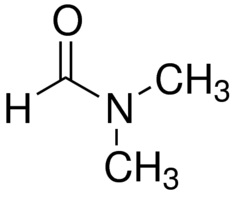
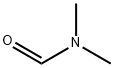
N,N-Dimethylformamide structure |
| Physical properties | Clear, colorless to light yellow, hygroscopic, mobile liquid with a faint, characteristic, ammonialike odor. An experimentally determined odor threshold concentration of 100 ppmv was reported by Leonardos et al. (1969). |
| Uses | N,N-Dimethylformamide (DMF) is a clear liquid that has been widely used in industries as a solvent, an additive, or an intermediate because of its extensive miscibility with water and most common organic solvents. Dimethylformamide solutions are used toprocess polymer fibers, films, and surface coatings; to permit easy spinning of acrylic fibers; to produce wire enamels, and as a crystallization medium in the pharmaceutical industry.
DMF can also be used for formylation with alkyllithium or Grignard reagents. It is used as a reagent in Bouveault aldehyde synthesis and also in Vilsmeier-Haack reaction. It acts as a catalyst in the synthesis of acyl chlorides. It is used for separating and refining crude from olefin gas. DMF along with methylene chloride acts as a remover of varnish or lacquers. It is also used in the manufacture of adhesives, fibers and films. |
| Definition | ChEBI: N,N-dimethylformamide is a member of the class of formamides that is formamide in which the amino hydrogens are replaced by methyl groups. It has a role as a polar aprotic solvent, a hepatotoxic agent and a geroprotector. It is a volatile organic compound and a member of formamides. It is functionally related to a formamide. |
| Production Methods | Industrial production of N,N-Dimethylformamide (DMF) is via three separate processes (Eberling 1980). Dimethylamine in methanol is reacted with carbon monoxide in the presence of sodium methoxide or metal carbonyls at 110-150°C and high pressure. Alternately, methyl formate is produced from carbon monoxide and methanol under high pressure at 60-100°C in the presence of sodium methoxide. The resulting methyl formate is distilled and then reacted with dimethylamine at 80-100°C and low pressure. The third process involves reaction of carbon dioxide, hydrogen and dimethylamine in the presence of halogen-containing transition metal compounds to yield DMF.
|
| Preparation | Two processes are used commercially to produce dimethylformamide. In the direct or one-step process, dimethylamine and carbon monoxide react at 100°C and 200 psia in the presence of a sodium methoxide catalyst to make dimethylformamide. The homogenous catalyst is separated from the crude DMF, which is then refined to the final product. In the indirect process, methyl formate is isolated, and then reacted with dimethylamine to form DMF. To obtain methyl formate, two methods may be used - dehydrogenation of methanol and esterification of formic acid.
The two-step process for the synthesis of N,N-dimethylformamide differs from direct synthesis because methyl formate is prepared separately and introduced in the form of ca. 96% pure (commercialgrade) material. Equimolar amounts of methyl formate and N,N-dimethylamine are subjected to a continuous reaction at 60-100°C and 0.1 – 0.3 MPa. The resulting product is a mixture of N,N-dimethylformamide and methanol. The purification process involves distillation and is analogous to that described for direct synthesis. However, no separation of salts is required because no catalysts are involved in the process. According to the corrosive properties of both starting materials and products, stainless steel has to be used as material of construction for production facilities. |
| Application | The principal applications of N,N-dimethylformamide are as a solvent and as an extractant, particularly for salts and compounds with high molecular mass. This role is consistent with its interesting combination of physical and chemical properties: low molecular mass, high dielectric constant, electron-donor characteristics, and ability to form complexes. The use of DMF as a component in synthesis is of relatively minor significance, at least commercially. N,N-Dimethylformamide (anhydrous) has been used as solvent for the synthesis of cytotoxic luteinizing hormone-releasing hormone (LH-RH) conjugate AN-152 (a chemotherapeutic drug) and fluorophore C625 [4-(N,N-diphenylamino)-4′-(6-O-hemiglutarate)hexylsulfinyl stilbene]. It may be employed as solvent medium for the various organic reduction reactions. |
| General Description | A water-white liquid with a faint fishy odor. Flash point 136°F. Slightly less dense than water. Vapors heavier than air. Toxic by inhalation or skin absorption. May irritate eyes. |
| Air & Water Reactions | Flammable. Water soluble. |
| Reactivity Profile | N,N-Dimethylformamide may react violently with a broad range of chemicals, e.g.: alkaline metals (sodium, potassium), azides, hydrides (sodium borohydride, lithium aluminum hydride), bromine, chlorine, carbon tetrachloride, hexachlorocyclohexane, phosphorus pentaoxide, triethylaluminum, magnesium nitrate, organic nitrates. Forms explosive mixtures with lithium azide [Bretherick, 5th ed., 1995, p. 453]. Oxidation by chromium trioxide or potassium permanganate may lead to explosion [Pal B. C. et al., Chem. Eng. News, 1981, 59, p. 47]. |
| Health Hazard | The acute toxicity of DMF is low by inhalation, ingestion, and skin contact. Contact with liquid DMF may cause eye and skin irritation. DMF is an excellent solvent for many toxic materials that are not ordinarily absorbed and can increase the hazard of these substances by skin contact. Exposure to high concentrations of DMF may lead to liver damage and other systemic effects. Dimethylformamide is listed by IARC in Group 2B ("possible human carcinogen"). It is not classified as a "select carcinogen" according to the criteria of the OSHA Laboratory Standard. No significant reproductive effects have been observed in animal tests. Repeated exposure to DMF may result in damage to the liver, kidneys, and cardiovascular system |
| Flammability and Explosibility | DMF is a combustible liquid (NFPA rating = 2). Vapors are heavier than air and may travel to source of ignition and flash back. DMF vapor forms explosive mixtures with air at concentrations of 2.2 to 15.2% (by volume). Carbon dioxide or dry chemical extinguishers should be used to fight DMF fires. |
| Industrial uses | World production capacity of DMF is about 225 x 103 tons per year. The main application of DMF is as solvent in industrial processes, especially for polar polymers such as Polyvinylchloride, polyacrylonitrile and polyurethanes. DMF solutions of high molecular weight polymers are processed to fibers, films, surface coatings and synthetic leathers. Since salts can be dissolved and dissociated in DMF, the solutions are used in electrolytic capacitors and certain electrolytic processes (Eberling 1980). |
| Contact allergens | This is an organic solvent for vinyl resins and acetylene, butadiene, and acid gases. It caused contact dermatitis in a technician at an epoxy resin factory and can provoke alcohol-induced flushing in exposed subjects. |
| Synthesis | N,N-Dimethylformamide is predominantly produced in a single-step reaction between dimethylamine and carbon monoxide under pressure at high temperatures and in the presence of basic catalysts such as sodium methoxide. The crude product contains methanol and N,N-dimethylformamide with increased purity (up to 99.9%) is obtained by multiple distillations. Alternatively, it can be produced by a two-step process in which methyl formate is prepared separately and, in a second step, reacts with dimethylamine under similar conditions as those described for the single-step reaction. No catalysts are involved in the process. |
| Potential Exposure | Conversion factor: 1 ppm 5 2.99 mg/m3 at 25℃ & 1 atm.OSHA PEL: 10 ppm/30 mg/m3 TWA [skin].NIOSH REL: 10 ppm/30 mg/m3 TWA [skin].ACGIH TLV: 10 ppm/30 mg/m3 TWA [skin]; BEI:15 mg (N-Methylformamide)/g creatinine in urine at endof-shift; 40 mg [N-Acetyl-S-(N-methylcarbamoyl)cystein]/gin urine prior to last shift of workweek; not classifiable as ahuman carcinogen.NIOSH IDLH: 500 ppm.Protective Action Criteria (PAC)*TEEL-0: 2 ppmPAC-1: 2 ppmPAC-2: 91 ppmPAC-3: 530 ppm*AEGLs (Acute Emergency Guideline Levels) & ERPGs(Emergency Response Planning Guideline) are in boldface.DFG MAK: 5 ppm/15 mg/m3, [skin]; Peak LimitationCategory II(4); Pregnancy Risk Group B; BAT: 15 mg(N-Methylformamide)/g creatinine in urine at end of exposure or end-of-shift.Australia: TWA 10 ppm (30 mg/m3), [skin], 1993;Austria 10 ppm (30 mg/m3), [skin], 1999; Belgium: TWA10 ppm (30 mg/m3), [skin], 1993; Denmark: TWA 10 ppm(30 mg/m3), [skin], 1999; Finland: TWA 10 ppm(30 mg/m3); STEL 20 ppm (60 mg/m3), [skin], 1999;France: VME 10 ppm (30 mg/m3), [skin], 1999; Hungary:TWA 10 mg/m3; STEL 20 mg/m3, [skin], 1993; theNetherlands: MAC-TGG 15 mg/m3, [skin], 2003; thePhilippines: TWA 10 ppm (30 mg/m3), [skin], 1993;Poland: MAC (TWA) 10 mg/m3, MAC (STEL) 60 mg/m3,1999; Russia: TWA 10 ppm; STEL 10 mg/m3, [skin], 1993;Sweden: NGV 10 ppm (30 mg/m3), KTV 15 ppm (45 mg/m3),[skin], 1999; Switzerland: MAK-W 10 ppm (30 mg/m3),KZG-W 20 ppm (60 mg/m3), [skin], 1999; Turkey: TW |
| First aid | If this chemical gets into the eyes, remove anycontact lenses at once and irrigate immediately for at least15 min, occasionally lifting upper and lower lids. Seek medical attention immediately. If this chemical contacts theskin, remove contaminated clothing and wash immediatelywith soap and water. Seek medical attention immediately. Ifthis chemical has been inhaled, remove from exposure,begin rescue breathing (using universal precautions, including resuscitation mask) if breathing has stopped and CPR ifheart action has stopped. Transfer promptly to a medicalfacility. When this chemical has been swallowed, get medical attention. Give large quantities of water and inducevomiting. Do not make an unconscious person vomit |
| Carcinogenicity | DMF is not carcinogenic to animals except under very high inhalation exposure conditions. No increase in tumors was seen in rats that inhaled 25, 100, or 400 ppm for 6 h/day, 5 days/week for 2 years. Similarly, no tumors were produced in mice under the same conditions for 18 months. In that chronic experiment, rats and mice were exposed by inhalation (6 h/day, 5 days/week) to 0, 25, 100, or 400 ppm DMF for 18 months (mice) or 2 years (rats). Body weights of rats exposed to 100 (males only) and 400 ppm were reduced and, conversely, body weights were increased in 400 ppm mice. Serum sorbitol dehydrogenase activity was increased in rats exposed to 100 or 400 ppm. DMF-related morphological changes in rats were observed only in the liver and consisted of increased relative liver weights, centrilobular hepatocellular hypertrophy, lipofuscin/hemosiderin accumulation in Kupffer cells, and centrilobular single cell necrosis (400 ppm only). The same liver effects were seen in all groups of mice, although the response at 25 ppm was judged as minimal. |
| Environmental fate | Biological. Incubation of [14C]N,N-dimethylformamide (0.1–100 μg/L) in natural seawater resulted in the compound mineralizing to carbon dioxide. The rate of carbon dioxide formation was inversely proportional to the initial concentration (Ursin, 1985).
Chemical. Reacts with acids or bases forming formic acid and dimethylamine (BASF, 1999) |
| Metabolic pathway | Three urinary metabolites are identified in humans and rodents, and the metabolites quantified are N- (hydroxymethyl)-N-methylformamide (HMMF), resulting in N-methylformamide (NMF) and N-acetyl-S-(N- methylcarbamoyl)cysteine (AMCC). Ten volunteers who absorb between 28 and 60 mmol/kg DMF during an 8 h exposure to DMF in air at 6 mg=m3 excrete in the urine within 72 h between 16.1 and 48.7% of the dose as HMMF, between 8.3 and 23.9% as formamide, and between 9.7 and 22.8% as AMCC. AMCC together with HMMF is also detected in the urine of workers after occupational exposure to DMF. There is a quantitative difference between the metabolic pathway of DMF to AMCC in humans and rodents. |
| storage | DMF should be used only in areas free of ignition sources, and quantities greater than 1 liter should be stored in tightly sealed metal containers in areas separate from oxidizers. |
| Shipping | This compound requires a shipping label of“FLAMMABLE LIQUID.” It falls in Hazard Class 3 andPacking Group II. |
| Purification Methods | DMF decomposes slightly at its normal boiling point to give small amounts of dimethylamine and carbon monoxide. The decomposition is catalysed by acidic or basic materials, so that even at room temperature DMF is appreciably decomposed if allowed to stand for several hours with solid KOH, NaOH or CaH2. If these reagents are used as dehydrating agents, therefore, they should not be refluxed with the DMF. Use of CaSO4, MgSO4, silica gel or Linde type 4A molecular sieves is preferable, followed by distillation under reduced pressure. This procedure is adequate for most laboratory purposes. Larger amounts of water can be removed by azeotropic distillation with *benzene (10% v/v, previously dried over CaH2), at atmospheric pressure: water and *benzene distil below 80o. The liquid remaining in the distillation flask is further dried by adding MgSO4 (previously ignited overnight at 300-400o) to give 25g/L. After shaking for one day, a further quantity of MgSO4 is added, and the DMF is distillied at 15-20mm pressure through a 3-ft vacuum-jacketed column packed with steel helices. However, MgSO4 is an inefficient drying agent, leaving about 0.01M water in the final DMF. More efficient drying (to around 0.001-0.007M water) is achieved by standing with powdered BaO, followed by decanting before distillation, then with alumina powder (50g/L, previously heated overnight to 500-600o), and distilling from more of the alumina, or by refluxing at 120-140o for 24hours with triphenylchlorosilane (5-10g/L), then distilling at ca 5mm pressure [Thomas & Rochow J Am Chem Soc 79 1843 1957]. Free amine in DMF can be detected by the colour reaction with 1-fluoro-2,4-dinitrobenzene. It has also been purified by drying overnight over KOH pellets and then distilling from BaO through a 10 cm Vigreux column (p 11) [Jasiewicz et al. Exp Cell Res 100 213 1976]. [For efficiency of desiccants in drying dimethylformamide see Burfield & Smithers J Org Chem 43 3966 1978, and for a review on purification, tests of purity and physical properties, see Juillard Pure Appl Chem 49 885 1977.] It has been purified by distilling from K2CO3 under high vacuum and fractionated in an all-glass apparatus. The middle fraction is collected, degassed (seven or eight freeze-thaw cycles) and redistilled under as high a vacuum as possible [Mohammad & Kosower J Am Chem Soc 93 2713 1971]. [Beilstein 4 IV 171.] Rapid purification: Stir over CaH2 (5% w/v) overnight, filter, then distil at 20mmHg. Store the distilled DMF over 3A or 4A molecular sieves. For solid phase synthesis, the DMF used must be of high quality and free from amines. |
| Incompatibilities | Though stable at normal temperatures and storage conditions, DMF may react violently with halogens, acyl halides, strong oxidizers, and polyhalogenated compounds in the presence of iron. Decomposition products include toxic gases and vapors such as dimethylamine and carbon monoxide. DMF will attack some forms of plastics, rubber, and coatings. |
| Toxics Screening Level | The initial threshold screening level (ITSL) for N,N-Dimethylformamide (DMF) is 30 μg/m3 with an annual averaging time (AT). The ITSL was established on 8/23/90, at 30 μg/m3 with a 24-hr AT as per the default AT (Rule 232(2)(b). |
| Waste Disposal | Excess DMF and waste material containing this substance should be placed in an appropriate container, clearly labeled, and handled according to your institution's waste disposal guidelines. |









 Argentina
 United States
 Malaysia
 Turkey
 India
India
 Kuwait
 Oman
Oman