Product
Supplier
Encyclopedia
Inquiry
Cyclopentanone120-92-3C5H8O buy - large image1
Cyclopentanone120-92-3C5H8O buy - image1
Cyclopentanone120-92-3C5H8O buy - image2
Cyclopentanone120-92-3C5H8O buy - image3
Cyclopentanone120-92-3C5H8O buy - image4
Cyclopentanone120-92-3C5H8O buy - image5
Cyclopentanone120-92-3C5H8O buy - image6

Cyclopentanone120-92-3C5H8O

5 Inquiries

Unit Price:

$33-34/MT FOB

Get Latest Price
CAS No.:

120-92-3

Grade:

Pharmaceutical Grade

Content:

99.5%

Port:

上海

Brand:

OORENT

Packaging:

Vial/Bottle/Bag/Carton

Price valid (until):

2026-07-17

Company Type:
Trader
Location:
China
Qualification:
Main Products:

pharmaceutical intermediates,peptides,electronic chemicals

  • Product Description

  • Seller Information

  • Inquiry History

  • Description

    Product Detail

    Cyclopentanone Basic information
    Physical and Chemical Properties The main purpose Chemical Properties Production method Category Toxicity grading Acute toxicity Data irritation Flammability and hazard characteristics Storage characteristics Extinguishing agent
    Product Name: Cyclopentanone
    Synonyms: Adipinketon;Dumasin;Pyran-2,4(3H)-dione, 3-acetyl-6-methyl-;ADIPIC KETONE;AKOS BBS-00004293;KETOCYCLOPENTANE;KETOPENTAMETHYLENE;CYCLOPENTANONE
    CAS: 120-92-3
    MF: C5H8O
    MW: 84.12
    EINECS: 204-435-9
    Product Categories: Pharmaceutical Intermediates;Organics;Alpha Sort;C;Volatiles/ Semivolatiles;C3 to C6;Alphabetical Listings;C-D;Flavors and Fragrances;Carbonyl Compounds;Ketones;120-92-3;K00001;A
    Mol File: 120-92-3.mol
    Shop Cyclopentanone120-92-3C5H8O-Detailed Image 1

    Cyclopentanone Chemical Properties
    Melting point  -51 °C (lit.)
    Boiling point  130-131 °C (lit.)
    density  0.951 g/mL at 25 °C (lit.)
    vapor density  2.97 (vs air)
    vapor pressure  11.5 hPa (20 °C)
    refractive index  n20/D 1.437(lit.)
    FEMA  3910 | CYCLOPENTANONE
    Fp  87 °F
    storage temp.  Store below +30°C.
    solubility  9.18g/l slightly soluble
    form  Liquid
    color  Clear colorless to slightly yellow
    Odor Pleasant
    Odor Type minty
    biological source synthetic
    explosive limit 1.6-10.8%(V)
    Water Solubility  PRACTICALLY INSOLUBLE
    Merck  14,2743
    JECFA Number 1101
    BRN  605573
    Henry's Law Constant 1.2×100 mol/(m3Pa) at 25℃, Brockbank (2013)
    Dielectric constant 16.0(-49℃)
    Stability: Stable. Incompatible with strong reducing agents, strong oxidizing agents, strong bases.
    Major Application flavors and fragrances
    Cosmetics Ingredients Functions PERFUMING
    InChI 1S/C5H8O/c6-5-3-1-2-4-5/h1-4H2
    InChIKey BGTOWKSIORTVQH-UHFFFAOYSA-N
    SMILES O=C1CCCC1
    LogP 0.7 at 25℃
    Surface tension 33.78mN/m at 298.15K
    CAS DataBase Reference 120-92-3(CAS DataBase Reference)
    NIST Chemistry Reference Cyclopentanone(120-92-3)
    EPA Substance Registry System Cyclopentanone (120-92-3)

    Safety Information
    Hazard Codes  Xi
    Risk Statements  10-36/38
    Safety Statements  23
    RIDADR  UN 2245
    WGK Germany  1
    RTECS  GY4725000
    Autoignition Temperature 445 °C
    TSCA  TSCA listed
    HS Code  2914 29 00
    HazardClass  3
    PackingGroup  III
    Storage Class 3 - Flammable liquids
    Hazard Classifications Eye Irrit. 2
    Flam. Liq. 3
    Skin Irrit. 2
    Hazardous Substances Data 120-92-3(Hazardous Substances Data)
    MSDS Information
    Provider Language
    SigmaAldrich English
    ACROS English
    ALFA English

    Cyclopentanone Usage And Synthesis
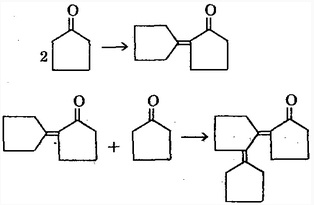
    Physical and Chemical Properties Cyclopentanone is also known Adipic Ketono. It is transparent colorless oily liquid. It has smell of special ether and also slightly mint-smell. It has a relative molecular mass being 84.12. It also has a relative density being 0.9487, melting point being-51.3 ℃, boiling point being 130.6 ℃, 23~24 ℃ (1.333 X 10³Pa), the refractive index being 1.4366, and the flash point being 30 ℃. It is insoluble in water, soluble in alcohol, ether and acetone. It is narcotic at high concentrations. It can be obtained through oxidation of cyclopentanol. It can also be obtained through the heating of Adipic acid in the presence of Barium hydroxide. Cyclopentanone is also easily subject to polymerization especially in the presence of an acid. In the case of heating, it can participate in the following dehydration reactions, respectively producing 2-cyclopentylene cyclopentanone and 2'-cyclopentylene-2-cyclopentylene cyclopentanone:
    Shop Cyclopentanone120-92-3C5H8O-Detailed Image 2
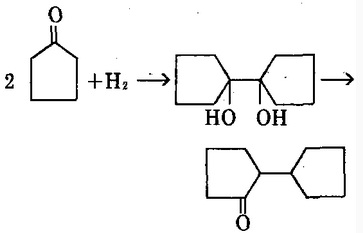
    Hydrogenation can produce double-cyclopentanol with further dehydration producing 2, 2-tetramethylene cyclopentanone.
    Shop Cyclopentanone120-92-3C5H8O-Detailed Image 3
    Cyclopentanone is mainly used for the manufacturing of drugs, biological agents, pesticides and rubber additives.
    Aldehydes, ketones can react with diazoalkane and have the nitrogen atoms lost, generating two carbonyl compounds and epoxy compounds. When the aldehydes, ketones molecules contain electron-withdrawing groups, the reactivity is increased will boost the generation of the epoxy compound. The ketone molecule, with the increase of the hydrocarbon group, also mainly generates epoxy compound. Cyclic ketones, instead, will have ring expansion reactions. The bigger the hydrocarbyl group of the diazoalkane is, the more carbonyl compounds can be obtained.
    The order of the ketone reactivity is consistent with its nucleophilic substitution order:
    Cl3CCOCH3> ClCH2COCH3> CH3COCH3> CH3COC6H5> cyclohexanone> cyclopentanone> cycloheptanone> cyclooctanone.
    The main purpose 1, Take the n-valeraldehyde and cyclopentanone as raw material, and first go through aldol condensation reaction and further dehydration reaction to obtain pentylene cyclopentanone, then followed by selective catalytic hydrogenation to obtain pentyl cyclopentanone. Pentyl cyclopentanone has strong floral and fruity aroma as well as nuances of jasmine. It can be used in the formulation of daily chemical flavor with the usage amount being less than 20%. IFRA has no restrictions.
    2, Take n-hexanal and cyclopentanone as the raw material, first have condensation, and then perform selective hydrogenation reaction to obtain hexyl cyclopentanone. Hexyl cyclopentanone has strong jasmine smell accompanied by fruit nuances and can be used in perfume fragrance as well as the formulation of other kinds of fragrance with the usage amount being less than 5%. IFRA has no restrictions.
    3, Take the 1-pentene or 1-heptene obtained by the cracking of paraffin or dehydration of the corresponding alcohol as the raw material, in the presence of t-butyl peroxide as the initiator, have addition reaction of the free radical group with cyclopentanone, generating 2-pentyl cyclopentanone (or 2-heptyl-cyclopentanone) with oxidation and ring expansion reaction to become δ-lactone (or δ-Dodecalactone).
    4 Synthesis route with cyclopentanone being the starting material is of the greatest industrial production value. Cyclopentanone is first had aldol condensation reaction with n-valeraldehyde with the dehydration products further undergoing condensation and the selective hydrogenation to generate 2-pentyl cyclopentanone. It finally undergoes oxidation and ring expansion to become δ-decalactone.
    5, δ-decalactone is mainly used in the formulation of edible food flavor. It is considered with the characteristic flavor of the natural cream. Before its emergence, perfumers had long been limited to application of monomer spices such as butanedione and vanillin monomers to be as the major raw material for the deployment of butter flavor. But it is generally recognized that the formulated butter flavor is worse than natural products in the respects of both taste or flavor respects. Only after the use of δ-decalactone can it have realistic cream flavor, especially in the case of using δ-Dodecalactone and δ-decalactone in combination for being as the main flavor raw material which can further improve the flavor and effect of the formulated cream spice.
    6, Take cyclopentanone and pentanal as raw materials, have condensation to produce 2-(1-hydroxy) pentyl cyclopentanone which is then reacted with dimethyl malonate and hydrolyzed at 160~180 ℃, go through decarboxylation, esterification to obtain methyl dihydrojasmonate. Methyl dihydrojasmonate is the edible flavor provided by the GB2760-1996 of China for temporary application. Its aroma is better than the natural methyl jasmonate. Its property is also relatively stable.
    The above information is edited by the chemicalbook of Dai Xiongfeng.
    Chemical Properties It is colorless, oily liquid with a pleasant mint smell. It has a melting point of-58.2 ℃, boiling point of 130.6 ℃, the relative density of 0.9509 (20 ℃), the refractive index of 1.4366 and the flash point of 29.82 ℃. It is miscible with ethanol, ethyl ether and slightly soluble in water. It is easy to undergo polymerization, especially in the case of trace amount of acid.
    Production method It can be obtained through the heating of Adipic acid in the presence of barium hydroxide. Mix the barium hydroxide and adipic acid uniformly and heat to 285-295 °C, further distill out the generated cyclopentanone at this temperature. The distilled calcium chloride is salted out for separating the cyclopentanone; add appropriate amount of alkaline solution to remove the adipic acid wash, then wash with water; dry with anhydrous calcium chloride; have distillation; collect the fraction in the 128-131 ℃ to obtain the finished product with the yield being 75-80%.
    Category Flammable liquid
    Toxicity grading poisoning
    Acute toxicity Intraperitoneal-mouse LD50: 1950 mg/kg; subcutaneous-Mouse LD50: 2600 mg/kg.
    Data irritation Skin-rabbit 500 mg Mild; Eyes-rabbit 100 mg severe.
    Flammability and hazard characteristics It is flammable in case of fire, high temperature and with burning producing irritated smoke.
    Storage characteristics Treasury: ventilation, low-temperature and dry; store it separately from oxidants and acids.
    Extinguishing agent Dry powder, dry sand, carbon dioxide, foam, 1211 fire extinguishing agent.
    Chemical Properties Cyclopentanone is a colorless liquid with a pleasant, slightly pepperminty odor. It is soluble in water and miscible with common organic solvents. Cyclopentanone has an agreeable, peppermint-like odor. It tends to polymerize in the presence of acids.
    Occurrence Reported found in roasted onion, baked potato, tomato, gruyere cheese, butter, heated chicken, boiled beef, heated pork, roasted pecan, yellow passion fruit juice.
    Uses Cyclopentanone is used as an intermediate in the synthesis of rubber adhesives, synthetic resins, pharmaceuticals and biologically active compounds. It acts as precursor for the preparation of cyclopentamine and also pentethylcyclanone, cyclopentobarbital. It is a useful laboratory reagent and is used as thinner for epoxies. It can also be used as a solvent in paint and varnish removers and for electronic applications. As a dry cleaning agent, it is used for oil extraction. It is also involved in the preparation of cyclopentanone derivatives like cyclopenylamine and cyclopentanol which find application in the perfume industry.
    Preparation Prepared by heating adipic acid (285 to 295°C) in the presence of barium hydroxide, distilling, ether extraction and then fractionation.
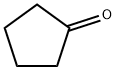
    Definition ChEBI: A cyclic ketone that consists of cyclopentane bearing a single oxo substituent.
    Aroma threshold values Aroma characteristics at 2.0%: musty, slightly toasted bitter almondlike nutty, solventlike with a powdery nuance.
    Taste threshold values Taste characteristics at 20 ppm: musty, toasted nutty with a slight meaty nuance.
    General Description A clear colorless liquid with a petroleum-like odor. Flash point 87°F. Less dense than water and insoluble in water. Vapors heavier than air.
    Air & Water Reactions Highly flammable. Insoluble in water.
    Reactivity Profile Cyclopentanone polymerizes easily, especially in the presence of acids. Can react with oxidizing materials, i.e. hydrogen peroxide.
    Health Hazard Inhalation or contact with material may irritate or burn skin and eyes. Fire may produce irritating, corrosive and/or toxic gases. Vapors may cause dizziness or suffocation. Runoff from fire control or dilution water may cause pollution.
    Safety Profile Moderately toxic by intraperitoneal and subcutaneous routes. A skin and severe eye irritant. Dangerous fire hazard when exposed to heat or flame; can react with oxidizers. To fight fire, use alcohol foam, foam, CO2, dry chemical. Potentially explosive reaction with hydrogen peroxide + nitric acid. When heated to decomposition it emits acrid smoke and fumes. See also KETONES.
    Purification Methods Shake it with aqueous KMnO4 to remove materials absorbing around 230 to 240nm. Dry it with Linde-type 13X molecular sieves and fractionally distil it. It has also been purified by conversion to the NaHSO3 adduct which, after crystallising four times from EtOH/water (4:1), is decomposed by adding to an equal weight of Na2CO3 in hot H2O. The free cyclopentanone is steam distilled from the solution. The distillate is saturated with NaCl and extracted with *benzene which is then dried (anhydrous K2CO3) and evaporated. The residue is then distilled [Allen, et al. J Chem Soc 1909 1960]. [Beilstein 7 IV 5.]


    Shop Fluorobenzene462-06-6C6H5F-Detailed Image 2 Shop Fluorobenzene462-06-6C6H5F-Detailed Image 3 Shop Fluorobenzene462-06-6C6H5F-Detailed Image 4 Shop Fluorobenzene462-06-6C6H5F-Detailed Image 5 Shop Fluorobenzene462-06-6C6H5F-Detailed Image 6 Shop Fluorobenzene462-06-6C6H5F-Detailed Image 7


    Basic Info
    Product Name:

    Cyclopentanone

    Other Name:

    Cyclopentanone;Adipic ketone;Dumasin;Ketocyclopentane;Ketopentamethylene;Adipin keton;NSC 4122;6: PN: WO2007101224 PAGE: 36 claimed sequence;1800084-96-1

    CAS No.:

    120-92-3

    Molecular Formula:

    C5H8O

    InChIKeys:

    InChIKey=BGTOWKSIORTVQH-UHFFFAOYSA-N

    Molecular Weight:

    84.118

    Exact Mass:

    84.12

    EC Number:

    204-435-9

    UNII:

    220W81TN3S

    ICSC Number:

    0427

    NSC Number:

    4122

    UN Number:

    2245

    DSSTox ID:

    DTXSID3029154

    Color/Form:

    WATER-WHITE, MOBILE LIQUID

    HScode:

    2914 29 00

    Characteristics
    PSA:

    17.1

    XLogP3:

    0.38

    Appearance:

    Cyclopentanone appears as a clear colorless liquid with a petroleum-like odor. Flash point 87°F. Less dense than water and insoluble in water. Vapors heavier than air.

    Density:

    0.94869 g/cm3 @ Temp: 20 °C

    Melting Point:

    -51.3 °C

    Boiling Point:

    130.6 °C @ Press: 760 Torr

    Flash Point:

    26°C

    Refractive Index:

    n 20/D 1.437(lit.)

    Water Solubility:

    H2O: 9.18g/l slightly soluble

    Storage Conditions:

    Flammables area

    Vapor Pressure:

    11.5 hPa (20 °C)

    Vapor Density:

    Relative vapour density (air = 1): 2.3

    Toxicity:

    Intraperitoneal-mouse LD50: 1950 mg/kg; subcutaneous-Mouse LD50: 2600 mg/kg.

    Flammability characteristics:

    It is flammable in case of fire, high temperature and with burning producing irritated smoke.

    Explosive limit:

    1.6-10.8%(V)

    Odor:

    DISTINCTIVE ETHEREAL ODOR, SOMEWHAT LIKE PEPPERMINT

    OH:

    2.94e-12 cm3/molecule*sec

    Henrys Law Constant:

    1.00e-05 atm-m3/mole

    Experimental Properties:

    POLYMERIZES EASILY, ESP IN PRESENCE OF ACIDS

    Air and Water Reactions:

    Highly flammable. Insoluble in water.

    Reactive Group:

    Ketones

    Reactivity Alerts:

    Highly Flammable

    Reactivity Profile:

    CYCLOPENTANONE polymerizes easily, especially in the presence of acids. Can react with oxidizing materials, i.e. hydrogen peroxide. (NTP, 1992)

    Peroxide Forming Chemical:

    Cyclopentanone|D*: Other compounds that may form peroxides|4 samples had 1-4 ppm peroxide; age >1 yrs|Management of time-sensitive chemicals (JCHAS)

    Physical Dangers:

    The vapour is heavier than air.

    Hazard Identification

    Classification of the substance or mixture

    Flammable liquids, Category 3

    Skin irritation, Category 2

    Eye irritation, Category 2

    GHS label elements, including precautionary statements

    Pictogram(s)
    Signal word

    Warning

    Hazard statement(s)

    H226 Flammable liquid and vapour

    H315 Causes skin irritation

    H319 Causes serious eye irritation

    Precautionary statement(s)
    Prevention

    P210 Keep away from heat, hot surfaces, sparks, open flames and other ignition sources. No smoking.

    P233 Keep container tightly closed.

    P240 Ground and bond container and receiving equipment.

    P241 Use explosion-proof [electrical/ventilating/lighting/...] equipment.

    P242 Use non-sparking tools.

    P243 Take action to prevent static discharges.

    P280 Wear protective gloves/protective clothing/eye protection/face protection/hearing protection/...

    P264 Wash ... thoroughly after handling.

    Response

    P303+P361+P353 IF ON SKIN (or hair): Take off immediately all contaminated clothing. Rinse affected areas with water [or shower].

    P370+P378 In case of fire: Use ... to extinguish.

    P302+P352 IF ON SKIN: Wash with plenty of water/...

    P321 Specific treatment (see ... on this label).

    P332+P317 If skin irritation occurs: Get medical help.

    P362+P364 Take off contaminated clothing and wash it before reuse.

    P305+P351+P338 IF IN EYES: Rinse cautiously with water for several minutes. Remove contact lenses, if present and easy to do. Continue rinsing.

    Storage

    P403+P235 Store in a well-ventilated place. Keep cool.

    Disposal

    P501 Dispose of contents/container to an appropriate treatment and disposal facility in accordance with applicable laws and regulations, and product characteristics at time of disposal.

    Other hazards which do not result in classification

    no data available

    Handling and Storage

    Precautions for safe handling

    NO open flames, NO sparks and NO smoking. Handling in a well ventilated place. Wear suitable protective clothing. Avoid contact with skin and eyes. Avoid formation of dust and aerosols. Use non-sparking tools. Prevent fire caused by electrostatic discharge steam.

    Conditions for safe storage, including any incompatibilities

    Fireproof. Separated from acids. Cool. Keep in the dark. Keep in a well-ventilated room. Store only if stabilized.

  • Seller Information
    Business Type:

    Trader

    Main Products:

    pharmaceutical intermediates,peptides,electronic chemicals

    Location:

    Room 102, 1st Floor, East Office Building, No. 45 Pengwan Road, Qianwan Bonded Port Area, Qingdao Zone, China (Shandong) Pilot Free Trade Zone

    Payment Terms:

    100% TT in advance

    Average lead Time:

    10

    Total Annual Revenue:

    $10 million-$25 million

    Total Employees:

    51-100

    Year of Establishment:

    2024

    A reliable supplier is like insurance.

    We are mainly specilized in supply of pharmaceutical intermediates, electronic chemicals,food additives, and other fine chemical products.
    Integrity is the foundation, quality is life. We would like to work together with you to build a greener and brighter future.

    Website: orientchem.cc
    Email: scarlett@orientchem.cc
    WhatsApp: +86 17753254221

  • Inquiry History
    5 Inquiries
    Country Product Purchase Quantity Date Posted
    India

    Cyclopentanone

    1000 KG Aug 27, 2024
    United States

    Cyclopentanone

    10 MT Aug 1, 2023
    United Kingdom

    cyclopentanone

    50 KG Jun 9, 2026
    United States

    Cyclopentanone

    1 MT Oct 7, 2024
    United Kingdom

    cyclopentanone

    1000 MT Jun 11, 2024
    Post an enquiry for this product
pic ×

Scan the QR Code to Share

All products displayed on this website are only for non-medical purposes such as industrial applications or scientific research, and cannot be used for clinical diagnosis or treatment of humans or animals. They are not medicinal or edible.

According to relevant laws and regulations and the regulations of this website, units or individuals who purchase hazardous materials should obtain valid qualifications and qualification conditions.

The information shown above is provided by the enterprise itself, and the authenticity, accuracy and legitimacy of the content are the responsibility of the publishing company. ECHEMI does not bear any guarantee responsibility for this. Please be aware that risks in internet transactions objectively exist.

Feedback & Suggestions
Send Message

Thank you for your feedback. If you require further assistance, please contact us by email at info@echemi.com or call us at +86-532-55729510.