Product
Supplier
Encyclopedia
Inquiry
Home > Industrial Coatings > Paint Solvent > Dimethyl carbonate for Sale > Dimethyl carbonate616-38-6C3H6O3
Dimethyl carbonate616-38-6C3H6O3 buy - large image1
Dimethyl carbonate616-38-6C3H6O3 buy - image1
Dimethyl carbonate616-38-6C3H6O3 buy - image2
Dimethyl carbonate616-38-6C3H6O3 buy - image3
Dimethyl carbonate616-38-6C3H6O3 buy - image4
Dimethyl carbonate616-38-6C3H6O3 buy - image5
Dimethyl carbonate616-38-6C3H6O3 buy - image6

Dimethyl carbonate616-38-6C3H6O3

29 Inquiries

Unit Price:

$33-34/MT FOB

Get Latest Price
CAS No.:

616-38-6

Grade:

Industrial Grade

Content:

99.5%

Port:

上海

Brand:

OORENT

Packaging:

Vial/Bottle/Bag/Carton

Price valid (until):

2026-07-17

Company Type:
Trader
Location:
China
Qualification:
Main Products:

pharmaceutical intermediates,peptides,electronic chemicals

  • Product Description

  • Seller Information

  • Inquiry History

  • Description

    Product Detail


    Dimethyl carbonate Chemical Properties
    Melting point  2-4 °C (lit.)
    Boiling point  90 °C (lit.)
    density  1.069 g/mL at 25 °C (lit.)
    vapor density  3.1 (vs air)
    vapor pressure  18 mm Hg ( 21.1 °C)
    refractive index  n20/D 1.368(lit.)
    Fp  65 °F
    storage temp.  Store below +30°C.
    solubility  139g/l
    form  Liquid
    color  <50(APHA)
    Odor Pleasant
    explosive limit 4.22-12.87%(V)
    Water Solubility  139 g/L
    Sensitive  Moisture Sensitive
    Merck  14,3241
    BRN  635821
    Henry's Law Constant 1.6×10⁻¹ mol/(m3Pa) at 25℃, Burkholder et al. (2019)
    Dielectric constant 3.1699999999999999
    Stability: Stable. Highly flammable. Incompatible with strong oxidizing agents, potassium t-butoxide.
    Cosmetics Ingredients Functions SOLVENT
    PROPELLANT
    FRAGRANCE
    Cosmetic Ingredient Review (CIR) Dimethyl carbonate (616-38-6)
    InChI 1S/C3H6O3/c1-5-3(4)6-2/h1-2H3
    InChIKey IEJIGPNLZYLLBP-UHFFFAOYSA-N
    SMILES O=C(OC)OC
    LogP 0.23-0.354 at 20-25℃
    Surface tension 28.08mN/m at 298.15K
    CAS DataBase Reference 616-38-6(CAS DataBase Reference)
    NIST Chemistry Reference Carbonic acid, dimethyl ester(616-38-6)
    EPA Substance Registry System Carbonic acid, dimethyl ester (616-38-6)

    Safety Information
    Hazard Codes  F
    Risk Statements  11
    Safety Statements  9-16-2017/9/16
    RIDADR  UN 1161
    WGK Germany  1
    RTECS  FG0450000
    Autoignition Temperature 458 °C
    TSCA  TSCA listed
    HS Code  2920 90 10
    HazardClass  3
    PackingGroup  II
    Storage Class 3 - Flammable liquids
    Hazard Classifications Flam. Liq. 2
    Hazardous Substances Data 616-38-6(Hazardous Substances Data)
    Toxicity LD50 in rats (g/kg): 13.8 orally; 2.5 dermally; LC50 (4 hr) in rats (mg/l): 140 by inhalation (Ono)
    MSDS Information
    Provider Language
    ACROS English
    SigmaAldrich English
    ALFA English

    Dimethyl carbonate Usage And Synthesis
    Outline Dimethyl carbonate is briefly referred to as DMC. At room temperature, it is a colorless and transparent liquid with a pungent odor with a relative density (D204) of 1.0694, a melting point of 4 °C, boiling point of 90.3 °C, the flash point being 21.7 °C (opening) and being 16.7 °C (closed ) and the refractive index (nd20) being 1.3687. It is flammable and non-toxic and is miserable with almost all organic solvents in any proportion with alcohols, ketones and esters. It is slightly soluble in water. It can be used as the methylating agent. Compared with other methylating reagent such as methyl iodide and dimethyl sulfate, dimethyl carbonate is less toxic, and biodegradable.
    The past method of making dimethyl carbonate with phosgene as raw materials is not frequently used. Instead, people now adopt the catalytic oxidative carbonylation of methanol in the presence of oxygen which is more environmentally friendly than the previous method.
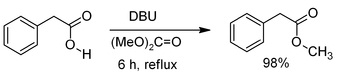
    Dimethyl carbonate can enable to methylation of aniline, phenol and carboxylic acid. However, many reaction demands high-pressure. DBU can be added during reflux of DMC for catalyzing the methylation of carboxylic acid with dimethyl carbonate.
    Shop Dimethyl carbonate616-38-6C3H6O3-Detailed Image 2
    Reference quality standards Index name battery grade excellent grade first grade qualified experimental methods
    Appearance, colorless and transparent liquid
    Dimethyl carbonate content% ≥99.9 ≥99.5 ≥99.0 ≥98.5 Gas Chromatography
    Water, Water Content% ≤30ppm ≤0.10 ≤0.10 ≤0.10 GB606
    Alkalinity mmol/10Og-≤0.10 ≤0.12 ≤0.12 Q/GNPC-JX 017
    Non-volatile matter, %-≤0.02 ≤0.02 ≤0.02 GB6324.2
    Peroxide (By H2O2) ≤5ppm---GB6016-85
    Density (20 ℃), Density g/cm3 1.071 ± 0.005
    The application of dimethyl carbonate 1, a novel type of low toxicity solvents and can substitute solvent such as toluene, xylene, ethyl acetate, butyl acetate, acetone or butanone in paints and adhesive industry, and is environmentally friendly green chemical products.
    2, it is excellent methylating agent, carbonylation agent, hydroxymethylation agent and methoxylation agent and is a kind of chemical raw material of wide application.
    3, it can be used as ideal substitute of highly toxic product such as phosgene, dimethyl sulfate, and methyl chloroformate.
    4, it can be used for synthesizing polycarbonate, diphenyl carbonate, and isocyanate and so on.
    5, in the field of medicine, it can be for the synthesis of anti-infective drugs, anti-inflammatory medicines, vitamin-class medicines and central nervous system drugs.
    6, in the field of pesticides, it can be mainly used for the production of methyl isocyanate, thereby producing some carbamate drugs, pesticides (anisole).
    7, it can be used as gasoline additives and lithium battery electrolyte and so on.
    The above information is edited by the chemicalbook of Dai Xiongfeng.
    Chemical Properties It is colorless liquid with a pungent odor. It is insoluble in water and soluble in alcohol, ether and other organic solvents.
    Uses Dimethyl carbonate product can be used as traditional substitute of toxic materials phosgene, dimethyl sulfate and methyl chloride and so on. It can be used for synthesis of polycarbonate, diphenyl carbonate, isocyanate and allyl diglycol carbonate ester; it can also used for the synthesis of various kinds of carbamate pesticides such as carbaryl and so on; it can also be used as intermediate of organic synthesis such as anisole, dimethoxybenzene, alkylated aryl amines, symmetrical diamine urea, methyl carbazate and so on; in the pharmaceutical industry, it can be used for making amino oxazolidinone, ciprofloxacin, β-keto acid ester class pharmaceutical intermediates. In addition, it can be used as additives of gasoline, diesel fuel, the refrigerator oil and solvent.
    Production method It can be produced through the reaction between methyl chloroformate ([79-22-1]) and methanol. The raw material, methyl chloroformate is produced from the reaction between methanol and phosgene. For the preparation, it is also plausible to have this phosgenation product been without isolation and add excess methanol for reflux reaction to synthesize dimethyl carbonate. The above reaction is called conventional phosgene method. 2 Transesterification methods: this is based on the transesterification between ethylene carbonate or propylene carbonate and methanol which can also produce dimethyl carbonate. This method has a high yield, small equipment corrosion and mild reaction conditions. However, the source of raw materials is limited by the development of petrochemical industry and the elements utilization rate is low. 3. Oxidative carbonylation method: this is based on the reaction of methanol, carbon monoxide and oxygen in the catalyst for direct synthesis of dimethyl carbonate. This method has a lot of advantages including easily available and cheap raw material, low toxicity and simple process. Therefore, it is the most promising approach. According to the technology conditions, it can be divided into liquid phase method and gas phase method. Gas phase can be further divided into one-step and two-step method, wherein the liquid phase of methanol oxidation-carbonylation method and the gas-phase oxidative carbonylation step method has been industrialized while the one-step way of gas-phase oxidative-carbonylation of methanol is still in development. 4. The synthesis reaction between methanol and CO2. This process route is still in development. 5. Synthesis method via reaction between methanol and urea. This process route is still in development.
    Category Flammable liquid
    Toxicity grading Low toxicity
    Acute toxicity Oral-rat LD50: 13000 mg/kg; Oral-Mouse LD50: 6000 mg/kg.
    Flammability and hazard characteristics It is flammable in case of fire, high temperature and oxidant with burning causing irritated fume.
    Storage characteristics Treasury: ventilation, low-temperature and dry; store it separately from oxidants.
    Extinguishing agent Dry powder dry sand, carbon dioxide, foam, 1211 fire extinguishing agent.
    Chemical Properties Dimethyl carbonate is miscible with most acids and alkalis, soluble in most organic solvents, but insoluble in water.
    Uses Dimethyl carbonate is used as a solvent in organic synthesis and considered as a replacement for solvent like methyl ethyl ketone, tert-butyl acetate and parachlorobenzotrifluoride. It is involved as an intermediate in the preparation of diphenylcarbonate, which in turn is used as a key raw material for the synthesis of Bisphenol-A-polycarbonate. It is also used as a 'green' methylating agent involved in the methylation of aniline, phenols and carboxylic acids. It can be used as a fuel additive due to its high oxygen content. It also finds applications related to supercapacitors and lithium batteries.
    Uses Environmentally benign substitute for dimethyl sulfate, q.v., and methyl halides in methylation reactions and for phosgene, q.v., in methylcarbonylation reactions.
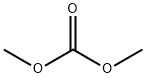
    Definition ChEBI: Dimethyl carbonate is a carbonate ester that is carbonic acid in which both hydrogens are replaced by methyl groups. A flammable, colourless liquid (m.p. 2-4°C, b.p. 90°C) with a characterstic ester-like odour, it is used as a 'green' methylating agent and as a solvent. It has a role as a solvent and a reagent.
    Preparation Dimethyl carbonate (DMC) is formed by the reaction of MeOH with phosgene or methyl chloroformate in the presence of a concentrated sodium hydroxide solution in a two-phase reaction in high yields and purity. Other alcohols can also be phosgenated. As DMC is now more easily accessible via the direct oxidative carbonylation of MeOH, phosgenation is losing its attractiveness in this application.
    Synthesis Reference(s) The Journal of Organic Chemistry, 49, p. 1122, 1984 DOI: 10.1021/jo00180a033
    Tetrahedron Letters, 15, p. 803, 1974
    General Description Dimethyl carbonate appears as a clear, colorless liquid with a pleasant odor. Denser than water and slightly soluble in water. Vapors are heavier than air. Used to make other chemicals and as a special purpose solvent.
    Air & Water Reactions Highly flammable. Slightly soluble in water.
    Reactivity Profile Dimethyl carbonate reacts with acids to liberate heat along with methanol and carbon dioxide. Strong oxidizing acids may cause a vigorous reaction that is sufficiently exothermic to ignite the reaction products. Heat is also generated by the interaction with caustic solutions. Flammable hydrogen is generated by mixing with alkali metals and hydrides.
    Hazard Flammable, dangerous fire risk. Toxic by inhalation, strong irritant.
    Health Hazard May cause toxic effects if inhaled or absorbed through skin. Inhalation or contact with material may irritate or burn skin and eyes. Fire will produce irritating, corrosive and/or toxic gases. Vapors may cause dizziness or suffocation. Runoff from fire control or dilution water may cause pollution.
    Fire Hazard HIGHLY FLAMMABLE: Will be easily ignited by heat, sparks or flames. Vapors may form explosive mixtures with air. Vapors may travel to source of ignition and flash back. Most vapors are heavier than air. They will spread along ground and collect in low or confined areas (sewers, basements, tanks). Vapor explosion hazard indoors, outdoors or in sewers. Runoff to sewer may create fire or explosion hazard. Containers may explode when heated. Many liquids are lighter than water.
    Flammability and Explosibility Highly flammable
    Safety Profile Moderately toxic by intraperitoneal route. Mildly toxic by ingestion. An irritant. Violent reaction or ignition on contact with potassium-tertbutoxide. A very dangerous fire hazard when exposed to heat, open flames (sparks), or oxiduers. To fight fire, use alcohol foam. When heated to decomposition it emits acrid smoke and irritating fumes.
    Purification Methods If the reagent has broad intense bands at 3300cm-1 and above (i.e. OH stretching), then it should be purified further. Wash it successively with 10% Na2CO3 solution, saturated CaCl2, H2O, and dry it by shaking mechanically for 1hour with anhydrous CaCl2, and fractionate. [Bowden & Butler J Chem Soc 78 1939, Vogel J Chem Soc 1847 1948, Beilstein 3 IV 3.]
    Toxics Screening Level The initial threshold screening level (ITSL) for dimethyl carbonate is 300 μg/m3 based on an annual averaging time.

    Shop 3-Chloro-1-propene107-05-1-Detailed Image 2 Shop 3-Chloro-1-propene107-05-1-Detailed Image 3 Shop 3-Chloro-1-propene107-05-1-Detailed Image 4 Shop 3-Chloro-1-propene107-05-1-Detailed Image 5 Shop 3-Chloro-1-propene107-05-1-Detailed Image 6 Shop 3-Chloro-1-propene107-05-1-Detailed Image 7


    Basic Info
    Product Name:

    Dimethyl carbonate

    Other Name:

    Carbonic acid,dimethyl ester;Dimethyl carbonate;Methyl carbonate ((MeO)2CO);Methyl carbonate;NSC 9371;AK 100;AK 100 (carbonate)

    CAS No.:

    616-38-6

    UN No.:

    1161

    Molecular Formula:

    C3H6O3

    InChIKeys:

    InChIKey=IEJIGPNLZYLLBP-UHFFFAOYSA-N

    Molecular Weight:

    90.0779

    Exact Mass:

    90.0317

    EC Number:

    210-478-4

    UNII:

    KE9J097SPN

    ICSC Number:

    1080

    NSC Number:

    9371

    UN Number:

    1161

    DSSTox ID:

    DTXSID9029192

    Color/Form:

    Colorless liquid

    HScode:

    2920909090

    Categories:

    Paint Solvent

    Characteristics
    PSA:

    35.53

    XLogP3:

    0.3992

    Appearance:

    colourless liquid

    Density:

    1.069

    Melting Point:

    41674ºC

    Boiling Point:

    90ºC

    Flash Point:

    18ºC

    Refractive Index:

    1.3672-1.3692

    Water Solubility:

    In water, 1.38X10+5 mg/L at 25 °C (est)|Miscible with alcohol and ether|Miscible with acids and alkalies; stable in the presence of water; soluble in most organic solvents|Soluble in oxygenated solvents|Solubility in water: none

    Storage Conditions:

    Flammables area

    Vapor Pressure:

    55.40 mmHg|55.364 mm Hg at 25 °C|Vapor pressure, kPa at 25 °C: 7.4

    Vapor Density:

    Relative vapor density (air = 1): 3.1

    Odor:

    Pleasant odor

    OH:

    3.10e-13 cm3/molecule*sec

    Henrys Law Constant:

    Henry's Law constant = 6.2X10⁻⁴ atm-cu m/mol at 25 °C (est)

    Experimental Properties:

    MP also listed as 4 °C|BP also stated as 89.7 °C|Hydroxyl radical reaction rate constant = 0.4352X10⁻¹² cu cm/molecule-sec at 25 °C (est)

    Air and Water Reactions:

    Highly flammable. Slightly soluble in water.

    Reactive Group:

    Esters, Sulfate Esters, Phosphate Esters, Thiophosphate Esters, and Borate Esters

    Reactivity Alerts:

    Highly Flammable

    Reactivity Profile:

    DIMETHYL CARBONATE reacts with acids to liberate heat along with methanol and carbon dioxide. Strong oxidizing acids may cause a vigorous reaction that is sufficiently exothermic to ignite the reaction products. Heat is also generated by the interaction with caustic solutions. Flammable hydrogen is generated by mixing with alkali metals and hydrides.

    Autoignition Temperature:

    458 °C

    Physical Dangers:

    The vapour is heavier than air and may travel along the ground; distant ignition possible. The vapour mixes well with air, explosive mixtures are easily formed.

    Heat of Vaporization:

    3.8363X10+7 J/Kmol at 273.15 K

    Critical Temperature & Pressure:

    Critical temperature: 548.00 K; Critical pressure: 4.5X10+6 Pa

    Hazard Identification

    Classification of the substance or mixture

    Flammable liquids, Category 2

    GHS label elements, including precautionary statements

    Pictogram(s)
    Signal word

    Danger

    Hazard statement(s)

    H225 Highly flammable liquid and vapour

    Precautionary statement(s)
    Prevention

    P210 Keep away from heat, hot surfaces, sparks, open flames and other ignition sources. No smoking.

    P233 Keep container tightly closed.

    P240 Ground and bond container and receiving equipment.

    P241 Use explosion-proof [electrical/ventilating/lighting/...] equipment.

    P242 Use non-sparking tools.

    P243 Take action to prevent static discharges.

    P280 Wear protective gloves/protective clothing/eye protection/face protection/hearing protection/...

    Response

    P303+P361+P353 IF ON SKIN (or hair): Take off immediately all contaminated clothing. Rinse affected areas with water [or shower].

    P370+P378 In case of fire: Use ... to extinguish.

    Storage

    P403+P235 Store in a well-ventilated place. Keep cool.

    Disposal

    P501 Dispose of contents/container to an appropriate treatment and disposal facility in accordance with applicable laws and regulations, and product characteristics at time of disposal.

    Other hazards which do not result in classification

    no data available

    Handling and Storage

    Precautions for safe handling

    NO open flames, NO sparks and NO smoking. NO contact with oxidizing agents. Closed system, ventilation, explosion-proof electrical equipment and lighting. Do NOT use compressed air for filling, discharging, or handling. Use non-sparking handtools. Handling in a well ventilated place. Wear suitable protective clothing. Avoid contact with skin and eyes. Avoid formation of dust and aerosols. Use non-sparking tools. Prevent fire caused by electrostatic discharge steam.

    Conditions for safe storage, including any incompatibilities

    Fireproof. Separated from strong oxidants. Well closed. Store in an area without drain or sewer access.Keep container tightly closed in a dry and well-ventilated place. Containers which are opened must be carefully resealed and kept upright to prevent leakage. Air sensitive.

  • Seller Information
    Business Type:

    Trader

    Main Products:

    pharmaceutical intermediates,peptides,electronic chemicals

    Location:

    Room 102, 1st Floor, East Office Building, No. 45 Pengwan Road, Qianwan Bonded Port Area, Qingdao Zone, China (Shandong) Pilot Free Trade Zone

    Payment Terms:

    100% TT in advance

    Average lead Time:

    10

    Total Annual Revenue:

    $10 million-$25 million

    Total Employees:

    51-100

    Year of Establishment:

    2024

    A reliable supplier is like insurance.

    We are mainly specilized in supply of pharmaceutical intermediates, electronic chemicals,food additives, and other fine chemical products.
    Integrity is the foundation, quality is life. We would like to work together with you to build a greener and brighter future.

    Website: orientchem.cc
    Email: scarlett@orientchem.cc
    WhatsApp: +86 17753254221

  • Inquiry History
    29 Inquiries
    Country Product Purchase Quantity Date Posted
    Kenya

    Dimethyl carbonate

    1 20' Fcl Feb 9, 2026
    France

    Dimethyl carbonate

    1 MT Feb 2, 2026
    Germany

    Dimethyl Carbonate

    300 TON Jun 17, 2024
    United Kingdom

    Natural Dimethyl carbonate (Fermentation)

    400 KG Jul 11, 2024
    India

    Dimethyl carbonate

    10.00 MT Dec 12, 2023
    Thailand

    Dimethyl carbonate

    1 KG Jun 18, 2025
    Singapore

    Wholesale Price Dimethyl Carbonate / DMC For Coatings

    1 MT Feb 7, 2025
    South Korea

    DMC

    1 20' Fcl Aug 20, 2024
    Russia

    Dimethyl carbonate

    1301.137 TON Jul 16, 2024
    Vietnam

    DMC/Dimethyl carbonate,Dimethyl carbonate from China. Are you manufacturer?

    200.00 KG Jul 23, 2023
    Russia

    Dimethylcarbonate

    1 20' Fcl Jul 13, 2023
    Belgium

    Dimethyl carbonate

    20 TON Jul 22, 2025
    India

    dimethyl carbonate

    1 MT Jul 10, 2025
    Colombia

    Dimethyl Carbonate

    4000 KG Oct 16, 2024
    Germany

    Dimethyl carbonate

    300 TON Jul 31, 2024
    United Kingdom

    Dimethyl carbonate BHT

    1000 MT Jul 4, 2024
    Thailand

    Dimethyl Carbonate

    1 20' Fcl Mar 12, 2024
    India

    Dimethyl carbonate

    100 KG Dec 29, 2023
    Turkey

    DMC/Dimethyl carbonate

    3.00 20' Fcl Jul 22, 2023
    United States

    Dimethyl Carbonate

    20 TON Jul 3, 2023
    • 1
    • 2
    • Go to Page Go
    Post an enquiry for this product
pic ×

Scan the QR Code to Share

All products displayed on this website are only for non-medical purposes such as industrial applications or scientific research, and cannot be used for clinical diagnosis or treatment of humans or animals. They are not medicinal or edible.

According to relevant laws and regulations and the regulations of this website, units or individuals who purchase hazardous materials should obtain valid qualifications and qualification conditions.

The information shown above is provided by the enterprise itself, and the authenticity, accuracy and legitimacy of the content are the responsibility of the publishing company. ECHEMI does not bear any guarantee responsibility for this. Please be aware that risks in internet transactions objectively exist.

Feedback & Suggestions
Send Message

Thank you for your feedback. If you require further assistance, please contact us by email at info@echemi.com or call us at +86-532-55729510.