The clinical data of 9 domestic liver disease centers confirmed that rutromopag is safe and effective for Chinese patients
Chronic liver disease is recognized as a major public health problem worldwide, with more than 800 million cases and an average annual death rate of 2 million. In particular, nearly 300 million people in China suffer from liver disease, mainly including chronic hepatitis B virus (HBV) and hepatitis C virus (HCV) infections, alcoholic liver disease (ALD), non-alcoholic fatty liver disease (NAFLD) and other liver diseases.
Data show that there are 7 million patients with cirrhosis in China, accounting for 11% of the world's deaths, of which about 78% of patients with cirrhosis are accompanied by thrombocytopenia of varying degrees. It can be said that thrombocytopenia is a common complication in patients with chronic liver disease and has a higher incidence in patients with cirrhosis. The severity of thrombocytopenia is related to the severity of liver disease and long-term prognosis. More importantly, severe thrombocytopenia (<50×109/L) is a predictor of perioperative haemorrhage or rebleeding, which poses significant challenges to surgical management.
In recent years, there has been increasing clinical evidence that oral administration of small molecule thrombopoietin receptor agonists (TPO-RAs) improves thrombocytopenia. Lusutrombopag is a novel second-generation oral TPO-RAs that can act on the thrombopoietin (TPO) receptor expressed in megakaryocytes, activate the differentiation and proliferation of megakaryocytes, and promote platelet production. The drug has obtained marketing authorization in Japan in September 2015, the United States in August 2018, and Europe in February 2019 for the treatment of chronic liver disease with thrombocytopenia; Its application for listing registration in Chinese mainland has been accepted.
Recently, the results of a phase 3 study of ruttrombopag in the Chinese population were officially published in Hepatology International (IF=9.029). This study evaluated the efficacy and safety of rutromupag in Chinese patients with chronic liver disease with thrombocytopenia undergoing elective invasive surgery. Results showed that ruttrombopag was effective in increasing platelet count (PLT) levels before elective invasive surgery in patients with chronic liver disease and thrombocytopenia, reducing the need for platelet transfusion, and showed a safety profile comparable to placebo. Professor Zhou Jian of Zhongshan Hospital affiliated to Fudan University is the corresponding author of the study.
Image credit: Hepatology International
This randomized, multicenter, placebo-controlled, double-blind, phase 3 study enrolled a total of 66 patients with chronic liver disease and severe thrombocytopenia in 9 centers in China from July 2020 to June 2021, and randomized them to rutromupag (n=44) or placebo (n=22) in a 2:1 ratio and treated with 3 mg of ruttrombopag or placebo once daily for 7 days. Of these, 2 patients in the placebo group missed 1 or 3 days of dosing due to study discontinuation or drug loss.
The primary efficacy endpoint was the proportion of day 8 responders (defined as: PLT≥50×109/L, an increase of ≥20×109/L from baseline and no bleeding salvage therapy); The key secondary efficacy endpoint was the proportion of patients with PLT ≥50×109/L on or after day 8 and 2 days before aggressive surgery (i.e., criteria for not requiring preoperative platelet transfusion); and recorded adverse events (AEs).
The results showed that the primary efficacy endpoint was significantly higher in the ruttrombopag group with a statistically significant difference in proportion between the two groups compared with the placebo group (43.2% [19/44] vs. 4.5% [1/22], P=0.0011).
The median PLT on day 8 in the rutromopag group and the placebo group were 61.5×10⁹/L and 41.0×10⁹/L, respectively. The proportion of patients with PLT ≥ 50×109/L on day 8 was 68.2% and 13.6%, respectively; The proportion of patients with a ≥20×109/L increase in PLT from baseline on day 8 was 43.2% and 4.5%, respectively.
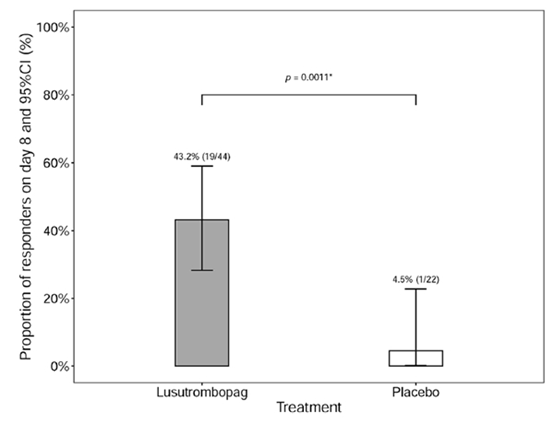
▲ Proportion of responders on day 8 in the rutromopag group and placebo group in the population with the full analysis set
Image source: Reference[1]
Secondary efficacy endpoints: The proportion of patients with PLTs ≥ 50×109/L on day 8 and after and 2 days before surgery was 72.7% (32/44) in the rutromupaga group and 18.2% (4/22) in the placebo group, with a statistically significant difference between the two groups (P<0.0001).
The median maximum PLT values of the two groups were 80.5×10⁹/L and 60.0×10⁹/L, respectively. The maximum median increase in PLT from baseline was 42.0×10⁹/L and 24.0×10⁹/L, respectively. In addition, the increase in PLT in the ruttrompag group occurred before aggressive surgery, while the increase in PLT in the placebo group occurred after aggressive surgery; The median time to reach maximum PLT in the ruttrombopag and placebo groups was 14.5 and 27.0 days, respectively. Median PLT returned to baseline within 35 days.
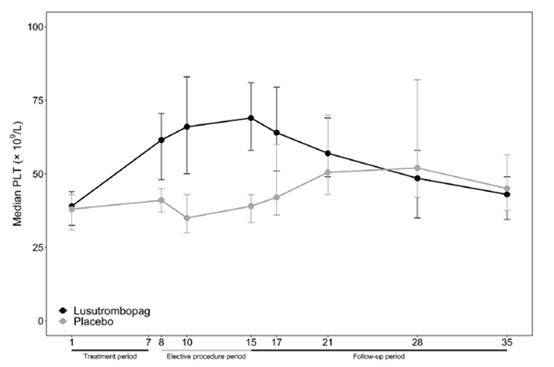
▲ Changes in median PLT values over time in ruttrombopag and placebo groups
Image source: Reference[1]
In terms of safety, in the rutromupag group, no patients died or discontinued due to adverse events. Only 1 patient in the placebo group discontinued the drug due to an adverse event. The overall incidence of adverse events (TEAEs) during treatment was 84.1% (37/44) in the rutromupag group and 90.9% (20/22) in the placebo group. Most TEAEs have mild or moderate severity. The incidence of TEAE after invasive surgery is higher than before surgery.
Drug-related adverse events occurred in 11.4% of patients in the rutromopag and placebo groups, respectively. All patients had mild or moderate severity, and the incidence of drug-related AEs was less than 5%. Three patients in the ruttrombopag group developed SAEs (hepatic encephalopathy and coagulopathy, fever, acute cholecystitis), but these were non-fatal and were not evaluated as being related to the study drug.
Few patients reported bleeding and thrombosis-related AEs during the study period. Compared with placebo, the incidence of bleeding events was lower in the ruttrombopag group (6.8% vs. 13.6%), and only one patient developed thrombosis-associated AE (brachiocephalic vein thrombosis) of mild severity, which was assessed as unrelated to the study drug.
Overall, the rate of adverse events during treatment was comparable between the rutromupag and placebo groups, and no additional safety concerns were found in the Chinese patient population compared with overseas studies.
epilogue
In summary, for patients with chronic liver disease and thrombocytopenia who plan to receive aggressive therapy, taking 3 mg of ruttrombopag once daily for 7 days can effectively increase PLT to meet the criteria for aggressive surgery, thereby avoiding preoperative platelet transfusion without adding additional safety issues. Crucially, in the face of tight platelet supplies, ruttrombopag is a safe, effective and reliable way to raise platelet counts prior to invasive surgery, providing more treatment options for patients with CLD in China.

You May Interested In


High Quality β-Nicotinamide adenine dinucleotide CAS 53-84-9 NADwith ready stock and best price
$3/UNIT FOB


2026-10-17
Trade Alert
Delivering the latest product trends and industry news straight to your inbox.
(We'll never share your email address with a third-party.)

Related News
-
Aekyung Chemical Plans to Sell Its Ningbo Subsidiary
-
Wanhua Chemical Raises Southeast Asia MDI and TDI Offers by $200 per Tonne
-
Ukraine Strikes Russia’s Ryazan Refinery Again, Setting 17-Million-Tonne Facility Ablaze
-
Global Chemical Giants Accelerate Plant Closures and Layoffs as Industry Enters Structural Capacity Rationalization
-
European Diesel Crack Spread Hits Record $74.66 per Barrel as Global Refinery Outages Mount
-
Ukraine Strikes Russia’s Perm Refinery Again, Forcing Crude Unit Offline at 260,000-BPD Facility
-
EU mulls expanding tariff scope on Chinese chemicals, sector-wide measures in the pipeline
-
Two Commercial Ships Confirmed Sunk Near Strait of Hormuz Within 24 Hours
-
U.S. 10% Temporary Tariff Expires, New Section 301 Tariffs Not Yet Implemented
-
Sichuan Unveils Revised List of 14 Qualified Chemical Parks in Major Industrial Realignment
Recommend Reading
-
![Lianolong Bets Big on Electronic Adhesives with $50M Strategic Stake in Sidofu]()
Lianolong Bets Big on Electronic Adhesives with $50M Strategic Stake in Sidofu
-
![“Did They Just Buy a Money Printer for ¥288 Million?”: Yip’s Chemical’s Bold Bet on Green Tech—Is This a Genuine Transformation or Just Another Story for the Stock Market?]()
“Did They Just Buy a Money Printer for ¥288 Million?”: Yip’s Chemical’s Bold Bet on Green Tech—Is This a Genuine Transformation or Just Another Story for the Stock Market?
-
![India Targets Fake Drug Packaging]()
India Targets Fake Drug Packaging
-
![India’s Pharma Cost Problem Gets Worse]()
India’s Pharma Cost Problem Gets Worse
-
![“Zero Tariff Is Not a Get-Out-of-Jail-Free Card”: Hainan’s Full Customs Closure—Boon or Trap for the Chemical Industry?]()
“Zero Tariff Is Not a Get-Out-of-Jail-Free Card”: Hainan’s Full Customs Closure—Boon or Trap for the Chemical Industry?
-
![Cost and Supply Resonance Drives Up Prices—Melamine Market Rises Strongly]()
Cost and Supply Resonance Drives Up Prices—Melamine Market Rises Strongly
-
![Hydrogen Peroxide Formula: H2O2 Concentration & Safety]()
Hydrogen Peroxide Formula: H2O2 Concentration & Safety
-
![Soaring and Then Plunging Rapidly! The Roller-Coaster Ride of Phenol Comes to an End—What’s Next for the Market?]()
Soaring and Then Plunging Rapidly! The Roller-Coaster Ride of Phenol Comes to an End—What’s Next for the Market?
-
![Butadiene Rubber Market Prices Surge Sharply]()
Butadiene Rubber Market Prices Surge Sharply
-
![On March 11, the Chinese acrylonitrile market remained stable and organized]()
On March 11, the Chinese acrylonitrile market remained stable and organized