




Shipping Pressure Continues—ABS Market Prices Still Declining
December 1st, News
In November, the Chinese ABS market continued to show a weak trend, with spot prices for most grades being reduced. According to the commodity market analysis system, as of December 1st, the average price of sampled ABS products was 8,572.50 CNY/ton, representing a change rate of -6.26% compared to early November.
Fundamental Analysis
Supply Level: Since November, the operating rate of China's ABS industry has been fluctuating within a narrow range. Previously, Chimei Chemical's 7 series production line in Zhenjiang was restarted; some production lines of Zhejiang Petrochemical underwent equipment upgrades; and Sinopec Ineos Styrolution Line 1 was shut down for maintenance. Later in the month, Zhejiang Petrochemical completed its upgrade and resumed operations; Jilin Petrochemical increased its production; and in Shandong, there was a mix of increased production and maintenance due to cost considerations. Overall, there were both increases and decreases in production throughout the month, with the overall industry operating rate oscillating around 71%, and the weekly average production exceeding 143,000 tons. The market supply remained ample, with the inventory of polymer enterprises holding firm at a high level of nearly 260,000 tons. In summary, the long-term supply surplus in the ABS market remains unchanged, and the support from the supply side for the ABS spot price continues to be weak.
Cost Factors: At the end of November, the market for the three upstream raw materials for ABS remained largely stagnant, exerting a relatively weak upward influence on ABS costs. Among these, acrylonitrile prices had already hit their lowest point at the beginning of the month, prompting downstream users to take advantage of the low prices and replenish their inventories, which in turn encouraged suppliers to slightly raise their quoted prices. However, given that downstream operating rates have been steadily declining while overall supply remains ample, the market continues to lack upward momentum and may face downward adjustment pressure.
At the end of November, the butadiene market in China experienced a decline followed by fluctuations. The spot price fell to a low level earlier, attracting some restocking orders and improving the trading atmosphere in the market. However, due to consistently weak terminal demand downstream and a bearish supply situation, the butadiene market as a whole entered a range-bound fluctuation under the dual negative impacts. Currently, the upstream synthetic rubber market is also soft, with a lack of positive support. It is expected that the butadiene market will mainly show a weak and fluctuating trend, with a focus on the procurement demand downstream.
Within the month, the styrene market experienced a decline followed by a recovery, with overall fluctuations being the main trend. During this period, the raw material benzene fluctuated within a range, providing limited support to styrene. On the other hand, styrene also entered a low-demand season. Although there was an unexpected reduction in supply due to the early shutdown for maintenance at Quanzhou Sinochem in the second half of the month, downstream operations in the consumption sector remained stable. Once the short-term supply and demand benefits are exhausted, it is expected that the resistance to further price increases in the styrene market in China will increase.
Demand Side: Affected by weakening profitability of end-user companies and volatile external markets, consumption in the ABS downstream sector—primarily the appliance casing industry—was hampered this month, and no increase in production schedules is expected in the near term. Downstream demand for ABS remains subdued, with factory utilization rates remaining moderate. Overall, end-user companies continue to adopt a just-in-time inventory strategy, replenishing orders only when absolutely necessary, resulting in slow turnover of goods. Merchants’ inventory levels also remain stubbornly high, and under increasing pressure to clear stock within the market, both manufacturers and traders continue to offer discounts and promotions to facilitate sales. The e-commerce shopping festival held mid-month provided limited boost to industry consumption; both domestic and overseas markets remain cautious, and the industry’s momentum remains weak. Overall, support from the demand side for ABS prices shows no signs of improvement.
Future Market Prediction
In November, the ABS market in China continued to decline. The production load of polymer plants remained largely stable with minor fluctuations, and consumer demand stayed low and flat. Analysts believe that the long-term supply-demand contradiction in the ABS market has been a persistent issue, dragging down the spot price. At the same time, the upstream raw material market is stagnant, leading to a generally negative sentiment among industry players. With a lack of positive guidance in the short term, it is expected that the downward pressure on ABS will continue to exist.

You May Interested In


Glow70/KLOW80 99% China Peptides Warehouse Direct Delivery Lyophilized Powder in Stock
$1.7E+2/UNIT FOB


Best Price Glow70 High Purity 99% Custom Peptide Scientifically Formulated for Skin Radiance and Tissue Repair
$5E+1/UNIT FOB

2026-07-28
Trade Alert
Delivering the latest product trends and industry news straight to your inbox.
(We'll never share your email address with a third-party.)

Related News
-
July Hydrogen Peroxide Market Prices Oscillate and Decline
-
Local Supply Reduction Leads to Significant Increase in Acrylonitrile Prices
-
Cost Values Make a Strong Comeback; PC Market Soars in the Second Half of July
-
Polyester Bottle Flakes Show Intraday Volatility and Strength on the 23rd, Closing Higher at Late Trading Hours
-
China's SBR Prices Rise Driven by Costs
-
Weak Demand Pressures Adipic Acid Prices in China
-
Bull-Bear Duel: Palm Oil Prices Show Mixed Trends
-
Restocking Boosts Short-term Consumption, ABS Stabilizes and Rebounds in the First Half of July in China
-
Insufficient Spot Buying Momentum, Acrylonitrile Market Continues to Weaken in China
-
MTBE Market Prices Continue to Decline
Recommend Reading
-

Sodium Metabisulfite Prices Rise This Week in China (3.2-3.6)
-
This Week China's Titanium Dioxide Market Remains Stable (2.2-2.6)
-

Cost Support: Butadiene Rubber Market Prices Rise Sharply
-

On March 6, the isopropyl alcohol market in China saw a significant increase in prices
-
This Week's Hydrogen Fluoride Market Operates Steadily in China (2.2-2.6)
-

Benzalkonium Chloride: Essential Uses, Safety Tips & Cleaning Guide
-
Applications of Aluminium Orthophosphate
-

Acesulfame Potassium: Safety, Side Effects, and Food Uses
-

SiO2: Properties, Uses, and Applications
-
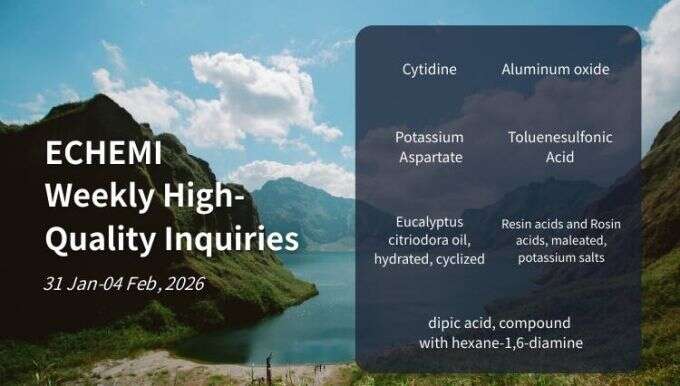
Premium Global Chemical Sourcing Requests (31 Jan - 4 Feb, 2026)