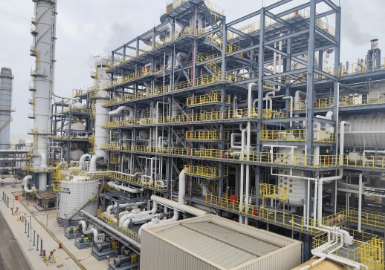
On August 11, Tinergy Chemical disclosed two investment announcements in succession. The holding subsidiary Guizhou Zhonghe Phosphorus Chemical plans to invest 5.538 billion yuan to construct a project with annual production capacity of 400,000 tons of titanium dioxide and 1.4 million tons of ferrous sulfate heptahydrate. The wholly-owned subsidiary Gansu Dongfang Titanium Industry plans to invest 5.462 billion yuan to construct a 600,000-ton annual capacity phosphate iron project. The total investment of the two projects amounts to approximately 11 billion yuan, equivalent to about 65% of the company's current market capitalization.
Tinergy Chemical's expanded push into phosphate iron is directly tied to its core titanium dioxide business. The sulfuric acid process for titanium dioxide generates large quantities of ferrous sulfate heptahydrate as a byproduct, which previously required costly disposal. Phosphate iron production, however, precisely requires this iron source. The company plans to channel the byproduct directly into its phosphate iron production lines, simultaneously reducing both byproduct disposal costs and raw material procurement expenses.
In the first half of 2026, Tinergy Chemical's phosphate iron business generated revenue of 349 million yuan, up 172.82% year-on-year, with gross margin turning positive from -5.20% in the same period of 2025 to 15.55%. The company currently has only 100,000 tons of phosphate iron capacity, with a capacity utilization rate of 41.09% in 2025. Upon completion of the new 600,000-ton project, total phosphate iron capacity will reach 700,000 tons. Titanium dioxide capacity will expand from 700,000 tons to 1.1 million tons, an increase of approximately 57%.
The shift in market pricing has restored the appeal of phosphate iron investment. At the end of 2025, conventional phosphate iron traded at about 10,000 yuan per ton; by July 2026, prices had climbed to approximately 15,200 yuan per ton, a rebound of over 50% within six months. During the same period, domestic lithium iron phosphate production reached approximately 2.72 million tons, up over 60% year-on-year.
This is not Tinergy Chemical's first attempt in this space. Over a year ago, the company had planned a 500,000-ton phosphate iron project, which was later terminated due to market conditions, with cumulative investment of 1.309 billion yuan already spent. Following that project's suspension, the company has now relaunched an even larger 600,000-ton project.
Pressure on the core titanium dioxide business has not eased. In the first half of 2026, the company's titanium dioxide revenue reached 3.163 billion yuan, up 4.67% year-on-year, but operating costs grew 11.36%, dragging gross margin down to 7.66%, a decline of 5.55 percentage points year-on-year. For the full year 2025, revenue grew 13.22% to 7.784 billion yuan, while net profit attributable to shareholders fell 36.85% to 357 million yuan. On the raw material front, sulfur prices have surged over 90% year-to-date, while sulfuric acid prices are up 213% year-on-year. Each ton of sulfuric acid-process titanium dioxide consumes 3 to 4 tons of sulfuric acid, and sulfuric acid alone now accounts for a significantly larger share of unit production costs.
The titanium dioxide business is squeezed by rising input costs, phosphate iron has regained profitability following the price rebound, and the ferrous sulfate heptahydrate byproduct can be directly channeled into phosphate iron production. These converging factors form the basis for Tinergy Chemical's decision to relaunch its phosphate iron project. Phosphate iron is no longer just a line of business the company had previously tested; it has now been formally incorporated into its next-phase capacity planning.