Breaking News! China's First KRAS G12D Inhibitor Approved for Clinical Use
On August 2, 2022, Hengrui Medicine issuedan announcement that the company received the approval and issuance of the"Drug Clinical Trial Approval Letter" for HRS-4642 injection from theState Food and Drug Administration. HRS-4642 targets the KRAS G12D mutation andinhibits tumor cell proliferation. At present, no similar drugs have enteredthe clinic at home and abroad, and there is no relevant sales data.
Most KRAS mutations occur at residues 12 or13, where glycine is mutated to cysteine or aspartate (eg, KRAS G12C, KRASG12D, and KRAS G13D). In cancer cells, mutated KRAS is constitutivelyactivated, leading to activation of downstream signaling pathways, such asRAS-RAF-MEK-ERK or PI3K-AKT.
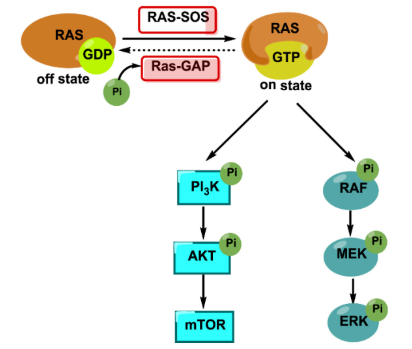
KRAS G12D has a high mutation rate inpancreatic cancer (PAAD, about 2/3) and colorectal cancer (CRC, 50%), but therehas been no effective drug. This is also related to the fact that KRAS has ahigh affinity for guanosine triphosphate (GTP), and is difficult to target dueto its small catalytic site and smooth protein surface.
Until it was discovered that theG12C-mutated allosteric switch-II pocket (S-IIP) can be covalently inhibited,KRAS inhibitors have developed by leaps and bounds. KRAS G12D (aspartic acidintroduced at position 12) differs from KRAS G12C (cysteine introduced at position 12) in only one amino acid residue. The successof G12C inhibitors can be attributed to the nucleophilic cysteine, which is thebest choice for covalent inhibition, while finding covalent warheads foraspartate is somewhat difficult. However, the success of the KRAS G12Cinhibitor (Amgen sotorasib was launched) also provided the basis and directionfor the research and development of G12D inhibitors.
KRAS G12D has been reported to retainGTPase activity, suggesting that the active form of KRAS G12D may haveswitch-II pocket binding.
The research and development of KRAS G12Dinhibitors has tried various directions, including the compound KAL-21404358targeting the P110 site, the pan-RAS inhibitor compound 3144 targeting the A59site, and the cyclic peptide KD2 targeting the active state of KRAS G12D, butall Not working enough.
Previously, the pioneer of KRAS G12Dinhibitors was Mirati's MRTX1133, which is a non-covalent inhibitor. Miratiannounced its preclinical data in 2021 that it binds to both inactivated andactivated KRAS G12D mutants. It was once considered the most promising KRASG12D inhibitor to enter the clinic first, but for some reason it has not beenable to wait for the follow-up.
Recently, there have been some newdiscoveries. TH-Z835 discovered by the team of Professor Yonghui Zhang ofTsinghua University exerts an inhibitory effect by forming a salt bridgebetween the piperazine moiety of the inhibitor and the Asp12 residue of theKRASG12D mutant protein.
Based on virtual screening, Jianjun Chen'steam from Southern Medical University identified KD-8, athieno[2,3-d]pyrimidine analog whose inhibitory effect is based on theinteraction with aspartic acid residues.

There are also some teams exploring thesimultaneous inhibition of KRASG12C and KRASG12D, but they are still in the drugdevelopment stage.

You May Interested In


High Quality β-Nicotinamide adenine dinucleotide CAS 53-84-9 NADwith ready stock and best price
$3E+1/UNIT FOB


2026-10-24
Trade Alert
Delivering the latest product trends and industry news straight to your inbox.
(We'll never share your email address with a third-party.)

Related News
-
Granja holdings Hengrui 40 million shares
-
Promoting Overseas Development and Commercialization of Pipeline Products Hengrui Established Luzsana Subsidiary
-
Saudi East-West Oil Pipeline Shut Down After Attack, Disrupting 4 Million bpd of Oil Flow
-
Global Countries Impose Tariffs on Chinese Chemical Products
-
Chemours Sells Its Former Titanium Dioxide Site in Taiwan: Turning a “White Powder” Factory into “Wind Power Real Estate” for $360 Million—Buying Not Cash, But Breathing Room
-
Celanese to Close Acetate Tow Plant in Lanaken, Belgium by 2026
-
The “Counter-Wind Ledger” of CHF 11.2 Billion: Sika Barely Grew in 2025—Yet Kept Taking Market Share
-
$530 Million Lawsuit Unheard, $76 Million Counterclaim Filed: Is Qicai Chemical’s ‘Reputation Defense’ a Desperate Last Stand or a Calculated PR Gambit?
-
Strait of Hormuz Reopens, Oil Prices Plunge: Is the Chemical Price Rally Over?
-
Alipay, Baidu, and iFlytek Win Big—As the Government Spends $1.1 Billion on AI Healthcare, Is This a Lifeline or a Feeding Frenzy for Tech Giants?
Recommend Reading
-
![U.S. Chemical Companies Are Benefiting from This Feedstock Shock]()
U.S. Chemical Companies Are Benefiting from This Feedstock Shock
-
![From Eggshell to Elixir: EFSA Declares Egg Membrane Collagen Peptides Safe for Adult Supplements]()
From Eggshell to Elixir: EFSA Declares Egg Membrane Collagen Peptides Safe for Adult Supplements
-
![India Launches Concentrated Anti-Dumping Actions Against Eight Categories of Chinese Chemicals, Covering APIs/Intermediates, Polyurethanes, and Refrigerants]()
India Launches Concentrated Anti-Dumping Actions Against Eight Categories of Chinese Chemicals, Covering APIs/Intermediates, Polyurethanes, and Refrigerants
-
![Blue from the Rainforest: EFSA Greenlights Natural “Jagua Blue” as Safe Food Colorant]()
Blue from the Rainforest: EFSA Greenlights Natural “Jagua Blue” as Safe Food Colorant
-
![Sumitomo Reclaims Dunlop’s Throne in Southeast Asia—Full Brand Rights Snapped Up Across Malaysia, Singapore, and Brunei]()
Sumitomo Reclaims Dunlop’s Throne in Southeast Asia—Full Brand Rights Snapped Up Across Malaysia, Singapore, and Brunei
-
![Business Society October 21, 2026 PC Trend Analysis: Clear Downtrend]()
Business Society October 21, 2026 PC Trend Analysis: Clear Downtrend
-
![Business Society September 30, 2026 Epoxy Chloropropane Trend Analysis: Volatility]()
Business Society September 30, 2026 Epoxy Chloropropane Trend Analysis: Volatility
-
![Ethylene Glycol: Production, Uses, and Safety]()
Ethylene Glycol: Production, Uses, and Safety
-
![Business Society’s Trend Analysis for Hydrofluoric Acid on September 11, 2026: Volatile (Bearish)]()
Business Society’s Trend Analysis for Hydrofluoric Acid on September 11, 2026: Volatile (Bearish)
-
![Costs Ease at High Levels; PC Prices Retract in Mid-October]()
Costs Ease at High Levels; PC Prices Retract in Mid-October