




Hydroxocobalamin

-
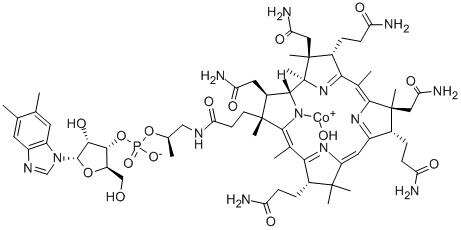
Hydroxocobalamin
structure -
-
CAS No:
13422-51-0
-
Formula:
C62H89CoN13O15P
-
Chemical Name:
Hydroxocobalamin
-
Synonyms:
Cobinamide,Co-hydroxy-,f-(dihydrogen phosphate),inner salt,3′-ester with (5,6-dimethyl-1-α-D-ribofuranosyl-1H-benzimidazole-κN3);Cobinamide,dihydroxide,dihydrogen phosphate (ester),mono(inner salt),3′-ester with 5,6-dimethyl-1-α-D-ribofuranosylbenzimidazole;Cobinamide,dihydroxide,dihydrogen phosphate (ester),mono(inner salt),3′-ester with 5,6-dimethyl-1-α-D-ribofuranosyl-1H-benzimidazole;Hydroxocobalamin;Vitamin B12a;Hydroxycobalamin;Hydroxycobalamine;Hydroxocobalamine;Vibeden;Cobinamide hydroxide phosphate 3′-ester with 5,6-dimethyl-1-α-D-ribofuranosylbenzimidazole inner salt;α-(5,6-Dimethylbenzimidazolyl)hydroxocobamide;Hydroxocobemine;Alpha Cobione;Axlon;Ciplamin H;Cobalex;Docclan;Docevita;Duradoce;Duralta-12;Hydrogrisevit;Hydrovit;Hyxobamine;Idrogrisevit;Neo-Cytamen;Neo-Macrabin;Neo-Rojamin;OH-Duphar;Oxobemin;AlphaRedisol;Vitadurin;Primabalt RP;Hydroxy vitamin B12;Cobalamin,hydroxo-;Hydrocobalamin;Redisol H;Docelan;Codroxomin;Ducobee Hy;Droxomin;Cobalin H;Sytobex H;Neo-Betalin 12;Megamilbedoce;Cyanokit;Depovit B12;8017-22-9
- Categories:
-
CAS No:
Description
A form of vitamin B 12.
Injectable form of VITAMIN B 12 that has been used therapeutically to treat VITAMIN B 12 DEFICIENCY.
Hydroxocobalamin Basic Attributes
1382.82
1345.567017
236-534-8
Dark red, orthorhombic needles or platelets from water and acetone|DARK RED CRYSTALS OR RED CRYSTALLINE POWDER
V03AB33|B - Blood and blood forming organs|V - Various
Characteristics
484.10000
6.43870
>300 °C
methanol: 10 mg/mL at 20 °C, clear, dark red
2-8°C
2.06X10⁻¹¹ mm Hg at 25 °C
LD50 intravenous in mouse: > 50mg/kg
ODORLESS OR HAS NOT MORE THAN SLIGHT ACETONE ODOR
MW: 1364.37. Absorption max (H2O): 274, 317, 351, 499, 527 nm (epsilon 20600, 6100, 26500, 8100, 8500) /Aquacobalamin/|MW: 1388.39 /Acetocobalamin/|Red crystalline solid. Absorption max in water: 352, 527,5 nm (E (1%/1cm) 153.2, 59.5); in 0.01N NaOH: 357, 535 nm (E (1%/1 cm) 139, 625.) /Nitrocobalamin/|MW: 1410.42. Absorption max: 275, 365, 418, 516 nm (E (1%/1 cm/ 328, 130, 49, 61) /Sulfitocobalamin/|For more Other Experimental Properties (Complete) data for HYDROXOCOBALAMIN (6 total), please visit the HSDB record page.
Safety Information
NONH for all modes of transport
3
36/37/38
26-36
GG3820000
Xi
SRP: At the time of review, criteria for land treatment or burial (sanitary landfill) disposal practices are subject to significant revision. Prior to implementing land disposal of waste residue (including waste sludge), consult with environmental regulatory agencies for guidance on acceptable disposal practices.
The Approved Drug Products with Therapeutic Equivalence Evaluations List identifies currently marketed prescription drug products, incl hydroxocobalamin, approved on the basis of safety and effectiveness by FDA under sections 505 of the Federal Food, Drug, and Cosmetic Act.
Listed as a hazardous air pollutant (HAP) generally known or suspected to cause serious health problems. The Clean Air Act, as amended in 1990, directs EPA to set standards requiring major sources to sharply reduce routine emissions of toxic pollutants. EPA is required to establish and phase in specific performance based standards for all air emission sources that emit one or more of the listed pollutants. Hydroxocobalamin is included on this list.
Toxicity
Concurrent administration of chloramphenicol and vitamin B12 reportedly may antagonize the hematopoietic response to vitamin B12 in vitamin B12-deficient patients. The hematologic response to vitamin B12 in patients receiving both drugs should be carefully monitored and alternate anti-infectives should be considered. /Vitamin B12/|Prednisone has been reported to increase the absorption of vitamin B12 and secretion of intrinsic factor (IF) in a few patients with pernicious anemia, but not in patients with partial or total gastrectomy. The clinical importance of these findings is unknown. /Vitamin B12/|Ascorbic acid may destroy substantial amounts of dietary vitamin B12 in vitro; this possibility should be considered when large doses of ascorbic acid are ingested within 1 hour of oral vitamin B12 administration. /Vitamin B12/|Absorption of vitamin B12 from the GI tract may be decreased by aminoglycoside antibiotics, colchicine, extended-release potassium preparations, aminosalicylic acid and its salts, anticonvulsants (e.g., phenytoin, phenobarbital, primidone), cobalt irradiation of the small bowel, and by excessive alcohol intake lasting longer than 2 weeks. Neomycin-induced malabsorption of vitamin B12 may be increased by concurrent administration of colchicine. /Vitamin B12|Caution should be exercised when administering other cyanide antidotes simultaneously with Cyanokit, as the safety of coadministration has not been established. If a decision is made to administer another cyanide antidote with Cyanokit, these drugs should not be administered concurrently in the same IV line.
LD50 Mouse iv 2 g/kg
In nature, the primary sources are certain microorganisms that grow in soil, sewage, water or the intestinal lumen of animals that synthesize the vitamin. /Vitamin B12/
Drug Information
Treatment of known or suspected cyanide poisoning., , Cyanokit is to be administered together with appropriate decontamination and supportive measures.,
Hematinics|Cyanokit is indicated for the treatment of known or suspected cyanide poisoning.|Pernicious anemia, both uncomplicated and accompanied by nervous system involvement.|The US government considers cyanide to be among the most likely agents of chemical terrorism. Cyanide differs from many other biological or chemical agents for which little or no defense is available because its individual and public health effects are largely remediable through appropriate preparedness and response. Because the toxicity of the cyanide antidote currently available in the United States renders it ill-suited for use in terrorist incidents and other situations requiring rapid out-of-hospital treatment, hydroxocobalamin--an effective and safe cyanide antidote being used in other countries--has been introduced in the United States. Unlike the other available cyanide antidote, hydroxocobalamin can be administered at the scene of a cyanide disaster, and it need not be reserved for cases of confirmed cyanide poisoning but can be administered in cases of suspected poisoning. Both of these attributes facilitate the rapid intervention necessary for saving lives. To realize the potential benefits of hydroxocobalamin, progress also needs to be realized in other aspects of readiness, including but not limited to developing plans for ensuring local and regional availability of antidote, educating emergency responders and health care professionals in the recognition and management of cyanide poisoning, and raising public awareness of the potential for a chemical weapons attack and of how to respond.|For more Therapeutic Uses (Complete) data for HYDROXOCOBALAMIN (10 total), please visit the HSDB record page.
Caution should be exercised when administering other cyanide antidotes simultaneously with Cyanokit, as the safety of coadministration has not been established. If a decision is made to administer another cyanide antidote with Cyanokit, these drugs should not be administered concurrently in the same IV line.|Use caution in the management of patients with known anaphylactic reactions to hydroxocobalamin or cyanocobalamin. Consideration should be given to use of alternative therapies, if available. Allergic reactions may include: anaphylaxis, chest tightness, edema, urticaria, pruritus, dyspnea, and rash. Allergic reactions including angioneurotic edema have also been reported in postmarketing experience.|Maternal Medication usually Compatible with Breast-Feeding: B12: Reported Sign or Symptom in Infant or Effect on Lactation: None. /from Table 6/|While determination of blood cyanide concentration is not required for management of cyanide poisoning and should not delay treatment with Cyanokit, collecting a pretreatment blood sample may be useful for documenting cyanide poisoning as sampling post- Cyanokit use may be inaccurate.|For more Drug Warnings (Complete) data for HYDROXOCOBALAMIN (19 total), please visit the HSDB record page.
Agents which improve the quality of the blood, increasing the hemoglobin level and the number of erythrocytes. They are used in the treatment of anemias. (See all compounds classified as Hematinics.)|A group of water-soluble vitamins, some of which are COENZYMES. (See all compounds classified as Vitamin B Complex.)
The possibility of direct transport of hydroxocobalamin from the nasal cavity into the cerebrospinal fluid after nasal administration in rats was investigated and the results were compared with a human study. Hydroxocobalamin was given to rats (n=8) both intranasally (214 ug/rat) and intravenously (49.5 ug/rat) into the jugular vein using a Vascular Access Port (VAP). Prior to and after drug administration, blood and cerebrospinal fluid samples were taken and analysed by radioimmunoassay. The AUCcerebrospinal fluid/AUCplasma ratio after nasal delivery does not differ from the ratio after intravenous infusion, indicating that hydroxocobalamin enters the cerebrospinal fluid via the blood circulation across the blood-brain barrier (BBB). This same transport route is confirmed by the cumulative AUC-time profiles in cerebrospinal fluid and plasma, demonstrating a 30 min delay between plasma absorption and cerebrospinal fluid uptake of hydroxocobalamin in rats and in a comparative human study. The present results in rats show that there is no additional uptake of hydroxocobalamin in the cerebrospinal fluid after nasal delivery compared to intravenous administration, which is in accordance with the results found in humans.|Fifty percent of the administered dose of hydroxocobalamin disappears from the injection site in 2.5 hours. Hydroxocobalamin is bound to plasma proteins and stored in the liver. It is excreted in the bile and undergoes some enterohepatic recycling. Within 72 hours after injection of 500 to 1000 mcg of hydroxocobalamin, 16 to 66 percent of the injected dose may appear in the urine. The major portion is excreted within the first 24 hours.|Hydroxocobalamin is absorbed more slowly from the site of injection than is cyanocobalamin and there is some evidence that liver uptake of hydroxocobalamin may be greater than that of cyanocobalamin. It is believed that the increased retention of hydroxocobalamin compared with that of cyanocobalamin results from the greater affinity of hydroxocobalamin for both specific and nonspecific binding proteins in blood and tissues, as well as to its slower absorption from the injection site.|In the presence of gastric acid and pancreatic proteases, dietary vitamin B12 is released from food and salivary binding protein and bound to gastric intrinsic factor. When the vitamin B12-intrinsic factor complex reaches the ileum, it interacts with a receptor on the mucosal cell surface and is actively transported into circulation. Adequate intrinsic factor, bile, and sodium bicarbonate (to provide a suitable pH) all are required for ileal transport of vitamin B12. Vitamin B12 deficiency in adults is rarely the result of a deficient diet per se; rather, it usually reflects a defect in one or another aspect of this complex sequence of absorption. Achlorhydria and decreased secretion of intrinsic factor by parietal cells secondary to gastric atrophy or gastric surgery is a common cause of vitamin B12 deficiency in adults. Antibodies to parietal cells or intrinsic factor complex also can play a prominent role in producing a deficiency. A number of intestinal diseases can interfere with absorption, including pancreatic disorders (loss of pancreatic protease secretion), bacterial overgrowth, intestinal parasites, sprue, and localized damage to ileal mucosal cells by disease or as a result of surgery. /Vitamin B-12/|For more Absorption, Distribution and Excretion (Complete) data for HYDROXOCOBALAMIN (9 total), please visit the HSDB record page.
Toxicokinetics of hydroxocobalamin were studied in rats and in dogs after single administration. In dogs, the AUCs of free cobalamins-(III) and total cobalamins-(III) increased proportionally to the dose. Mean Cmax measured for free- and total cobalamins-(III) were 1 to 5 fold higher than those measured in humans treated with 5.0 and 10.0 g hydroxocobalamin. Terminal half-lives reached approximately 6 and 8 hours for free and total cobalamins-(III), respectively in dogs. Corresponding figures in rats amounted to 3 and 5 hours. In dogs, the clearance of total cobalamins-(III) (0.064 to 0.083 L/h/kg) was 6-7 fold lower than clearance of free cobalamins-(III).|The binding of hydroxocobalamin to proteins may be regarded as reversible metabolism. Hydroxocobalamin also reacts with cyanide thereby forming cyanocobalamin. This complex is highly stable and is therefore regarded as a physiological end product of hydroxocobalamin especially during cyanide intoxication.
In normal individuals, hydroxocobalamin has a plasma half life of 3-20 hours. In patients with cyanide poisoning, the half life is 14-24 hours.
Hydroxocobalamin is a complexation agent that acts by direct binding of the cyanide ions, resulting in cyanocobalamin which is a highly stable, nontoxic compound that is excreted in the urine. In addition, increased blood pressure observed in some healthy subjects of the phase I clinical study and results of a non-clinical study performed in anesthetized rabbits suggest an interference of hydroxocobalamin with the NO system.|VITAMIN B12 IS IMPLICATED IN PROTEIN SYNTH THROUGH ITS ROLE IN SYNTH OF AMINE ACID METHIONINE... /COBALAMINS/|COENZYME B12 IS REQUIRED FOR HYDROGEN TRANSFER & ISOMERIZATION WHEREBY METHYLMALONATE IS CONVERTED TO SUCCINATE, THUS INVOLVING COBALAMIN IN BOTH FAT & CARBOHYDRATE METABOLISM. ... METHYLCOBALAMIN IS REQUIRED FOR CONVERSION OF HOMOCYSTEINE TO METHIONINE IN MAMMALS. /COBALAMINS/
/SRP:/ Immediate first aid: Ensure that adequate decontamination has been carried out. If patient is not breathing, start artificial respiration, preferably with a demand valve resuscitator, bag-valve-mask device, or pocket mask, as trained. Perform CPR if necessary. Immediately flush contaminated eyes with gently flowing water. Do not induce vomiting. If vomiting occurs, lean patient forward or place on the left side (head-down position, if possible) to maintain an open airway and prevent aspiration. Keep patient quiet and maintain normal body temperature. Obtain medical attention. /Poisons A and B/|/SRP:/ Basic treatment: Establish a patent airway (oropharyngeal or nasopharyngeal airway, if needed). Suction if necessary. Watch for signs of respiratory insufficiency and assist ventilations if needed. Administer oxygen by nonrebreather mask at 10 to 15 L/min. Monitor for pulmonary edema and treat if necessary ... . Monitor for shock and treat if necessary ... . Anticipate seizures and treat if necessary ... . For eye contamination, flush eyes immediately with water. Irrigate each eye continuously with 0.9% saline (NS) during transport ... . Do not use emetics. For ingestion, rinse mouth and administer 5 mL/kg up to 200 mL of water for dilution if the patient can swallow, has a strong gag reflex, and does not drool ... . Cover skin burns with dry sterile dressings after decontamination ... . /Poisons A and B/|/SRP:/ Advanced treatment: Consider orotracheal or nasotracheal intubation for airway control in the patient who is unconscious, has severe pulmonary edema, or is in severe respiratory distress. Positive-pressure ventilation techniques with a bag valve mask device may be beneficial. Consider drug therapy for pulmonary edema ... . Consider administering a beta agonist such as albuterol for severe bronchospasm ... . Monitor cardiac rhythm and treat arrhythmias as necessary ... . Start IV administration of D5W /SRP: "To keep open", minimal flow rate/. Use 0.9% saline (NS) or lactated Ringer's if signs of hypovolemia are present. For hypotension with signs of hypovolemia, administer fluid cautiously. Watch for signs of fluid overload ... . Treat seizures with diazepam or lorazepam ... . Use proparacaine hydrochloride to assist eye irrigation ... . /Poisons A and B/
/HUMAN EXPOSURE STUDIES/ Independent groups of healthy volunteers received single intravenous doses of 2.5, 5, 7.5, or 10 g hydroxocobalamin over 7.5 to 30 minutes. In the pharmacokinetic population (n = 41), hydroxocobalamin caused short-lived mean blood pressure increases. Blood pressure increased shortly after initiation of infusion and returned nearly to baseline by 4 hours post-infusion. The time course of blood pressure changes coincided with that of changes in plasma total and free cobalamins-(III). Change in mean arterial pressure (MAP) was strongly correlated with plasma area-under-the-concentration-time curves (AUCs) of total and free cobalamins-(III) during infusion (r > 0.7) but not through 24 hours post-infusion (r < or = 0.36). The short-lived increase in mean blood pressure during administration of antidotal doses of hydroxocobalamin is closely linked to initial exposure to total and free cobalamins-(III).|/OTHER TOXICITY INFORMATION/ Hydroxocobalamin is a complexation agent that acts by direct binding of the cyanide ions, resulting in cyanocobalamin which is a highly stable, nontoxic compound that is excreted in the urine. In addition, increased blood pressure observed in some healthy subjects of the phase I clinical study and results of a non-clinical study performed in anesthetized rabbits suggest an interference of hydroxocobalamin with the NO system.
Hydroxo-Cobalamin
Hydroxocobalamin Use and Manufacturing
Preparaton: E.A. Kaczka et al US 2738301 (1956 to Merck & Co).|CYANOCOBALAMIN IN SOLN IS HYDROGENATED @ ROOM TEMP WITH AID OF RANEY NICKEL. SOLN IS THEN EXPOSED TO AIR & DIL WITH ACETONE. OXIDATION TAKES PLACE &, UPON STANDING, HYDROXOCOBALAMIN CRYSTALLIZES.
Vitamin (hematopoietic).
Cyanokit (hydroxocobalamin for injection) 5 g for intravenous use|Parenteral: Injection: 1000 mcg/mL (Available by nonproprietary name).
Cobinamide, Co-hydroxy-, f-(dihydrogen phosphate), inner salt, 3'-ester with (5,6-dimethyl-1-.alpha.-D-ribofuranosyl-1H-benzimidazole-.kappa.N3): ACTIVE|VITAMIN B-12 IS COMPOSED OF 2 HETEROCYCLIC SYSTEMS, BENZIMIDAZOLE & MODIFIED PORPHYRIN NUCLEUS... WHEN LIGAND IS HYDROXIDE INSTEAD OF CYANIDE, CMPD IS VITAMIN B-12A (HYDROXOCOBALAMIN)...|ON WT BASIS, VITAMIN B12 IS MOST POTENT OF KNOWN VITAMINS. ORIGINAL & SOLE SOURCE OF COMPD IN NATURE APPEARS TO BE FROM SYNTH BY MICROORGANISMS. ... IN MAN, SYNTH...OCCURS BY BACTERIA IN LARGE BOWEL, FROM WHICH SITE IT IS NOT ABSORBED. /VITAMIN B12/|PREPN OF STABLE SOLN: MARCUS ET AL, FRENCH PATENT 1,336,671 (1963 TO MERCK & CO), CA 60, 380A (1964). /HYDROXOCOBALAMIN ACETATE/
MICROBIOLOGICAL PROCEDURES USING TITRIMETRIC & TURBIDIMETRIC METHODS.|HYDROXOCOBALAMINE, CYANOCOBALAMINE, COENZYME B12, & METHYLCOBALAMINE WERE SEPARATED BY HPLC WITH METHANOL-0.05% AQUEOUS H2SO4 AS MOBILE PHASE & INJECTION PRESSURE OF 25 BARS.|Analyte: hydroxocobalamin; matrix: chemical identification; procedure: visible absorption spectrophotometry with maxima at 426, 516, and 550 nm|Analyte: hydroxocobalamin; matrix: chemical identification; procedure: reaction with potassium pyrosulfate; addition of water, phenolphthalein and sodium hydroxide; appearance of pink color; addition of sodium acetate, acetic acid, and nitroso salt solution; appearance of red or orange-red color|For more Analytic Laboratory Methods (Complete) data for HYDROXOCOBALAMIN (16 total), please visit the HSDB record page.
Human drugs -> Cyanokit -> EMA Drug Category|All other therapeutic products -> Human pharmacotherapeutic group|Human Drugs -> FDA Approved Drug Products with Therapeutic Equivalence Evaluations (Orange Book) -> Active Ingredients
Computed Properties
Molecular Weight:1347.4
Hydrogen Bond Donor Count:10
Hydrogen Bond Acceptor Count:20
Rotatable Bond Count:16
Exact Mass:1346.574890
Monoisotopic Mass:1346.574890
Topological Polar Surface Area:453
Heavy Atom Count:92
Complexity:3150
Defined Atom Stereocenter Count:10
Undefined Atom Stereocenter Count:4
Defined Bond Stereocenter Count:3
Covalently-Bonded Unit Count:3
Compound Is Canonicalized:Yes
Recommended Suppliers of Hydroxocobalamin
-
![China]() CN
CN
5 YRS
Business licensedTrader Supplier of Intermediates,Building blocks,API,Silicones,Peptides,Lab chemicals,Biochemicals,Pharmaceuticals,Screening Compounds,Food Additives -
![China]() CN
CN
8 YRS
Business licensed Certified factoryManufactory Supplier of Biochemicals Ingredients,Vitamin Amino Acid Ingredients,Cosmestic Ingredients,Pharma Chemicals,Organic Fine Chemicals,Food Nutrient Ingredients,Natural Plant Ingredients,APIS Intermidiates,Daily Chemicals,Agricultural Chemicals,Surfactant Chemicals,Ultraviolet Absorbents,Antioxidant Ingredients,Scientific Research Chemical,Flavors and Fragrances ChemicalsInquiryCAS No.: 13422-51-0Grade: Pharmaceutical GradeContent: 99%

Latest News on Hydroxocobalamin
- The world's first uniform international safety standard for plastics and rubber
- The nation's first group standard for meltblown cloth for masks is released
- Several compulsory national standards have been issued
- Japan has seized the right to formulate international standards
- Henan Efforts to Improve the Standardized Management Level of Food Production
Learn More Other Chemicals
-
Hydroxocobalamin hydrochloride
58288-50-9
-
Fluocinolone
807-38-5
-
2-Propenoic acid, 2-methyl-, methyl ester, polymer with butyl 2-propenoate, 2-ethylhexyl 2-propenoate and 2-propenoic acid
42398-14-1
-
(3S,7R)-N-[(2-fluorophenyl)methyl]-11-hydroxy-7-methyl-9,12-dioxo-4-oxa-1,8-diazatricyclo[8.4.0.03,8]tetradeca-10,13-diene-13-carboxamide Formula
1863916-87-3
-
1,1-Cyclopropanedicarboxylic acid dimethyl ester Formula
6914-71-2
-
(6R,7R)-7-[[2-amino-2-(cyclohexen-1-yl)acetyl]amino]-3-methyl-8-oxo-5-thia-1-azabicyclo[4.2.0]oct-2-ene-2-carboxylic acid Formula
37051-00-6
-
3-Hydroxy-4-Methyl-2(5H)-thiophenone Structure
34876-35-2
-
10-Methoxy-5H-dibenz[b,f]azepine-5-carbonyl chloride Structure
28721-08-6
-
What is 3,7-Dihydro-3,7-dimethyl-1-(2-propen-1-yl)-1H-purine-2,6-dione
2530-99-6
-
What is 1-[4-[4-(2,3-Dichlorophenyl)piperazin-1-yl]butyl]-7-hydroxy-3,4-dihydrocarbostyril
1797983-65-3