Product
Supplier
Encyclopedia
Inquiry
N,N-Dimethylaniline121-69-7 buy - large image1
N,N-Dimethylaniline121-69-7 buy - image1
N,N-Dimethylaniline121-69-7 buy - image2
N,N-Dimethylaniline121-69-7 buy - image3
N,N-Dimethylaniline121-69-7 buy - image4
N,N-Dimethylaniline121-69-7 buy - image5
N,N-Dimethylaniline121-69-7 buy - image6

N,N-Dimethylaniline121-69-7

6 Inquiries

Unit Price:

$33-34/MT FOB

Get Latest Price
CAS No.:

121-69-7

Grade:

Pharmaceutical Grade

Content:

99.5%

Port:

上海

Brand:

OORENT

Packaging:

Vial/Bottle/Bag/Carton

Price valid (until):

2026-07-16

Company Type:
Trader
Location:
China
Qualification:
Main Products:

pharmaceutical intermediates,peptides,electronic chemicals

  • Product Description

  • Seller Information

  • Inquiry History

  • Description

    Product Detail  

    N,N-Dimethylaniline Basic information
    Product Name: N,N-Dimethylaniline
    Synonyms: Aniline, N,N-dimethyl-;Benzenamine,N,N-dimethyl-;N,N-dimethyl-Benzenamine;N,N-Dimethylbenzeneamine;N,N-Dimethyl-N-phenylamine;N,N-Dimethylphenylamine;N,N-DIMETHYLACETATE;N-ACETYLDIMETHYLAMINE
    CAS: 121-69-7
    MF: C8H11N
    MW: 121.18
    EINECS: 204-493-5
    Product Categories: C-D, Puriss p.a. ACSNitrogen Compounds;Anilines, Aromatic Amines and Nitro Compounds;Intermediates of Dyes and Pigments;Organics;organic chemical;Dyestuff Intermediates;Amines;Analytical Reagents for General Use;C8;Puriss p.a. ACS;C8Essential Chemicals;Nitrogen Compounds;Reagent Plus;Routine Reagents;121-69-7;A
    Mol File: 121-69-7.mol
    Shop N,N-Dimethylaniline121-69-7-Detailed Image 1

    N,N-Dimethylaniline Chemical Properties
    Melting point  1.5-2.5 °C (lit.)
    Boiling point  193-194 °C (lit.)
    density  0.956 g/mL at 25 °C (lit.)
    vapor density  3 (vs air)
    vapor pressure  2 mm Hg ( 25 °C)
    refractive index  n20/D 1.557(lit.)
    Fp  158 °F
    storage temp.  Store below +30°C.
    solubility  1.2g/l
    pka 5.15(at 25℃)
    form  Liquid
    color  Clear yellow
    PH 7.4 (1.2g/l, H2O, 20℃)
    Relative polarity 0.179
    explosive limit 1.2-7%(V)
    Water Solubility  1 g/L (20 ºC)
    Thermal Conductivity 0.142 W/(m·K) at 25 ℃
    Merck  14,3234
    BRN  507140
    Henry's Law Constant 4.98(x 10-6 atmm3/mol) at 20 °C (approximate - calculated from water solubility and vapor pressure)
    Dielectric constant 4.4000000000000004
    Exposure limits ACGIH:TLV-TWA 5 ppm (25 mg/m3); TLV-STEL 10 ppm (50 mg/m3)
    OSHA:PEL-TWA 5 ppm (25 mg/m3)
    NIOSH:REL-TWA 5 ppm; REL-STEL 10 ppm
    Stability: Stable. Incompatible with strong oxidizing agents, strong acids, acid chlorides, acid anhydrides, chloroformates, halogens. Combustible.
    Major Application microbiology
    InChI 1S/C8H11N/c1-9(2)8-6-4-3-5-7-8/h3-7H,1-2H3
    InChIKey JLTDJTHDQAWBAV-UHFFFAOYSA-N
    SMILES CN(C)c1ccccc1
    LogP 1.171 at 35℃
    CAS DataBase Reference 121-69-7(CAS DataBase Reference)
    IARC 3 (Vol. 57) 1993
    NIST Chemistry Reference Benzenamine, N,N-dimethyl-(121-69-7)
    EPA Substance Registry System N,N-Dimethylaniline (121-69-7)

    Safety Information
    Hazard Codes  T,N
    Risk Statements  61-20/21-51/53-40-23/24/25
    Safety Statements  53-45-61-36/37-28A-28
    RIDADR  UN 2253
    OEB A
    OEL TWA: 5 ppm (25 mg/m3), STEL: 10 ppm (50 mg/m3) [skin]
    WGK Germany  3
    RTECS  BX4725000
    8
    Autoignition Temperature 370 °C DIN 51794
    TSCA  TSCA listed
    HS Code  2921 42 00
    HazardClass  6.1
    PackingGroup  II
    Storage Class 6.1A - Combustible acute toxic Cat. 1 and 2
    very toxic hazardous materials
    Hazard Classifications Acute Tox. 3 Dermal
    Acute Tox. 3 Inhalation
    Acute Tox. 3 Oral
    Aquatic Chronic 2
    Carc. 2
    Hazardous Substances Data 121-69-7(Hazardous Substances Data)
    Toxicity LD50 orally in rats: 1.41 ml/kg (Smyth)
    IDLH 100 ppm
    MSDS Information
    Provider Language
    ACROS English
    SigmaAldrich English
    ALFA English

    N,N-Dimethylaniline Usage And Synthesis
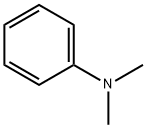
    Description DMA, an aromatic amine, is a straw-coloredliquid with a characteristic amine-like odor. It turns brownon contact with air. Molecular weight= 121.20; Boilingpoint= 192℃; Freezing/Melting point = 2.2℃; Vaporpressure = 1 mmHg at 20℃; Flash point = 61℃;Autoignition temperature= 371℃. Explosive limits:LEL = 1%; UEL= 7%. Insoluble in water.
    Chemical Properties N,N-Dimethylaniline is a light yellow to light brown oily liquid. Has a pungent odor. Soluble in ethanol, chloroform, ether and aromatic organic solvents, slightly soluble in water.It is a tertiary amine used in the synthesis of several triarylmethane dyes like malachite green. It is also used in the synthesis of a magnetic gram stain for the detection of bacteria.
    Physical properties Straw to brown-colored oily liquid with a characteristic amine-like odor. Odor threshold concentration is 13 ppb (quoted, Amoore and Hautala, 1983).
    Uses N,N-Dimethylaniline is used in production of dyestuffs, as a solvent, a reagent in methylation reactions, and a hardener in fiberglass reinforced resins.
    Uses N,N-dimethylaniline is an important dye intermediate. It can be used to prepare alkaline yellow, Crystal Violet 5BN, basic magenta green, basic lake blue BB, basic brilliant blue R, cationic red 2BL, brilliant red 5GN, violet 3BL, brilliant blue, etc. In the pharmaceutical industry, the product can be used to manufacture cefazolin V, sulfamonomethoxine, Sulfadoxine, fluorocytosine, etc. moreover, It can be used as an intermediate to vanillin, a stabilizer for colorimetric peroxidase determination or as a reagent in chemical synthesis.
    Definition ChEBI: N,N-dimethylaniline is a tertiary amine that is aniline in which the amino hydrogens are replaced by two methyl groups. It is a tertiary amine and a dimethylaniline.
    Production Methods N,N-Dimethylaniline is made by heating aniline, methyl alcohol and sulfuric acid under pressure, followed by hydrolysis of the sulfate formed with sodium hydroxide to the free base (Windholz et al 1983). United States production in 1975 was estimated at 4,600 metric tons (HSDB 1989).
    General Description N,N-Dimethylaniline appears as a yellow to brown colored oily liquid with a fishlike odor. Less dense than water and insoluble in water. Flash point 150°F. Toxic by ingestion, inhalation, and skin absorption. Used to make dyes and as a solvent.
    Air & Water Reactions Insoluble in water.
    Reactivity Profile Explosive decomposition occurred when finely divided benzoyl peroxide was allowed to react with N,N-Dimethylaniline by breaking an ampoule containing 0.5 grams of dimethylaniline in an autoclave, NFPA 491M, 1991. This result may be expected with other peroxides and various oxidants.
    Health Hazard TOXIC; inhalation, ingestion or skin contact with material may cause severe injury or death. Contact with molten substance may cause severe burns to skin and eyes. Avoid any skin contact. Effects of contact or inhalation may be delayed. Fire may produce irritating, corrosive and/or toxic gases. Runoff from fire control or dilution water may be corrosive and/or toxic and cause pollution.
    Health Hazard Clinical signs of intoxication with N,N-dimethylaniline in man are headaches, cyanosis, dizziness, labored breathing, paralysis and convulsions (HSDB 1989). It is absorbed through the skin to produce a dangerous methemoglobinemia (Gosselin 1984). Treatment is similar to that of aniline with the object of managing methemoglobinemia.
    Fire Hazard Combustible material: may burn but does not ignite readily. When heated, vapors may form explosive mixtures with air: indoors, outdoors and sewers explosion hazards. Contact with metals may evolve flammable hydrogen gas. Containers may explode when heated. Runoff may pollute waterways. Substance may be transported in a molten form.
    Flammability and Explosibility Non flammable
    Industrial uses N,N-Dimethylaniline is used as chemical intermediate in the manufacturing of vanillin, Michler's ketone, and dyes such as Acid Red 2, Basic Green 4 and Basic Violet 1 (Northcott 1978). It is also used as a solvent and an activator for polyesters and as an alkylating agent (Beard and Noe 1981). It is used as an acid scavenger or accepter in the manufacture of beta-lactam antibiotics such as penicillin and cephalosporin (Nachtmann and Gstrein 1981).
    Safety Profile Suspected carcinogen with equivocal tumorigenic data. Human poison by ingestion. Moderately toxic by inhalation and skin contact. A skin irritant. Human systemic effects by ingestion: nausea or vomiting. Physiological action is similar to, but less toxic than, adne. A central nervous system depressant. Mutation data reported. Flammable liquid when exposed to heat, flame, or oxidizers. Explodes on contact with benzoyl peroxide or disopropyl peroxydicarbonate. To fight fire, use foam, CO2, dry chemical. When heated to decomposition it emits htghly toxic fumes of adne and NOx. See also ANILINE.
    Potential Exposure Tumorigen,Mutagen, Human Data; Primary Irritant. This material isused as a chemical intermediate in the manufacture of manydyes and rubber chemicals; solvent, emulsifier, and analytical reagent.
    Carcinogenicity A 2-year corn oil gavage bioassay conducted by NTP in F344/N rats (0.3 or 30 mg/kg) and B6C3F1 mice (0, 15, or 30 mg/kg) for 103 weeks concluded that there was some evidence of carcinogenic activity for male F344/N rats as indicated by the increased incidences of sarcomas or osteosarcomas in the spleen; there was no evidence of carcinogenic activity in the female rats or male mice; there was equivocal evidence of carcinogenic activity for female mice as indicated by an increased incidence of squamous cell papillomas of the forestomach. Both rats and mice could have tolerated doses higher than those used in these studies.
    Environmental fate Photolytic. A rate constant of 1.48 x 10⁻¹⁰ cm3/moleculesec was reported for the reaction of N,N-dimethylaniline and OH radicals in air at room temperature (Atkinson et al., 1987).
    Chemical/Physical. Products identified from the gas-phase reaction of ozone with N,Ndimethylaniline in synthetic air at 23 °C were: N-methylformanilide, formaldehyde, formic acid, hydrogen peroxide, and a nitrated salt having the formula: [C6H6NH(CH3)2]+NO3 - (Atkinson et al., 1987). Reacts with acids forming water-soluble salts.
    Metabolism Ν,Ν-Dimethylaniline undergoes N-demethylation, N-oxidation, and ring hydroxylation in animals. Urinary metabolites produced by dogs and rabbits injected with this compound included 4-aminophenol, 4-dimethylaminophenol, 2-aminophenol and N-methylaniline (Williams 1959; Kiese and Renner 1974). N-oxidation, N-demethylation and ring hydroxylation of Ν,Ν-dimethylaniline was demonstrated in vitro using liver microsomal preparations from pigs, rats, rabbits, chickens, and guinea pigs (Fish et al 1955; Zeigler and Pettit 1964, 1966; Abou-Donia and Menzel 1968). N-oxidation was also demonstrated using whole homogenate of human liver (Zeigler and Gold 1971; Rane 1974). Evidence has been obtained with rabbit liver microsomes for two pathways for Ν,Ν-dimethylaniline N-oxidation (Hlavica and Kehl 1977). One pathway involves cytochrome P-450 while the second makes use of flavin-containing monooxygenase. N,N-Dimethylaniline was also metabolized to formaldehyde in the nasal and respiratory mucosa of Fischer 344 rats (McNulty et al 1983). Alveolar type II cells from rabbit and rat lungs catalyzed the N-oxidation of this compound (Devereux and Fouts 1974; Ohmiya and Mehendale 1981). The microsomal preparation from rat seminal vesicles when fortified with arachidonic acid catalyzed the dealkylation of N,Ndimethylaniline (Sivarajah et al 1982).
    Shipping This compound requires a shipping label of“POISONOUS/TOXIC MATERIALS.” It falls in HazardClass 6.1 and Packing Group II.
    Purification Methods Primary and secondary amines (including aniline and monomethylaniline) can be removed by refluxing for 4-5hours with excess acetic anhydride, and then fractionally distilling. Crocker and Jones (J Chem Soc 1808 1959) used four volumes of acetic anhydride, then distilled off the greater part of it, and dissolved the residue in ice-cold dilute HCl. Non-basic materials were removed by ether extraction, then the dimethylaniline was liberated with ammonia, extracted with ether, dried, and distilled under reduced pressure. Metzler and Tobolsky (J Am Chem Soc 76 5178 1954) refluxed with only 10% (w/w) of acetic anhydride, then cooled and poured it into excess 20% HCl, which, after cooling, was extracted with diethyl ether. (The amine hydrochloride remains in the aqueous phase.) The HCl solution was cautiously made alkaline to phenolphthalein, and the amine layer was drawn off, dried over KOH and fractionally distilled under reduced pressure, under nitrogen. Suitable drying agents for dimethylaniline include NaOH, BaO, CaSO4, and CaH2. Other purification procedures include the formation of the picrate (m 163o from Me2CO or EtOH/H2O), prepared in *benzene solution and crystallised to constant melting point, then decomposed with warm 10% NaOH and extracted into ether: the extract was washed with water and distilled under reduced pressure. The oxalate salt has also been used for purification. The base has been fractionally crystallised by partial freezing and also from aqueous 80% EtOH then from absolute EtOH. It has been distilled from zinc dust, under nitrogen. [Beilstein 12 H 141, 12 I 151, 12 II 2, 12 III 245, 12 IV 243.]
    Incompatibilities Forms explosive mixture with air.Contact with strong oxidizers, strong acids, benzoyl peroxide may cause fire and explosion hazard. Contact withhypochlorite bleaches form explosive chloramines.Incompatible with anhydrides, isocyanates, aldehydes.
    Toxics Screening Level The IRSL for N,N-dimethylaniline is 0.085 μg/m3 with annual averaging time.
    References N,N-Dimethylaniline and 1-(trifluoromethyl)benzene-functionalized tetrakis(ethynyl)pyrenes: synthesis, photophysical, electrochemical and computational studies DOI:10.1016/J.TET.2011.12.066
    Friedel-Crafts Reaction of N,N-Dimethylaniline with Alkenes Catalyzed by Cyclic Diaminocarbene-Gold(I) Complex doi: 10.1038/s41598-018-29854-0
    Groundwater Chemicals Desk Reference DOI:10.5860/choice.27-6127
    Patty's Toxicology 6-Volume Set-Wiley (2012)
    Proctor Proctor and Hughes' chemical hazards of the workplace (5th edn) Wiley Interscience DOI:10.1002/JAT.1034
    Nitrogen and phosphorus solvents DOI:10.1016/c2009-0-01359-2
    Purification of Laboratory Chemicals DOI:10.5860/choice.50-6768


        Shop Hypophosphorous acid6303-21-5-Detailed Image 3 Shop Hypophosphorous acid6303-21-5-Detailed Image 4 Shop Hypophosphorous acid6303-21-5-Detailed Image 5 Shop Hypophosphorous acid6303-21-5-Detailed Image 6 Shop Hypophosphorous acid6303-21-5-Detailed Image 7 Shop Hypophosphorous acid6303-21-5-Detailed Image 8


    Basic Info
    Product Name:

    N,N-Dimethylaniline

    Other Name:

    Benzenamine,N,N-dimethyl-;Aniline,N,N-dimethyl-;N,N-Dimethylbenzenamine;Dimethylaniline;(Dimethylamino)benzene;Dimethylphenylamine;N,N-Dimethylaminobenzene;Versneller NL 63/10;N,N-Dimethylaniline;N,N-Dimethylphenylamine;NL 63-10P;EP 210;NSC 7195;DMA;Accelerator NL 63-100;162744-63-0;168153-21-7;171745-67-8

    CAS No.:

    121-69-7

    Molecular Formula:

    C8H11N

    InChIKeys:

    InChIKey=JLTDJTHDQAWBAV-UHFFFAOYSA-N

    Molecular Weight:

    121.18000

    Exact Mass:

    121.18

    EC Number:

    204-493-5

    HScode:

    2921492000

    Characteristics
    PSA:

    3.24000

    XLogP3:

    1.75260

    Appearance:

    N,n-dimethylaniline appears as a yellow to brown colored oily liquid with a fishlike odor. Less dense than water and insoluble in water. Flash point 150°F. Toxic by ingestion, inhalation, and skin absorption. Used to make dyes and as a solvent.

    Density:

    0.956 g/cm3 @ Temp: 20 °C

    Melting Point:

    2.50 °C

    Boiling Point:

    193.54 °C

    Flash Point:

    63ºC

    Refractive Index:

    1.557-1.559

    Water Solubility:

    H2O: 1 g/L (20 ºC)

    Storage Conditions:

    0-6ºC

    Vapor Pressure:

    2 mm Hg ( 25 °C)

    Vapor Density:

    3 (vs air)

    Toxicity:

    LD50 orally in rats: 1.41 ml/kg (Smyth)

    Flammability characteristics:

    Class IIIA Combustible Liquid: Fl.P. at or above 140°F and below 200°F.

    Explosive limit:

    vol% in air: 1

    Odor:

    Amine-like odor

    Hazard Identification

    Classification of the substance or mixture

    Acute toxicity - Category 3, Oral

    Acute toxicity - Category 3, Dermal

    Acute toxicity - Category 3, Inhalation

    Carcinogenicity, Category 2

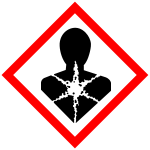
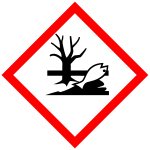
    Hazardous to the aquatic environment, long-term (Chronic) - Category Chronic 2

    GHS label elements, including precautionary statements

    Pictogram(s)
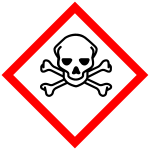
    Signal word

    Danger

    Hazard statement(s)

    H301 Toxic if swallowed

    H311 Toxic in contact with skin

    H331 Toxic if inhaled

    H351 Suspected of causing cancer

    H411 Toxic to aquatic life with long lasting effects

    Precautionary statement(s)
    Prevention

    P264 Wash ... thoroughly after handling.

    P270 Do not eat, drink or smoke when using this product.

    P280 Wear protective gloves/protective clothing/eye protection/face protection/hearing protection/...

    P261 Avoid breathing dust/fume/gas/mist/vapours/spray.

    P271 Use only outdoors or in a well-ventilated area.

    P203 Obtain, read and follow all safety instructions before use.

    P273 Avoid release to the environment.

    Response

    P301+P316 IF SWALLOWED: Get emergency medical help immediately.

    P321 Specific treatment (see ... on this label).

    P330 Rinse mouth.

    P302+P352 IF ON SKIN: Wash with plenty of water/...

    P316 Get emergency medical help immediately.

    P361+P364 Take off immediately all contaminated clothing and wash it before reuse.

    P304+P340 IF INHALED: Remove person to fresh air and keep comfortable for breathing.

    P318 IF exposed or concerned, get medical advice.

    P391 Collect spillage.

    Storage

    P405 Store locked up.

    P403+P233 Store in a well-ventilated place. Keep container tightly closed.

    Disposal

    P501 Dispose of contents/container to an appropriate treatment and disposal facility in accordance with applicable laws and regulations, and product characteristics at time of disposal.

    Other hazards which do not result in classification

    no data available

    Handling and Storage

    Precautions for safe handling

    NO open flames. NO contact with oxidizing agents. Above 62°C use a closed system and ventilation. Handling in a well ventilated place. Wear suitable protective clothing. Avoid contact with skin and eyes. Avoid formation of dust and aerosols. Use non-sparking tools. Prevent fire caused by electrostatic discharge steam.

    Conditions for safe storage, including any incompatibilities

    Separated from strong oxidants, acids, acid anhydrides, acid chlorides, hypochlorites, halogens and food and feedstuffs. Well closed. Store in an area without drain or sewer access.Keep container tightly closed in a dry and well-ventilated place. Containers which are opened must be carefully resealed and kept upright to prevent leakage.

  • Seller Information
    Business Type:

    Trader

    Main Products:

    pharmaceutical intermediates,peptides,electronic chemicals

    Location:

    Room 102, 1st Floor, East Office Building, No. 45 Pengwan Road, Qianwan Bonded Port Area, Qingdao Zone, China (Shandong) Pilot Free Trade Zone

    Payment Terms:

    100% TT in advance

    Average lead Time:

    10

    Total Annual Revenue:

    $10 million-$25 million

    Total Employees:

    51-100

    Year of Establishment:

    2024

    A reliable supplier is like insurance.

    We are mainly specilized in supply of pharmaceutical intermediates, electronic chemicals,food additives, and other fine chemical products.
    Integrity is the foundation, quality is life. We would like to work together with you to build a greener and brighter future.

    Website: orientchem.cc
    Email: scarlett@orientchem.cc
    WhatsApp: +86 17753254221

  • Inquiry History
    6 Inquiries
    Country Product Purchase Quantity Date Posted
    Peru

    DIMETHALINILINE

    1600.00 KG Sep 14, 2024
    Pakistan

    N,N-Dimethylaniline 99%

    100 KG Nov 24, 2023
    India

    N,N-Dimethylaniline

    1 MT Jan 24, 2025
    Pakistan

    Nn Dimethylaniline

    1 TON Jun 13, 2025
    India

    N,N-Dimethylaniline

    1000.00 KG Jan 26, 2025
    India

    N N Dimethyl Aniline

    100 MT May 22, 2024
    Post an enquiry for this product
pic ×

Scan the QR Code to Share

All products displayed on this website are only for non-medical purposes such as industrial applications or scientific research, and cannot be used for clinical diagnosis or treatment of humans or animals. They are not medicinal or edible.

According to relevant laws and regulations and the regulations of this website, units or individuals who purchase hazardous materials should obtain valid qualifications and qualification conditions.

The information shown above is provided by the enterprise itself, and the authenticity, accuracy and legitimacy of the content are the responsibility of the publishing company. ECHEMI does not bear any guarantee responsibility for this. Please be aware that risks in internet transactions objectively exist.

Feedback & Suggestions
Send Message

Thank you for your feedback. If you require further assistance, please contact us by email at info@echemi.com or call us at +86-532-55729510.