Product
Supplier
Encyclopedia
Inquiry
Benzyl chloroformate501-53-1 buy - large image1
Benzyl chloroformate501-53-1 buy - image1
Benzyl chloroformate501-53-1 buy - image2
Benzyl chloroformate501-53-1 buy - image3
Benzyl chloroformate501-53-1 buy - image4
Benzyl chloroformate501-53-1 buy - image5
Benzyl chloroformate501-53-1 buy - image6

Benzyl chloroformate501-53-1

Unit Price:

$33-34/MT FOB

Get Latest Price
CAS No.:

501-53-1

Grade:

Pharmaceutical Grade

Content:

99.5%

Port:

上海

Brand:

OORENT

Packaging:

Vial/Bottle/Bag/Carton

Price valid (until):

2026-07-17

Company Type:
Trader
Location:
China
Qualification:
Main Products:

pharmaceutical intermediates,peptides,electronic chemicals

  • Product Description

  • Seller Information

  • Description

    Product Detail


    Benzyl chloroformate Basic information
    Product Name: Benzyl chloroformate
    Synonyms: Benzyl Chlorofomate;Phenylmethyl chloroformate;BENZYL CHLOROFORMATE SOLUTION, 50% IN TO LUENE;BENZYL CHLOROFORMATE, TECH. 95%;Z-Cl (Cbz-Cl);Benzyl chloroformate, pract., 95%;Cbz-Cl (Carboobenzoxy Chloride);CBZ-Cl (Z-Cl)
    CAS: 501-53-1
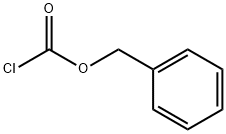
    MF: C8H7ClO2
    MW: 170.59
    EINECS: 207-925-0
    Product Categories: N-Protecting Reagents;Aromatic Esters;Amino Acid Derivatives;CHLOROFORMATES;Biochemistry;Cbz-Amino acid series;Pharmaceutical Intermediates;Benzene derivatives;Peptide Synthesis;Protection & Derivatization Reagents (for Synthesis);Protective Reagents (Peptide Synthesis);Synthetic Organic Chemistry;API Intermediate;bc0001;K00001
    Mol File: 501-53-1.mol
    Shop Benzyl chloroformate501-53-1-Detailed Image 1

    Benzyl chloroformate Chemical Properties
    Melting point  -20 °C
    Boiling point  103 °C20 mm Hg(lit.)
    density  1.212 g/mL at 20 °C
    vapor density  1 (vs air)
    vapor pressure  1.39 psi ( 20 °C)
    refractive index  n20/D 1.519(lit.)
    Fp  197 °F
    storage temp.  Store at +2°C to +8°C.
    solubility  Miscible with ether, acetone and benzene.
    form  Solution
    color  slightly yellow to slightly pink
    Odor Irritating; sharp, penetrating.
    Water Solubility  decomposes
    Sensitive  Moisture Sensitive
    Merck  14,1801
    Exposure limits ACGIH: TWA 1 ppm
    OSHA: TWA 1 ppm(5 mg/m3)
    NIOSH: IDLH 10 ppm; Ceiling 1 ppm(5 mg/m3)
    Stability: Stable. Incompatible with water, oxidizing agents. Combustible.
    InChI 1S/C8H7ClO2/c9-8(10)11-6-7-4-2-1-3-5-7/h1-5H,6H2
    InChIKey HSDAJNMJOMSNEV-UHFFFAOYSA-N
    SMILES ClC(=O)OCc1ccccc1
    CAS DataBase Reference 501-53-1(CAS DataBase Reference)
    NIST Chemistry Reference Benzyl chloroformate(501-53-1)
    EPA Substance Registry System Carbonochloridic acid, phenylmethyl ester (501-53-1)

    Safety Information
    Hazard Codes  T,C,N,F
    Risk Statements  45-20-34-48/22-50/53-67-65-63-48/20-11-43-37-23
    Safety Statements  53-26-36/37/39-45-60-61-62-46-36/37
    RIDADR  UN 1739
    WGK Germany  3
    RTECS  LQ5860000
    19
    Autoignition Temperature 590 °C
    TSCA  TSCA listed
    HS Code  2915 90 70
    HazardClass  8
    PackingGroup  I
    Storage Class 6.1C - Combustible, acute toxic Cat.3
    toxic compounds or compounds which causing chronic effects
    Hazard Classifications Aquatic Acute 1
    Aquatic Chronic 1
    Carc. 1B
    Eye Dam. 1
    Skin Corr. 1B
    STOT SE 3
    Hazardous Substances Data 501-53-1(Hazardous Substances Data)
    Toxicity LD50 orally in Rabbit: 3000 mg/kg
    MSDS Information
    Provider Language
    ACROS English
    SigmaAldrich English
    ALFA English

    Benzyl chloroformate Usage And Synthesis
    Description Benzyl chloroformate, also known as benzyl chlorocarbonate or Z-chloride, is the benzyl ester of chloroformic acid. It can be also described as the chloride of the benzyloxycarbonyl (Cbz or Z) group. In its pure form it is a water-sensitive oily colorless liquid, although impure samples usually appear yellow. It possesses a characteristic pungent odor and degrades in contact with water.
    The compound was first prepared by Leonidas Zervas in the early 1930s who used it for the introduction of the benzyloxycarbonyl protecting group, which became the basis of the Bergmann-Zervas carboxybenzyl method of peptide synthesis he developed with Max Bergmann. This was the first successful method of controlled peptide chemical synthesis and for twenty years it was the dominant procedure used worldwide until the 1950s. To this day, benzyl chloroformate is often used for amine group protection.
    Chemical Properties colorless or light yellow oily liquid with rancid odor. soluble in ether, acetone, benzene and other organic solvents. It is used to protect amino groups in peptide synthesis.
    Uses Benzyl chloroformate is widely used as a reactive chemical intermediate in plastic, pharmaceutical, agricultural and organic chemicals. It is useful for the introduction of carboxybenzyl (cbz) protecting group for amines such as aniline in organic synthesis. It is also involved in the synthesis of 1,2,4-oxadiazoles.
    Application Benzyl chloroformate is used as a reagent in peptide synthesis to protect the amine functionality as the benzyloxycarbonyl (Cbz or Z) derivative.
    Cbz-protected anilines were prepared directly from aromatic carboxylic acids, sodium azide and Cbz-Cl.
    Protecting reagent in peptide synthesis.
    Preparation Benzyl chloroformate is prepared in the lab by treating benzyl alcohol with phosgene:
    PhCH2OH + COCl2→ PhCH2OC(O)Cl + HCl
    Phosgene is used in excess to minimise the production of the carbonate (PhCH2O)2C=O.
    The use of phosgene gas in the lab preparation carries a very large health hazard, and has been implicated in the chronic pulmonary disease of pioneers in the usage of the compound such as Zervas.
    General Description Benzyl chloroformate appears as a colorless liquid with an acrid odor. Vapors irritate eyes and mucous membranes. Corrosive to metals and tissue. Long-term inhalation of low concentrations or short-term inhalation of high concentrations can result in adverse health effects.
    Air & Water Reactions Decomposes in moist air. Decomposes slowly in water to give corrosive hydrochloric acid and organic acids.
    Reactivity Profile Benzyl chloroformate decomposes slowly in water forming benzyl alcohol, HCl, and CO2. Gives off HCl fumes in moist air. Reacts with bases, both organic and inorganic. Attacks many metals especially in humid atmosphere [Handling Chemicals Safely 1980. p. 476]. Catalytic impurity incidents involving the iron catalyzed decomposition of benzoyl chloroformate have caused several explosions. The iron presumably comes from corrosion of steel storage tanks [Loss Prev. Bull., 1975, (003), 2]. May react vigorously or explosively if mixed with diisopropyl ether or other ethers in the presence of trace amounts of metal salts [J. Haz. Mat., 1981, 4, 291].
    Hazard Highly toxic, emits very toxic phosgene fumes at 100C. Irritant to eyes.
    Health Hazard Inhalation causes mucous membrane irritation. Eyes are irritated by excessive exposure to vapor. Liquid causes severe irritation of eyes and irritates skin. Ingestion causes irritation of mouth and stomach.
    Safety Profile Poison by ingestion andinhalation routes. A powerful corrosive irritant. Thermallyunstable. Will react with water or steam to produce toxic and corrosive fumes and heat. Iron salts catalyze theexplosive decomposition of the ester. When heated todecomp.
    Synthesis Benzyl chloroformate (CbzCl) was synthesized by combining the carbonylation of benzyl alcohol with carbon monoxide and sulfur (or carbonyl sulfide) in the presence of DBU, with the chlorination using sulfuryl chloride.
    https://doi.org/10.1016/S0040-4039(02)01834-8
    storage Store at temperature at or below –15°C (5°F) in a dry, well‐ventilated location. All equipment and storage vessels must be constructed of Teflon or glass‐lined steel. Keep container tightly closed. Protect from sunlight and avoid any contact with iron.Product is stable when stored properly at recommended storage temperature. Storage in recommended temperatures and conditions will ensure product quality for minimum 12 months before retesting may be needed to determine assay. Storage in conditions between –15°C (5°F) and –5°C (23°F) may require retesting after 6 months to determine assay. Storage above 0°C (32°F) not recommended.
    Purification Methods The commercial material is usually better than 95% pure and may contain some toluene, benzyl alcohol, benzyl chloride and HCl. After long storage (e.g. two years at 4o, Greenstein and Winitz [The Chemistry of the Amino Acids Vol 2 p. 890, J Wiley and Sons NY, 1961] recommended that the liquid should be flushed with a stream of dry air, filtered and stored over sodium sulfate to remove CO2 and HCl which are formed by decomposition. It may further be distilled from an oil bath at a temperature below 85o because Thiel and Dent [Annalen 301 257 1898] stated that benzyloxycarbonyl chloride decarboxylates to benzyl chloride slowly at 100o and vigorously at 155o. Redistillation at higher vacuum below 85o yields material which shows no other peaks than those of benzyloxycarbonyl chloride by NMR spectroscopy. [Beilstein 6 IV 2278.] LACHRYMATORY and TOXIC.

    Shop 3-Chloro-1-propene107-05-1-Detailed Image 2 Shop 3-Chloro-1-propene107-05-1-Detailed Image 3 Shop 3-Chloro-1-propene107-05-1-Detailed Image 4 Shop 3-Chloro-1-propene107-05-1-Detailed Image 5 Shop 3-Chloro-1-propene107-05-1-Detailed Image 6 Shop 3-Chloro-1-propene107-05-1-Detailed Image 7


    Basic Info
    Product Name:

    Benzyl chloroformate

    Other Name:

    Carbonochloridic acid,phenylmethyl ester;Formic acid,chloro-,benzyl ester;Benzyl chloroformate;(Benzyloxy)carbonyl chloride;Carbobenzoxy chloride;Carbobenzyloxy chloride;Chloroformic acid benzyl ester;Benzyl carbonochloridate;Benzyl chlorocarbonate;Phenylmethyl chloroformate;NSC 83466;Benzyl chloridocarbonate;Benzyloxyformyl chloride;94274-21-2;728010-31-9;960053-05-8

    CAS No.:

    501-53-1

    Molecular Formula:

    C8H7ClO2

    InChIKeys:

    InChIKey=HSDAJNMJOMSNEV-UHFFFAOYSA-N

    Molecular Weight:

    170.59

    Exact Mass:

    170.59

    EC Number:

    207-925-0

    UNII:

    170BP0DD31

    ICSC Number:

    0990

    NSC Number:

    83466

    UN Number:

    1739

    DSSTox ID:

    DTXSID9027158

    Color/Form:

    OILY LIQUID|COLORLESS TO PALE YELLOW LIQUID

    HScode:

    2915900090

    Characteristics
    PSA:

    26.3

    XLogP3:

    2.68

    Appearance:

    Clear slightly yellow to slightly pink Solution

    Density:

    1.2166 g/cm3 @ Temp: 20 °C

    Melting Point:

    -20 °C

    Boiling Point:

    152 °C @ Press: 760 Torr

    Flash Point:

    197 °F

    Refractive Index:

    1.531

    Water Solubility:

    Decomposes in water.Miscible with ether, acetone and benzene.

    Storage Conditions:

    2-8°C

    Vapor Pressure:

    1.39 psi ( 20 °C)

    Vapor Density:

    1 (vs air)

    Toxicity:

    Oral-Rat LD50: 3000 mg/kg; Inhalation-Rat LC50: 590 mg/m3/4 hours

    Flammability characteristics:

    Decomposes carbon dioxide and toxic chlorides and phosgene vapors when exposed to heat; emits toxic and corrosive hydrogen chloride gas when exposed to water

    Explosive limit:

    CONTAINERS MAY EXPLODE /DURING FIRE/.

    Odor:

    ACRID ODOR

    Experimental Properties:

    DECOMP TO CO2 & BENZYL CHLORIDE UPON HEATING AT 100-155 °C|DECOMP IN HOT ETHANOL & WATER|CONVERSION FACTORS: 6.96 MG/CU M= 1 PPM|Reacts with water to form hydrochloric acid|Flash point: 80.0 °C (Tag open cup), 107.9 °C (Tag closed cup)

    Air and Water Reactions:

    Decomposes in moist air. Decomposes slowly in water to give corrosive hydrochloric acid and organic acids.

    Reactive Group:

    Acyl Halides, Sulfonyl Halides, and Chloroformates

    Reactivity Alerts:

    Water-Reactive

    Reactivity Profile:

    BENZYL CHLOROFORMATE decomposes slowly in water forming benzyl alcohol, HCl, and CO2. Gives off HCl fumes in moist air. Reacts with bases, both organic and inorganic. Attacks many metals especially in humid atmosphere [Handling Chemicals Safely 1980. p. 476]. Catalytic impurity incidents involving the iron catalyzed decomposition of benzoyl chloroformate have caused several explosions. The iron presumably comes from corrosion of steel storage tanks [Loss Prev. Bull., 1975, (003), 2]. May react vigorously or explosively if mixed with diisopropyl ether or other ethers in the presence of trace amounts of metal salts [J. Haz. Mat., 1981, 4, 291].

    Heat of Combustion:

    -10.000 BTU/LB= -5,700 CALORIES/G= -240X10+5 JOULES/KG (ESTIMATED)

    Corrosivity:

    Corrosive

    Heat of Vaporization:

    90 BTU/LB= 50 CALORIES/G= 2.1X10+5 JOULES/KG (ESTIMATED)

    Hazard Identification

    Classification of the substance or mixture

    Skin corrosion, Sub-category 1B

    Hazardous to the aquatic environment, short-term (Acute) - Category Acute 1

    Hazardous to the aquatic environment, long-term (Chronic) - Category Chronic 1

    GHS label elements, including precautionary statements

    Pictogram(s)

    Signal word

    Danger

    Hazard statement(s)

    H314 Causes severe skin burns and eye damage

    H410 Very toxic to aquatic life with long lasting effects

    Precautionary statement(s)
    Prevention

    P260 Do not breathe dust/fume/gas/mist/vapours/spray.

    P264 Wash ... thoroughly after handling.

    P280 Wear protective gloves/protective clothing/eye protection/face protection/hearing protection/...

    P273 Avoid release to the environment.

    Response

    P301+P330+P331 IF SWALLOWED: Rinse mouth. Do NOT induce vomiting.

    P363 Wash contaminated clothing before reuse.

    P304+P340 IF INHALED: Remove person to fresh air and keep comfortable for breathing.

    P316 Get emergency medical help immediately.

    P321 Specific treatment (see ... on this label).

    P305+P351+P338 IF IN EYES: Rinse cautiously with water for several minutes. Remove contact lenses, if present and easy to do. Continue rinsing.

    P391 Collect spillage.

    Storage

    P405 Store locked up.

    Disposal

    P501 Dispose of contents/container to an appropriate treatment and disposal facility in accordance with applicable laws and regulations, and product characteristics at time of disposal.

    Other hazards which do not result in classification

    no data available

    Handling and Storage

    Precautions for safe handling

    NO open flames. NO contact with water. Handling in a well ventilated place. Wear suitable protective clothing. Avoid contact with skin and eyes. Avoid formation of dust and aerosols. Use non-sparking tools. Prevent fire caused by electrostatic discharge steam.

    Conditions for safe storage, including any incompatibilities

    Separated from food and feedstuffs. Dry. Well closed.

  • Seller Information
    Business Type:

    Trader

    Main Products:

    pharmaceutical intermediates,peptides,electronic chemicals

    Location:

    Room 102, 1st Floor, East Office Building, No. 45 Pengwan Road, Qianwan Bonded Port Area, Qingdao Zone, China (Shandong) Pilot Free Trade Zone

    Payment Terms:

    100% TT in advance

    Average lead Time:

    10

    Total Annual Revenue:

    $10 million-$25 million

    Total Employees:

    51-100

    Year of Establishment:

    2024

    A reliable supplier is like insurance.

    We are mainly specilized in supply of pharmaceutical intermediates, electronic chemicals,food additives, and other fine chemical products.
    Integrity is the foundation, quality is life. We would like to work together with you to build a greener and brighter future.

    Website: orientchem.cc
    Email: scarlett@orientchem.cc
    WhatsApp: +86 17753254221

  • Country Product Purchase Quantity Date Posted
    Post an enquiry for this product
pic ×

Scan the QR Code to Share

All products displayed on this website are only for non-medical purposes such as industrial applications or scientific research, and cannot be used for clinical diagnosis or treatment of humans or animals. They are not medicinal or edible.

According to relevant laws and regulations and the regulations of this website, units or individuals who purchase hazardous materials should obtain valid qualifications and qualification conditions.

The information shown above is provided by the enterprise itself, and the authenticity, accuracy and legitimacy of the content are the responsibility of the publishing company. ECHEMI does not bear any guarantee responsibility for this. Please be aware that risks in internet transactions objectively exist.

Feedback & Suggestions
Send Message

Thank you for your feedback. If you require further assistance, please contact us by email at info@echemi.com or call us at +86-532-55729510.