The anti-aging genes carried by centenarians can set back the age of the heart by 10 years!
Past demographic work has found that there are areas with high percentages of people living over 100 years old, which have been named "Blue Zones", and are currently identified as blue zones in Sardinia in Italy, Okinawa in Japan, Nicoya Peninsula in Costa Rica, Ikalia Island in Greece and Lomalinda in California.
However, the secret of the centenarian's longevity has not yet been revealed. Lifestyle, genetic inheritance, environmental factors are all possible answers, but they cannot explain them all. For example, a 2011 study published in the Journal of the American Geriatrics Society looked at nearly 500 Ashkenazi Jews aged 95 or older and found that this group of long-lived people had a large number of bad habits. 60% of them smoked heavily, half were lifelong obese or overweight, had a higher percentage of alcohol consumption, and had even worse exercise habits than controls.
Richard Farager, an authoritative expert in gerontology in the UK and professor of biological gerontology at the University of Brighton, said: "The first thing we need to tell people interested in longevity is not to ask centenarians or super centenarians for advice on life secrets." ”
The lifestyle of centenarians cannot explain longevity (Source: [1])
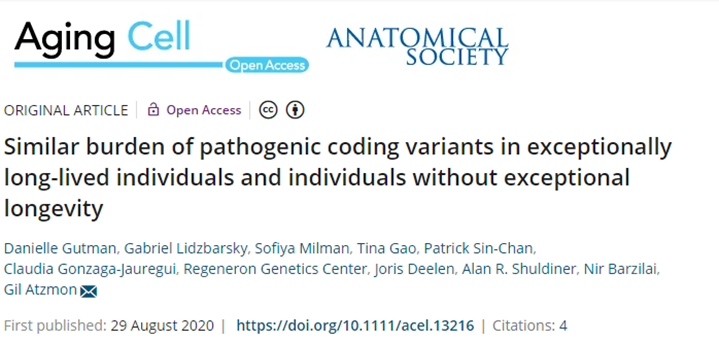
Another 2020 study of Ashkenazi Jewish centenarians showed that centenarians carry as many genetic variants that can lead to diseases in later life as the general population, and that some even carry two common Alzheimer's disease risk genes without getting the disease.
Long-lived people carry a similar burden of disease-causing gene variants as the general population (Source: [2])
Therefore, a reasonable explanation is that these long-lived people do not lack bad genetic variants, but carry beneficial "longevity genes". These genes help long-lived people reduce the risk of cardiovascular disease, Alzheimer's disease and other diseases.
In addition, studies have found that these super-long-lived people are healthier than others in their later years. Dr. Nir Barzilai, director of the Institute of Aging at the Albert Einstein College of Medicine in New York, said in his 2020 book "Age Later: Health Span, Life Span, and the New Science of Longevity" that centenarians he studied quickly die at the end of their lives, and the last five to eight years without disease, and when the disease does come, it will only last for a few weeks. Barzilai calls it a "huge longevity dividend." If the longevity factor of super-longevity can be replicated in ordinary people, it will be of great significance to "healthy aging".
Longevity-associated mutation LAV-BPIFB4 that protects cardiovascular health
Previously, researchers at the University of Salerno in Italy found through a series of studies that a longevity-related mutation called LAV-BPIFB4 is more present in centenarians in southern Italy. BPIFB4 is a secreted protein that is elevated in the serum of long-lived individuals. This mutation may improve cardiovascular health by improving NO release and angiogenesis. The results of systemic gene therapy in defective mice using LAV-BPIFB4 showed that it could save endothelial and nitric oxide synthase dysfunction in elderly mice and reduce atherosclerosis and inflammation in mice, confirming that the gene is expected to be a new therapeutic tool against cardiovascular disease.
Not only that, the research team at Salerno University also found that gene therapy with LAV-BPIFB4 can prevent disease progression in mouse models of Huntington's disease, and reduce the accumulation of immunosenescent cells and reverse the decline of NAD+ levels in the aging process in late aging mouse models with a weakened immune system. Gene therapy with LAV-BPIFB4 also significantly delayed the progression of vulnerability to stress events in older mice. All indications are that LAV-BPIFB4 is indeed an important mutation for longevity.
Recently, a new study published by a research team from the University of Bristol in the United Kingdom and MultiMedica Group in Italy proves that LAV-BPIFB4 can protect cells collected from heart failure patients who need heart transplantation. The study was published in Cardiovascular Research under the title "The longevity-associated BPIFB4 gene supports cardiac function and vascularization in aging cardiomyopathy."
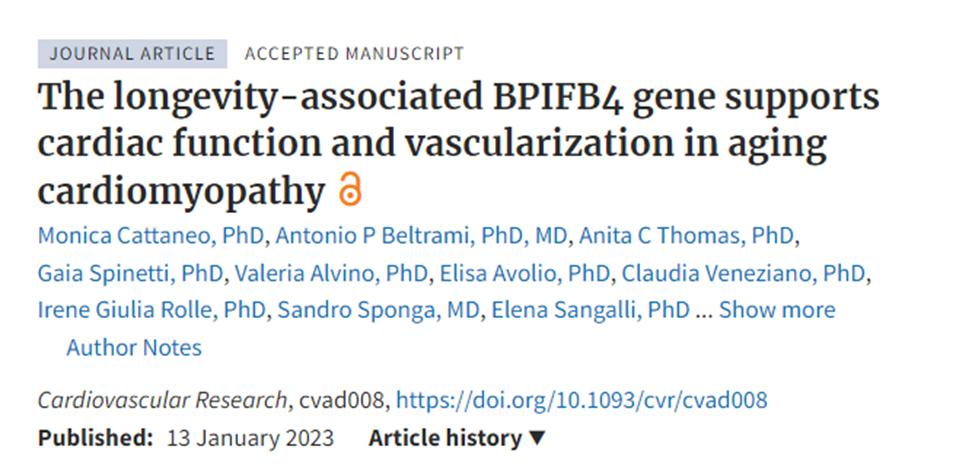
Research results (Source: [5])
The research team found that a single administration of LAV-BPIFB4 could stop the decline of heart function in middle-aged mice. More notably, when this gene was applied to older mice, its hearts showed the same changes observed in older patients, and the gene set back the heart's circadian clock by more than a decade in humans.
The three-year study is also looking at human heart cells in test tubes. Researchers at MultiMedica Group genetically administered heart cells from elderly patients with severe heart problems and then compared their function to those of healthy people.
Monica Cattaneo, lead author of the study and researcher at the MultiMedica Group, said: "Cells from older patients, especially those that support cardiovascular construction called pericytes, are impaired in function. By adding longevity genes/proteins in test tubes, we observed the process of heart rejuvenation: heart cells in elderly heart failure patients returned to normal function and could build new blood vessels more efficiently. ”
The study shows for the first time that longevity genes can not only be passed on by centenarians to their offspring, but can also be transferred to unrelated people to protect the heart. Corresponding authors of the study, Paolo Madeddu and Professor Annibale Puca, believe that the study is expected to advance therapies inspired by the genetics of centenarians.
Professor Madeddu added: "Our findings confirm that healthy mutated genes can reverse the decline in heart function in older people. We are now interested in whether proteins can be used instead of genes to do the same. At present, gene therapy is widely used to treat diseases caused by bad genes, but protein-based therapy is safer and more feasible than gene therapy. ”

You May Interested In


High Quality β-Nicotinamide adenine dinucleotide CAS 53-84-9 NADwith ready stock and best price
$3/UNIT FOB


2026-10-14
Trade Alert
Delivering the latest product trends and industry news straight to your inbox.
(We'll never share your email address with a third-party.)

Related News
-
A new Skin Anti-aging Product - Bio-Based Degradable Film is Available!
-
Removing Free Radicals in the Body Through Food Therapy and Tips
-
Brief Intriduction of the Free Radicals in Human Body
-
What inspiration can the 2021 high-potential ingredient list for beauty products bring to oral beauty foods?
-
Yemoja pushes algae active ingredients, anti-aging/oxidation
-
Activate mitochondria, how to open the door of anti-aging?
-
Yaben Chemical's Shangyu base will produce 'anti-aging drugs'
-
Naturex cranberry ingredients win awards to improve urinary tract health
-
EFSA Approves Cellulase from GM Aspergillus Niger with Low Allergy Risk
-
Canada Launches Re-Evaluation of Herbicide Iodosulfuron-Methyl-Sodium
Recommend Reading
-
![UK Proposes Sharp Increase in MRL for Flubendiamide in Tea]()
UK Proposes Sharp Increase in MRL for Flubendiamide in Tea
-
![Singapore Suspends Poultry Imports from Avian Flu-Affected Areas in Japan]()
Singapore Suspends Poultry Imports from Avian Flu-Affected Areas in Japan
-
![EFSA Finds L-Cysteine Feed Additives Safe for All Animal Species]()
EFSA Finds L-Cysteine Feed Additives Safe for All Animal Species
-
![EFSA Confirms Safety of Triacylglycerol Lipase for Expanded Food Uses]()
EFSA Confirms Safety of Triacylglycerol Lipase for Expanded Food Uses
-
![US-Iran Conflict Escalates Again as Oil Tops $90 and Petrochemical Feedstock Risks Return]()
US-Iran Conflict Escalates Again as Oil Tops $90 and Petrochemical Feedstock Risks Return
-
![Business Society’s September 1, 2026 View on Isooctanol Market Trends: Clearly Downward]()
Business Society’s September 1, 2026 View on Isooctanol Market Trends: Clearly Downward
-
![Dichloromethane Market Experiences Severe Fluctuations in China]()
Dichloromethane Market Experiences Severe Fluctuations in China
-
![Why Did Ethylene Glycol Prices Rebound Again at the End of April? Are Prices Likely to Remain Strong in May?]()
Why Did Ethylene Glycol Prices Rebound Again at the End of April? Are Prices Likely to Remain Strong in May?
-
![Business Society’s September 1, 2026 Acetic Acid Market Outlook: Clearly Upward Trend]()
Business Society’s September 1, 2026 Acetic Acid Market Outlook: Clearly Upward Trend
-
![This Week's Caustic Soda Prices Remain Stable (8.24-8.28)]()
This Week's Caustic Soda Prices Remain Stable (8.24-8.28)