Product
Supplier
Encyclopedia
Inquiry
Home > Analytical Chemistry > Standard > Fenitrothion for Sale > Fenitrothion in Methanol
Fenitrothion in Methanol buy - large image1
Fenitrothion in Methanol buy - image1

Fenitrothion in Methanol

Unit Price: Get Latest Price
CAS No.:

122-14-5

Content:

100%

Packaging:

Ampoules

Price valid (until):

2025-08-31

Company Type:
Trader
Location:
China
Qualification:
Main Products:

reference material,reference standards,Reference Standard Materials,ICP & ICP-MS Single/Mix Standards,Analytical standards,Lab reagents

  • Product Description

  • Seller Information

  • Description


      Product Detail  


    Pls input...

    Items Specifications
    Stroma Alcohol
    Form Liquid
    Storage conditions Refrigerate at 2-8°C and store in an airtight and dark condition. It should be equilibrated at room temperature (20±3℃) before use, and shaken well to ensure uniformity. Ampoules should be used immediately once opened, and cannot be used as a standard material after being melted again. Strictly prevent contamination during use.
    Applications This reference material can be used as a working standard for daily analysis and testing; for Instrument calibration, analysis method confirmation and evaluation, measurement process quality control, technical arbitration and certification evaluation, etc.
    Packing Ampoules
    Reference material Quality Control Manual for Pesticide Residue Testing.
    Physical and chemical properties The pure product is white crystal, and the original Oil is yellowish brown Oil-like liquid with slight garlic smell. Vapor pressure 0.80mPa(20 ℃); Melting point 0.3 ℃; Boiling point 140~145 ℃/13.3Pa; Solubility: insoluble in water (14mg/L), but soluble in most organic solvents. Low solubility in aliphatic hydrocarbons; Density: 1.3227; Stability: When hydrolyzed by alkali, the half-life in 0.01mol of sodium hydroxide at 30 ℃ is 272min, and distillation will cause isomerization; Hazard mark 14 (with drugs),34 (flammable liquid); Main use: It is a contact insecticide, which has special effects on rice borer, Chilo suppressalis, Chilo suppressalis, Chilo suppressalis: inhalation, ingestion, percutaneous absorption. Health hazards: The minimum oral poisoning dose is 800mg/kg. Nausea, vomiting, diarrhea and dyspnea occurred after poisoning. Acute poisoning manifestations include headache, dizziness, nausea, vomiting, abdominal pain, diarrhea, salivation, etc. Severe poisoning patients have pulmonary edema. Coma, etc. 2. toxicological data and environmental behavioral toxicity: low toxicity. Acute toxicity: LD50250mg/kg (rat oral);LD50700mg/kg (rat percutaneous); Dogs had obvious toxic reaction after oral 40 mg/kg/day × 98 days. Carp LC508.2mg/L,48 hours. Subacute and chronic toxicity: Cholinesterase activity was significantly reduced in rats at 80-160ppm × 16 weeks through the mouth. Aquatic organism tolerance limit (48 hours): 8.2ppm for carp. The toxicity to fish is moderate, non-toxic to frogs, and highly toxic to bees. Metabolism and degradation: It is characterized by its rapid migration in the soil, which is converted into non-toxic aminopyroxene due to hydrolysis or microbial action. Generally, it will no longer be found after 10 days of application. Residue and accumulation: The metabolism and degradation of carbores are fast, so the accumulation is not strong, but because it has a certain absorption like dimethoate, the residual period is medium (similar to dichlorvos). Migration and transformation: carpel has little effect on the transfer to the deep soil by leaching. Under natural conditions, the annual movement distance is 35cm. After carpel is absorbed by the gastrointestinal tract and the surface of the skin, it is metabolized in the animal body. Quickly, it is excreted with urine and feces. Therefore, carpel will not transfer with the food chain. Dangerous characteristics: flammable in case of open flame and high heat. It can react with strong oxidants. Thermal decomposition, release nitrogen, phosphorus oxides and other toxic gases. Combustion (decomposition) products: carbon monoxide, carbon dioxide, phosphorus oxide, nitrogen oxide. 3. On-site emergency monitoring methods: 4. Laboratory monitoring methods: gas chromatography (GB/T14552-93, water and soil) gas chromatography (GB/T5009.20-1996, food) gas chromatography (crops, fruits, vegetables) "Pesticide Residues Gas Chromatography" Compiled by the State Commodity Inspection Bureau 5. Environmental Standards: the maximum allowable concentration of harmful substances in China (TJ36-79) workshop air is 1mg/m3 (skin) the maximum allowable concentration in the former Soviet Union (1977) environmental air is 0.005mg/m3 (primary value) 0.001mg/m3 (daily average) the maximum allowable concentration in the former Soviet Union (1977) surface water is 0.25mg/L the maximum allowable concentration in the former Soviet Union (1977) fishery water is 0mg/L China (GB4788-94) standard 5 mg/kg (grain) 6. Emergency treatment and disposal methods: 1. leakage emergency treatment, quickly evacuate the leakage pollution area and strictly restrict access. Cut off the fire source and do not directly touch the leak. Small amount of leakage: adsorption or absorption with sand or other non-combustible materials. Large leakage: build dikes or dig pits to accommodate; cover with foam to reduce steam disasters. Transfer by pump to tank truck or special collector, recycle or transport to waste disposal site. If it is solid, collect it in a dry, clean, covered container with a clean shovel. If there is a large amount of leakage, it will be collected and recycled or transported to the waste disposal site for disposal. 2. protection measures Respiratory system protection: Wear a gas mask for production operations or agricultural use. When emergency rescue or escape, you should wear a self-contained respirator. Eye protection: safety mask can be used. Protective clothing: Wear corresponding protective clothing. Hand protection: wear protective gloves. Others: Smoking, eating and drinking are prohibited at the work site. After work, shower and change. Store clothes contaminated with poisons separately and reuse them after washing. In case of acute poisoning 3. first aid measures, the patient should be immediately removed from the scene and contaminated clothes should be removed. The contaminated parts of the whole body should be thoroughly cleaned with soapy water or alkali solution. For oral administration, 2% sodium bicarbonate or light saline should be used for gastric lavage. Eye pollution can be washed with soda water or normal saline. Fire fighting: Use sand, foam and carbon dioxide fire extinguishers to extinguish the fire. Pay attention to wearing reliable anti-virus and protective equipment to prevent personal poisoning.

    Basic Info
    Product Name:

    Fenitrothion

    Other Name:

    Phosphorothioic acid,O,O-dimethyl O-(3-methyl-4-nitrophenyl) ester;Phosphorothioic acid,O,O-dimethyl O-(4-nitro-m-tolyl) ester;OMS 43;S 112A;S 5660;8057HC;ENT 25,715;Bayer 41831;CP 47114;O,O-Dimethyl O-(3-methyl-4-nitrophenyl) phosphorothioate;O,O-Dimethyl O-4-nitro-m-tolyl phosphorothioate;Fenitrothion;Metathion;Metathione;Metathionine E 50;Nitrophos;BAY 41831;CL 47300;Folithion;Metathion E 50;Monsanto CP 47114;Sumithion;EI 47300;Accothion;Phenitrothion;Folithion EC 50;Metation E 50;Agrothion;Ovadofos;O,O-Dimethyl O-(3-methyl-4-nitrophenyl) thiophosphate;O,O-Dimethyl O-(4-nitro-3-methylphenyl)thiophosphate;O,O-Dimethyl O-(3-methyl-4-nitrophenyl) phosphorothioate;O,O-Dimethyl O-(3-methyl-4-nitrophenyl) phosphorothioate;MEP;O,O-Dimethyl O-4-nitro-m-tolyl thiophosphate;Bayer S 5660;Verthion;Agriya 1050;Oleosumifene;Metation;Agria 1050;O,O-DiMe O-(3-methyl-4-nitrophenyl) thiophosphate;Nuvanol;MEP (pesticide);Arbogal;Methylnitrophos;Dimethyl 4-nitro-m-tolyl phosphorothionate;Mglawik F;Owadofos;Fenition;Oleometathion;Methadion;Insectigas F;Sumithion 20F;Sumifene;Owadophos;Super Sumithion;Sumithion 20MC;Sumi oil;Sumithion 50EC;Tionfos 50 LE;Sumigran;Sumithion Super 1000EC;Sumithion Super;Paluthion;ShaMingSong;Smichion 10FL;Sumithion 10FL;12764-87-3;54182-70-6;94650-98-3

    CAS No.:

    122-14-5

    Molecular Formula:

    C9H12NO5PS

    InChIKeys:

    InChIKey=ZNOLGFHPUIJIMJ-UHFFFAOYSA-N

    Molecular Weight:

    277.23

    Exact Mass:

    277.23

    EC Number:

    204-524-2

    HScode:

    29201900

    Categories:

    Standard

    Characteristics
    PSA:

    115.41000

    XLogP3:

    3.24

    Appearance:

    Fenitrothion is a brownish-yellow oil. Used as a selective acaricide and a contact and stomach insecticide against chewing and sucking insects on rice, orchard fruits, vegetables, cereals, cotton and forest. Also used against flies, mosquitoes, and cockroaches. (EPA, 1998)

    Density:

    1.3227 g/cm3 @ Temp: 25 °C

    Melting Point:

    3.4 °C

    Boiling Point:

    118 °C @ Press: 0.05 Torr

    Flash Point:

    >100 °C

    Refractive Index:

    nD25 1.5528

    Water Solubility:

    0.003 g/100 mL

    Storage Conditions:

    APPROX 4°C

    Vapor Pressure:

    1.5 x 10 -2 Pa (20 °C)

    Toxicity:

    Oral-rat LD50: 250 mg/kg; Oral-Mouse LD50: 229 mg/kg

    Flammability characteristics:

    Decompose toxic phosphorus oxide, sulfur oxide, nitrogen oxide gas by heating

    Odor:

    Faint characteristic odor

    Hazard Identification

    Classification of the substance or mixture

    Acute toxicity - Category 4, Oral

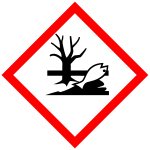
    Hazardous to the aquatic environment, short-term (Acute) - Category Acute 1

    Hazardous to the aquatic environment, long-term (Chronic) - Category Chronic 1

    GHS label elements, including precautionary statements

    Pictogram(s)

    Signal word

    Warning

    Hazard statement(s)

    H302 Harmful if swallowed

    H410 Very toxic to aquatic life with long lasting effects

    Precautionary statement(s)
    Prevention

    P264 Wash ... thoroughly after handling.

    P270 Do not eat, drink or smoke when using this product.

    P273 Avoid release to the environment.

    Response

    P301+P317 IF SWALLOWED: Get medical help.

    P330 Rinse mouth.

    P391 Collect spillage.

    Storage

    none

    Disposal

    P501 Dispose of contents/container to an appropriate treatment and disposal facility in accordance with applicable laws and regulations, and product characteristics at time of disposal.

    Other hazards which do not result in classification

    no data available

    Handling and Storage

    Precautions for safe handling

    NO open flames. Handling in a well ventilated place. Wear suitable protective clothing. Avoid contact with skin and eyes. Avoid formation of dust and aerosols. Use non-sparking tools. Prevent fire caused by electrostatic discharge steam.

    Conditions for safe storage, including any incompatibilities

    Provision to contain effluent from fire extinguishing. Separated from food and feedstuffs. Keep in a well-ventilated room./Storage temperature should be less than 40 deg C on account of the tendency/ to isomerize.

  • Seller Information
    Business Type:

    Trader

    Main Products:

    reference material,reference standards,Reference Standard Materials,ICP & ICP-MS Single/Mix Standards,Analytical standards,Lab reagents

    Location:

    Beijing

    Payment Terms:

    100% TT in advance

    Average lead Time:

    10

    Total Annual Revenue:

    $2.5 million-$5 million

    Total Employees:

    101-200

    Year of Establishment:

    2012

    Certifications:

    ISO17034

    Weiyel was introduced in 2007. It is a high-tech enterprise integrating labeling, production and sales of reference materials and microbial quality control products. It has more than 200 professional laboratory researchers.Weiyel is committed to accurate standard measurement. Our mission is to provide one-stop reference material procurement services and empower basic scientific research and testing application research.


    It has independently developed more than 30,000 kinds of reference materials, and its products cover many fields such as food, chemical products, environmental chemistry, microorganisms, geology and minerals, building materials, clinical medicine and pharmaceuticals.


    Its brand "BNCC" is a member of the World Federation for Culture Collection (WFCC). It specializes in providing a series of products such as microbial strains, experimental cells, and microbial quality control samples. It also provides customized services such as quantitative strains, competent cells, genomic DNA, and nucleic acid reference products.


    Weiyel has many branches and offices around the world including Hong Kong, the United States, and Japan. Currently, it has served 3,000+ testing institutions in more than 60 countries including the United States, Germany, Russia, India, and Indonesia, covering food testing, environmental testing, microbial testing and calibration laboratories, etc.

  • Country Product Purchase Quantity Date Posted
    Post an enquiry for this product
pic ×

Scan the QR Code to Share

All products displayed on this website are only for non-medical purposes such as industrial applications or scientific research, and cannot be used for clinical diagnosis or treatment of humans or animals. They are not medicinal or edible.

According to relevant laws and regulations and the regulations of this website, units or individuals who purchase hazardous materials should obtain valid qualifications and qualification conditions.

The information shown above is provided by the enterprise itself, and the authenticity, accuracy and legitimacy of the content are the responsibility of the publishing company. ECHEMI does not bear any guarantee responsibility for this. Please be aware that risks in internet transactions objectively exist.

Feedback & Suggestions
Send Message

Thank you for your feedback. If you require further assistance, please contact us by email at info@echemi.com or call us at +86-532-55729510.