Product
Supplier
Encyclopedia
Inquiry
Chlorotrimethylsilane75-77-4 buy - large image1
Chlorotrimethylsilane75-77-4 buy - image1
Chlorotrimethylsilane75-77-4 buy - image2
Chlorotrimethylsilane75-77-4 buy - image3
Chlorotrimethylsilane75-77-4 buy - image4
Chlorotrimethylsilane75-77-4 buy - image5
Chlorotrimethylsilane75-77-4 buy - image6

Chlorotrimethylsilane75-77-4

3 Inquiries

Unit Price:

$33-34/MT FOB

Get Latest Price
CAS No.:

75-77-4

Grade:

Industrial Grade

Content:

99.5%

Port:

上海

Brand:

OORENT

Packaging:

Vial/Bottle/Bag/Carton

Price valid (until):

2026-07-17

Company Type:
Trader
Location:
China
Qualification:
Main Products:

pharmaceutical intermediates,peptides,electronic chemicals

  • Product Description

  • Seller Information

  • Inquiry History

  • Description

    Product Detail


    Chlorotrimethylsilane Chemical Properties
    Melting point  −40 °C(lit.)
    Boiling point  57 °C(lit.)
    density  0.857 g/mL at 25 °C
    vapor density  3.7 (vs air)
    vapor pressure  100 mm Hg ( 25 °C)
    refractive index  n20/D 1.500
    Fp  104 °F
    storage temp.  Store below +30°C.
    solubility  Miscible with ether, benzene, diethylether and perchloroethylene.
    form  Liquid
    Specific Gravity 0.8536 (27℃)
    color  Clear colorless
    explosive limit 1.5-46%(V)
    Water Solubility  REACTS
    Sensitive  Moisture Sensitive
    Hydrolytic Sensitivity 8: reacts rapidly with moisture, water, protic solvents
    BRN  1209232
    Stability: Stable. Highly flammable - note low flash point. Reacts violently with water. Incompatible with water, moisture, strong oxidizing agents, strong acids, strong bases, aldehydes, alcohols, amines, esters, ketones.
    InChI 1S/C3H9ClSi/c1-5(2,3)4/h1-3H3
    InChIKey IJOOHPMOJXWVHK-UHFFFAOYSA-N
    SMILES C[Si](C)(C)Cl
    CAS DataBase Reference 75-77-4(CAS DataBase Reference)
    NIST Chemistry Reference Silane, chlorotrimethyl-(75-77-4)
    EPA Substance Registry System Trimethylchlorosilane (75-77-4)

    Safety Information
    Hazard Codes  T,F,C,Xn
    Risk Statements  20/21-36/38-34-21-14-11-37-35-19-40-10-67-20/21/22-52
    Safety Statements  26-36/37/39-45-16-36/37-7/9
    RIDADR  UN 1298
    WGK Germany  2
    RTECS  VV2710000
    10-21
    Autoignition Temperature 752 °F
    Hazard Note  Highly Flammable/Corrosive/Moisture Sensitive
    TSCA  TSCA listed
    HazardClass  3
    PackingGroup  II
    HS Code  29310095
    Storage Class 3 - Flammable liquids
    Hazard Classifications Acute Tox. 3 Inhalation
    Acute Tox. 3 Oral
    Acute Tox. 4 Dermal
    Eye Dam. 1
    Flam. Liq. 2
    Skin Corr. 1A
    Hazardous Substances Data 75-77-4(Hazardous Substances Data)
    Toxicity LD50 orally in Rabbit: 4868 mg/kg LD50 dermal Rabbit 1530 mg/kg
    MSDS Information
    Provider Language
    Chlorotrimethylsilane English
    ACROS English
    SigmaAldrich English
    ALFA English

    Chlorotrimethylsilane Usage And Synthesis
    Description Chlorotrimethylsilane is a valuable reagent for the protection of the hydroxyl function in organic synthesis. It should be distilled from calciumhydride (or tributylamine) under nitrogen before use,and stored and weighed under nitrogen. Use of the reagent without purification has been reported to lead to explosions. Chlorotrimethylsilane may contain dichlorodimethylsilane as an impurity. This may be removed before distillation by very cautious treatment with a small amount of water,which hydrolyses the dichloro compound more rapidly. Excess chlorotrimethylsilane in a reaction mixture may be destroyed by the very careful addition of aqueous sodium hydrogencarbonate solution.
    Chemical Properties Trimethylchlorosilane is a colorless fuming liquid with a pungent odor. Readily hydrolyzed with liberation of hydrogen chloride; soluble in benzene, ether and perchloroethylene. Chlorotrimethylsilane is a chloro-organosilane compound mainly used for silylation reactions.
    Uses Chlorotrimethylsilane is a typical Silane Blocking Agent, which can protect or deprotect functional groups selectively. It have been used in the preparation of volatile derivatives of a wide range of compounds for GC analysis, and used for silylation and as a protection group in the process of various organic synthesis. It is used in the production of trimethylsilyl halides, pseudohalides and various organic silicon compounds. It is also used to produce hexamethyldisilane by reduction.
    Application Trimethylsilyl chloride(TMCS) is the most extensively used derivatization reagent for gas chromatography.The reactions are generally performed under anhydrous conditions although reactions can be performed on samples obtained from water-containing samples.There are considerable opportunities for artifacts stemming from a variety of reasons including off-target reactions with aldehydes and ketones.The rate of reaction of TMCS with nucleophilic targets is comparatively slow compared to other alkylsilyl chlorides and requires the presence of a base catalyst such as pyridine.TMCS is included as a catalyst with other trialkylsilyl reagent such N,O-bis- (trimethylsilyl)trifluroacetamide (BSA) or N-methyl-N-(trimethylsilyl)trifluoroacetamide (MSTFA).The order of functional group reactivity is alcohols>phenols>carboxylic acids>amines>amides.
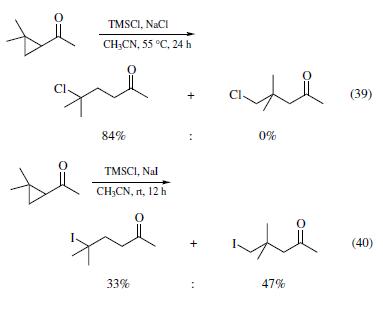
    Reactions Related to the epoxide ring opening, TMSCl also mediates some cyclopropane ring opening reactions. For example, treatment of 1-aceto-2,2-dimethylcyclopropane with TMSCl and sodium chloride in acetonitrile at 55°C for 24 h generated 5-chloro-5-methyl-2-hexanone in 84% yield (eq 39).When sodium iodide was employed to replace sodium chloride, iodotrimethylsilane generated in situ, and the reaction completed under more facile conditions (rt and 12 h). Interestingly, the dominant product is 5-iodo-4,4-dimethyl-2-pentanone (eq 40), arising from iodide attacking at the less hindered secondary methylene carbon, instead of the quaternary dimethylmethylene carbon.
    Shop Chlorotrimethylsilane75-77-4-Detailed Image 2
    Definition ChEBI: Chlorotrimethylsilane is a silyl chloride consisting of a central silicon atom covalently bound to one chloro and three methyl groups. Chlorotrimethylsilane is a derivatisation agent used in gas chromatography/mass spectrometry applications. It has a role as a chromatographic reagent.
    General Description Trimethylchlorosilane appears as a colorless fuming liquid with a pungent odor. Boiling point 135° F, Flash point -18°F. Density 0.854g/cm3. The vapor and liquid may cause burns. Vapors are heavier than air.
    Reactivity Profile Chlorotrimethylsilane reacts vigorously and exothermically with water to produce hydrogen chloride.
    Health Hazard Similar to other silanes. Toxicity is rated high for inhalation, ingestion and local irritation. May cause death or permanent injury after a very short exposure to small quantities.
    Fire Hazard Violent reaction with water. Toxic and irritating hydrogen chloride and phosgene may be formed in fires. Difficult to extinguish, re-ignition may occur. Flashback along vapor trail may occur. Containers may explode in fire. Vapor may explode if ignited in enclosed area. When heated to decomposition or on contact with acids or acid fumes, chloride fumes are emitted. Reacts with surface moisture, releasing hydrogen chloride, which will corrode common metals and form flammable hydrogen gas. Avoid contact with water; Chlorotrimethylsilane readily hydrolyzes, liberating hydrochloric acid. Hazardous polymerization may not occur.
    reaction suitability reagent type: derivatization reagent
    reaction type: Silylations
    Safety Profile Poison by ingestion and skin contact. Moderately toxic by inhalation and intraperitoneal routes. A corrosive irritant to skin, eyes, and mucous membranes. Questionable carcinogen with experimental neoplastigenic data. Mutation data reported. A flammable liquid and very dangerous fire hazard when exposed to heat or flame. Violent reaction with water or hexafluoroisopropylideneamino lithium, A preparative hazard. To fight fire, use foam, alcohol foam, fog. When heated to decomposition it emits toxic fumes of Cl-. An intermediate in the production of silicones. See also CHLOROSILASES.
    Synthesis Add 20 ml of dichloromethane, 20 ml of hexamethyldisiloxane, 12.5 g of BTC and 0.2 g of tetrabutylammonium bromide to a reaction flask with a reflux condenser, and dissolve with stirring; lower the temperature to 0~10 , add 8 ml of MDMF dropwise to the reaction flask for 20 min; warm up the temperature to 322 , and the reaction was carried out for 17 h. GC detected that the conversion rate of the hexamethyldisiloxane was >99%; convert the The reflux condenser was changed to a distillation column and distilled under reduced pressure at 30~35C to obtain ~20 ml of dichloromethane and 23.3 ml of trimethylchlorosilane; the content of trimethylchlorosilane was 99.5% by GC.
    Potential Exposure Trimethylchlorosilane is used as an intermediate to make silicone products, including lubricants
    Shipping UN1298 Trimethylchlorosilane, Hazard Class: 3; Labels: 3-Flammable liquid, 8-Corrosive material.
    Purification Methods Likely impurities are other chlorinated methylsilanes and tetrachlorosilane (b 57.6o), some of which can form azeotropes. To avoid the latter, very efficient fractional distillation is required. It has been fractionated through a 12 plate glass helices-packed column with only the heart-cut material being used. It has also been fractionated through a 90cm, 19mm diameter Stedman column (p 11). Purify it by redistilling from CaH2 before use. [Sauer et al. J Am Chem Soc 70, 4254 1948, Sauer & Hadsell J Am Chem Soc 70 4258 1948, Langer et al. J Org Chem 23 50 1958, Beilstein 4 IV 4007.] FLAMMABLE and CORROSIVE.
    Incompatibilities Incompatible with oxidizers (chlorates, nitrates, peroxides, permanganates, perchlorates, chlorine, bromine, fluorine, etc.); contact may cause fires or explosions. Keep away from alkaline materials, strong bases, strong acids, oxoacids, epoxides. Chlorosilanes react vigorously with bases and both organic and inorganic acids generating toxic and/or flammable gases. Chlorosilanes react with water, moist air, or steam to produce heat and toxic, corrosive fumes of hydrogen chloride. They may also produce flammable gaseous hydrogen. Attacks metals in the presence of moisture. Vigorous reaction with aluminum powder.
    Toxics Screening Level The ITSL for TRIMETHYLCHLOROSILANE has been set at 6. 3 μg/m3 based on annual average time.
    Waste Disposal Do not discharge into drains or sewers. Use a licensed disposal contractor to an approved landfill. Must be disposed properly by following package label directions or by contacting your local or federal environmental control agency, or by contacting your regional EPA office for guidance on acceptable disposal practices. The most favorable course of action is to use an alternative chemical product with less inherent propensity for occupational exposure or environmental contamination. Recycle any unused portion of the material for its approved use or return it to the manufacturer or supplier. Ultimate disposal of the chemical must consider: the material’s impact on air quality; potential migration in soil or water; effects on animal, aquatic, and plant life; and conformance with environmental and public health regulations.

    Chlorotrimethylsilane Preparation Products And Raw materials
    Raw materials Acetyl chloride-->Copper(I) chloride-->Chloromethane-->Silicon-->Chloromethyl silane-->Tetramethylsilane
    Preparation Products (2R)-2-[(4-Ethyl-2,3-dioxopiperazinyl)carbonylamino]-2-phenylacetic acid-->5-Fluoro-2-picolinic acid-->(Trifluoromethyl)trimethylsilane-->Hexamethyldisilazane-->Thiophene-2-ethylamine-->Rhodanine-3-acetic acid-->Pyridine sulfur trioxide-->6-IODO-PYRIDINE-2-CARBOXYLIC ACID-->Cefoperazone-->1-METHOXY-3-TRIMETHYLSILOXY-1,3-BUTADIENE-->Trimethylsilylacetylene-->(2R)-2-[(4-Ethyl-2,3-dioxopiperazinyl)carbonylamino]-2-(4-hydroxyphenyl)acetic acid-->4-AMINO-2,6-DIFLUORO-BENZALDEHYDE-->Hexamethyldisiloxane-->2,4-DIMETHOXYPHENETHYLAMINE-->5-BROMO-3-FLUORO-2-PYRIDINONE-->5-BROMO-3-CHLORO-2-PYRIDINONE-->Aniracetam-->TRIS(TRIMETHYLSILYL)SILANE-->Thiazole-4-carboxaldehyde-->6-CYANONICOTINIC ACID-->ROKITAMYCIN-->2-(TRIMETHYLSILYL)PHENYL TRIFLUOROMETHANESULFONATE-->7-Aminocephalosporanic acid-->Bis(trimethylsilyl)acetylene-->2,4-DIMETHYLQUINOLINE-3-CARBOXYLIC ACID-->Azidotrimethylsilane-->4'-Iodoacetophenone-->Ethoxytrimethylsilane-->2-ETHYL-4-METHYLQUINOLINE-3-CARBOXYLIC ACID-->BIS(TRIMETHYLSILYL)PEROXIDE-->ETHYL 2,4-DIMETHYLQUINOLINE-3-CARBOXYLATE-->ETHYL 2-(CHLOROMETHYL)-4-PHENYLQUINOLINE-3-CARBOXYLATE-->ETHYL 2-(CHLOROMETHYL)-4-PHENYLQUINOLINE-3-CARBOXYLATE HYDROCHLORIDE-->Tegafur-->1-(2,4-DIMETHYLQUINOLIN-3-YL)ETHANONE HYDROCHLORIDE-->ETHYL 2-(CHLOROMETHYL)-4-METHYLQUINOLINE-3-CARBOXYLATE HYDROCHLORIDE-->METHYL 2-(CHLOROMETHYL)-4-METHYLQUINOLINE-3-CARBOXYLATE HYDROCHLORIDE-->N,O-Bis(trimethylsilyl)acetamide-->Allyltrimethylsilane

    Shop 3-Chloro-1-propene107-05-1-Detailed Image 2 Shop 3-Chloro-1-propene107-05-1-Detailed Image 3 Shop 3-Chloro-1-propene107-05-1-Detailed Image 4 Shop 3-Chloro-1-propene107-05-1-Detailed Image 5 Shop 3-Chloro-1-propene107-05-1-Detailed Image 6 Shop 3-Chloro-1-propene107-05-1-Detailed Image 7


    Basic Info
    Product Name:

    Chlorotrimethylsilane

    Other Name:

    Silane,chlorotrimethyl-;Chlorotrimethylsilane;Trimethylchlorosilane;Trimethylsilyl chloride;Trimethylsilicon chloride;Monochlorotrimethylsilicon;Trimethylsilane chloride;TSL 8031;Monochlorotrimethylsilane;KA 31;KA 31 (silane);NSC 15750;TMCS;LS 260;TMSCl;127290-36-2;36642-33-8

    CAS No.:

    75-77-4

    Molecular Formula:

    C3H9ClSi

    InChIKeys:

    InChIKey=IJOOHPMOJXWVHK-UHFFFAOYSA-N

    Molecular Weight:

    108.64200

    Exact Mass:

    108.64

    EC Number:

    200-900-5

    UNII:

    62UO4690X6

    ICSC Number:

    0966

    NSC Number:

    15750

    UN Number:

    1298

    DSSTox ID:

    DTXSID2024822

    Color/Form:

    Colorless liquid

    HScode:

    29310095

    Categories:

    Analysis Reagents

    Characteristics
    PSA:

    0

    XLogP3:

    2.06010

    Appearance:

    Trimethylchlorosilane appears as a colorless fuming liquid with a pungent odor. Boiling point 135° F, Flash point -18°F. Density 0.854 g / cm3. The vapor and liquid may cause burns. Vapors are heavier than air.

    Density:

    0.854 g/cm3 @ Temp: 25 °C

    Melting Point:

    -57.7 °C

    Boiling Point:

    57 °C

    Flash Point:

    -18ºC

    Refractive Index:

    1.387-1.389

    Water Solubility:

    Solubility in water: reaction

    Storage Conditions:

    Store at RT.

    Vapor Pressure:

    100 mm Hg ( 25 °C)

    Vapor Density:

    3.7 (vs air)

    Toxicity:

    LD50 orally in Rabbit: 4868 mg/kg LD50 dermal Rabbit 1530 mg/kg

    Flammability characteristics:

    LOWER 1.8%

    Explosive limit:

    vol% in air: 1.8

    Odor:

    SHARP, HYDROCHLORIC ACID-LIKE ODOR; ACRID.

    Experimental Properties:

    Ratio of specific heats of vapor (gas): 1.0683. (est)|Readily hydrolyzed with liberation of hydrochloric acid|Organo-functional silanes are noted for their ability to bond organic polymer systems to inorganic substrates /Silane cmpd/|The reaction of organosilanes with halogens and halogen cmpd usually proceeds in good yield through cleavage of the Si--H bond and formation of the silicon-halogen bond. Reaction with fluorine, however, does not proceed satisfactorily because of cleavage of not only the Si--H but also C--Si and C--H bonds. Direct halogenation with chlorination, bromine, and iodine proceeds smoothly, however. /Organosilanes/|Hydroxyl radical reaction rate constant = 4.49X10⁻¹³ cu cm/molec sec at 25 °C (est)

    Air and Water Reactions:

    Highly flammable. Fumes in air. Reacts vigorously and exothermically with water. Products of the reaction include hydrogen chloride. The heat may be sufficient to ignite nearby combustible materials. Trimethylchlorosilane reacts vigorously with water to generate gaseous HCl. Based on a scenario where the chemical is spilled into an excess of water (at least 5 fold excess of water), half of the maximum theoretical yield of Hydrogen Chloride gas will be created in 1.3 minutes. Experimental details are in the following: "Development of the Table of Initial Isolation and Protective Distances for the 2008 Emergency Response Guidebook", ANL/DIS-09-2, D.F. Brown, H.M. Hartmann, W.A. Freeman, and W.D. Haney, Argonne National Laboratory, Argonne, Illinois, June 2009.

    Reactive Group:

    Chlorosilanes

    Reactivity Alerts:

    Highly Flammable

    Reactivity Profile:

    TRIMETHYLCHLOROSILANE reacts vigorously and exothermically with water to produce hydrogen chloride.

    Autoignition Temperature:

    743 °F (USCG, 1999)|743 °F (395 °C)|395 °C

    Heat of Combustion:

    -10,300 BTU/LB (EST)

    Flammable Limits:

    Lower flammable limit: 1.8% by volume; Upper flammable limit: 6.0% by volume|LOWER 1.8%

    Physical Dangers:

    The vapour is heavier than air and may travel along the ground; distant ignition possible.

    Heat of Vaporization:

    126 BTU/LB

    Hazard Identification

    Classification of the substance or mixture

    Flammable liquids, Category 2

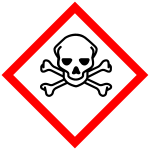
    Acute toxicity - Category 3, Oral

    Acute toxicity - Category 4, Dermal

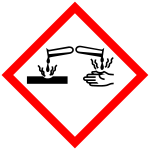
    Skin corrosion, Sub-category 1A

    Acute toxicity - Category 3, Inhalation

    GHS label elements, including precautionary statements

    Pictogram(s)
    Signal word

    Danger

    Hazard statement(s)

    H225 Highly flammable liquid and vapour

    H301 Toxic if swallowed

    H312 Harmful in contact with skin

    H314 Causes severe skin burns and eye damage

    H331 Toxic if inhaled

    Precautionary statement(s)
    Prevention

    P210 Keep away from heat, hot surfaces, sparks, open flames and other ignition sources. No smoking.

    P233 Keep container tightly closed.

    P240 Ground and bond container and receiving equipment.

    P241 Use explosion-proof [electrical/ventilating/lighting/...] equipment.

    P242 Use non-sparking tools.

    P243 Take action to prevent static discharges.

    P280 Wear protective gloves/protective clothing/eye protection/face protection/hearing protection/...

    P264 Wash ... thoroughly after handling.

    P270 Do not eat, drink or smoke when using this product.

    P260 Do not breathe dust/fume/gas/mist/vapours/spray.

    P261 Avoid breathing dust/fume/gas/mist/vapours/spray.

    P271 Use only outdoors or in a well-ventilated area.

    Response

    P303+P361+P353 IF ON SKIN (or hair): Take off immediately all contaminated clothing. Rinse affected areas with water [or shower].

    P370+P378 In case of fire: Use ... to extinguish.

    P301+P316 IF SWALLOWED: Get emergency medical help immediately.

    P321 Specific treatment (see ... on this label).

    P330 Rinse mouth.

    P302+P352 IF ON SKIN: Wash with plenty of water/...

    P317 Get medical help.

    P362+P364 Take off contaminated clothing and wash it before reuse.

    P301+P330+P331 IF SWALLOWED: Rinse mouth. Do NOT induce vomiting.

    P363 Wash contaminated clothing before reuse.

    P304+P340 IF INHALED: Remove person to fresh air and keep comfortable for breathing.

    P316 Get emergency medical help immediately.

    P305+P351+P338 IF IN EYES: Rinse cautiously with water for several minutes. Remove contact lenses, if present and easy to do. Continue rinsing.

    Storage

    P403+P235 Store in a well-ventilated place. Keep cool.

    P405 Store locked up.

    P403+P233 Store in a well-ventilated place. Keep container tightly closed.

    Disposal

    P501 Dispose of contents/container to an appropriate treatment and disposal facility in accordance with applicable laws and regulations, and product characteristics at time of disposal.

    Other hazards which do not result in classification

    no data available

    Handling and Storage

    Precautions for safe handling

    NO open flames, NO sparks and NO smoking. NO contact with hot surfaces. Closed system, ventilation, explosion-proof electrical equipment and lighting. Do NOT use compressed air for filling, discharging, or handling. Handling in a well ventilated place. Wear suitable protective clothing. Avoid contact with skin and eyes. Avoid formation of dust and aerosols. Use non-sparking tools. Prevent fire caused by electrostatic discharge steam.

    Conditions for safe storage, including any incompatibilities

    Fireproof. Separated from food and feedstuffs and other compounds. Cool. Dry. Well closed.Storage temperature; ambient.

  • Seller Information
    Business Type:

    Trader

    Main Products:

    pharmaceutical intermediates,peptides,electronic chemicals

    Location:

    Room 102, 1st Floor, East Office Building, No. 45 Pengwan Road, Qianwan Bonded Port Area, Qingdao Zone, China (Shandong) Pilot Free Trade Zone

    Payment Terms:

    100% TT in advance

    Average lead Time:

    10

    Total Annual Revenue:

    $10 million-$25 million

    Total Employees:

    51-100

    Year of Establishment:

    2024

    A reliable supplier is like insurance.

    We are mainly specilized in supply of pharmaceutical intermediates, electronic chemicals,food additives, and other fine chemical products.
    Integrity is the foundation, quality is life. We would like to work together with you to build a greener and brighter future.

    Website: orientchem.cc
    Email: scarlett@orientchem.cc
    WhatsApp: +86 17753254221

  • Inquiry History
    3 Inquiries
    Country Product Purchase Quantity Date Posted
    South Korea

    TMCS Trimethylchlorosilane

    1 MT Jan 14, 2026
    India

    Chlorotrimethylsilane 99% powder or vials/Liquid or oily/Crystal or Ointment Chlorotrimethylsilane

    1 MT Jun 30, 2023
    Romania

    Trimethylchlorosilane

    680 KG Sep 30, 2025
    Post an enquiry for this product
pic ×

Scan the QR Code to Share

All products displayed on this website are only for non-medical purposes such as industrial applications or scientific research, and cannot be used for clinical diagnosis or treatment of humans or animals. They are not medicinal or edible.

According to relevant laws and regulations and the regulations of this website, units or individuals who purchase hazardous materials should obtain valid qualifications and qualification conditions.

The information shown above is provided by the enterprise itself, and the authenticity, accuracy and legitimacy of the content are the responsibility of the publishing company. ECHEMI does not bear any guarantee responsibility for this. Please be aware that risks in internet transactions objectively exist.

Feedback & Suggestions
Send Message

Thank you for your feedback. If you require further assistance, please contact us by email at info@echemi.com or call us at +86-532-55729510.