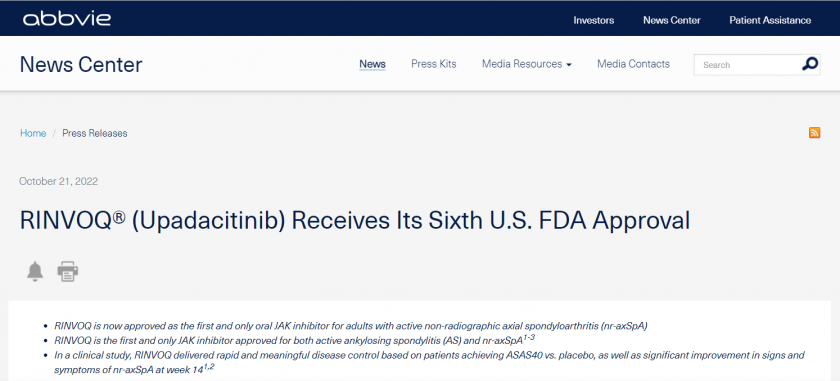
The world's first Upadatinib extended-release tablets approved by FDA for non-radiological axial spondyloarthritis
On October 21, AbbVie announced that the FDA has approved upadatinib extended-release tablets (RINVOQ, 15 mg, once daily) for the treatment of adults with active nonradiographic axial spondyloarthritis (nr-axSpA), these patients had objective signs of inflammation and had an inadequate response to tumor necrosis factor (TNF) blockers. Upatinib is the first and only JAK inhibitor approved for the treatment of nr-axSpA patients, and the first JAK inhibitor approved for both nr-axSpA and ankylosing spondylitis.
Axial spondyloarthritis (axSpA) is a chronic, progressive, and disabling inflammatory disease that affects the spine, causing back pain, limited mobility, and structural damage after attacks. axSpA is mainly divided into radiological axial spondyloarthritis (r-axSpA) and non-radiological axial spondyloarthritis (nr-axSpA), of which r-axSpA is also known as ankylosing spondylitis (AS). About 5% of nr-axSpA patients progressed to AS after 5 years, and 19% developed AS after 10 years.
Upatinib is a JAK1 inhibitor independently developed by AbbVie and was first approved for marketing in August 2019 for moderate to severe rheumatoid arthritis. Since then, upatinib has become the first JAK1 inhibitor approved for marketing.
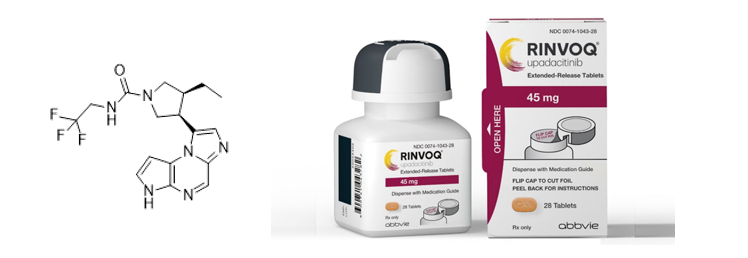
As of today, the global approved indications for Upatinib extended-release tablets include: (1) moderately to severe active rheumatoid arthritis; (2) active psoriatic arthritis; (3) moderate to severe atopic (4) active ankylosing spondylitis; (5) moderate to severe ulcerative colitis; (6) active non-radiological axial spondyloarthritis.
In addition, AbbVie submitted a marketing application for upatinib extended-release tablets to the FDA and EMA in July this year for the treatment of Crohn's disease, and its phase III trials in giant cell arteritis and Takayasu arteritis are ongoing middle.
The FDA approval is based on positive results from the Phase III SELECT-AXIS 2 study. The study is a multicenter, randomized, double-blind, placebo-controlled Phase III clinical trial involving a total of 314 patients to evaluate the efficacy, safety and tolerability of upatinib in patients with nr-axSpA.
The data showed that at week 14 of treatment, a significantly higher proportion of patients in the upatinib group achieved an International Spondyloarthritis Society 40 Response (ASAS40, a measure of a patient's physical activity) than in the placebo group (45% vs 23%; p<0.0001), and ASAS40 was observed within 2 weeks. In addition, the trial met multiple secondary endpoints: significant improvements in back pain, signs of inflammation, physical function, and disease activity. At week 14, adverse event rates were similar in the upatinib and placebo groups (48% vs 46%).

You May Interested In


Glow70/KLOW80 99% China Peptides Warehouse Direct Delivery Lyophilized Powder in Stock
$169/UNIT FOB


2026-10-14
Trade Alert
Delivering the latest product trends and industry news straight to your inbox.
(We'll never share your email address with a third-party.)

Related News
-
Syngenta is launching the herbicide Axial (Pinoxaden) in Brazil to control ryegrass and oat grass
-
Upadatinib's launch accelerated: Crohn's disease has simultaneously submitted marketing applications in FDA&EMA
-
AbbVie's blockbuster product for atopic dermatitis, Upadacitinib, has been approved for marketing in the EU and Japan
-
AbbVie's blockbuster product for atopic dermatitis, Upadacitinib, has been approved for marketing in the EU and Japan
-
India Proposes New GMP Rules for Clinical Trial and API Manufacturing
-
FDA Color Policy Uncertainty Opens a New Chapter for Food Ingredient Reform
-
2026 Q1 Chemical Giant Earnings: Supply Contraction, Flat Demand, Full-Scale "Defense Priority"
-
South Korea’s Largest Petrochemical Hub Moves to Cut Cracker Capacity by 40%
-
UK’s £350 Million Critical Chemicals Fund Enters Formal Review, Offering Up to 50% Support Per Project
-
FDA Tracks Industry Dye Removal
Recommend Reading
-
![India Prepares New Seed and Pesticide Laws]()
India Prepares New Seed and Pesticide Laws
-
![Syngenta Caught in Trade Crossfire]()
Syngenta Caught in Trade Crossfire
-
![FDA Lifts Administrative Stay, Restoring Red No. 3 Ban Timeline for Food and Ingested Drugs]()
FDA Lifts Administrative Stay, Restoring Red No. 3 Ban Timeline for Food and Ingested Drugs
-
![G20 Pushes Fertilizer Access as Food-Security Risk Rises]()
G20 Pushes Fertilizer Access as Food-Security Risk Rises
-
![U.S. Section 232 Pharmaceutical Tariffs Take Effect, With 100% Base Rate on Patented Drugs and APIs]()
U.S. Section 232 Pharmaceutical Tariffs Take Effect, With 100% Base Rate on Patented Drugs and APIs
-
![Cost-side Support Boosts Polyester Staple Fiber Prices, Stopping the Decline and Rebounding]()
Cost-side Support Boosts Polyester Staple Fiber Prices, Stopping the Decline and Rebounding
-
![Double Positive Factors for Costs and Supply—PTA Prices Show Volatile but Strong Tendencies]()
Double Positive Factors for Costs and Supply—PTA Prices Show Volatile but Strong Tendencies
-
![Aluminum Sulfate: Industrial and Water Treatment Applications]()
Aluminum Sulfate: Industrial and Water Treatment Applications
-
![China's Natural Rubber Prices Show a Slight Decline]()
China's Natural Rubber Prices Show a Slight Decline
-
![Zoledronic Acid: Uses, Mechanism, and Side Effects]()
Zoledronic Acid: Uses, Mechanism, and Side Effects