RSV vaccine $10 billion market Battle: Divided by 2023
RSV (respiratory syncytial virus) vaccine market battle, imminent.
Last week, Pfizer and GlaxoSmithKline won approval from the FDA's Vaccines and Related Biologics Products Advisory Committee, which recommended the two vaccines for adults in their 60s and older.
After six decades of failure, RSV vaccines are finally reaching zero. Not surprisingly, we could see the first RSV vaccine in just over two months.
All are based on Phase 3 clinical data released in 2022 by Pfizer and GlaxoSmithKline, as well as Moderna.
Hope is accompanied by challenge. Although no head-to-head trials were conducted for these three vaccines, the protection rates of Pfizer, Moderna, and GlaxoSmithKline vaccines were 66.7%, 83.7%, and 94.1%, respectively, when the efficacy against two or more RsV-related lower respiratory tract symptoms (RVS-LRTD2) was used as a unified clinical endpoint.
Based on the above data, the mRNA technology, which was extraordinary in COVID-19, failed to increase the effectiveness of Moderna's RSV vaccine this time. Pfizer and GlaxoSmithKline's two recombinant protein vaccines, although the same technical route, the protective effect is very different.
Along the same lines in the same field, Big Pharma has struck different sparks. So what are the core factors that affect the effectiveness of RSV vaccines? What experience will this bring to the later comers?
2023 is destined to go down in the history of RSV vaccine development. The dividing line is 2023.
01
Antigens that determine life and death
Antigen selection is an important factor in determining the effectiveness of a vaccine.
If the right antigens are selected, the body can develop humoral and/or cellular immunity, rendering the pathogen incapacitated and successfully defending against the virus. On the other hand, if an inappropriate antigen is selected, there is a reasonable chance that an immune response will occur, but this immunity is likely to be ineffective against the pathogen.
In the past, researchers have gone a long way toward selecting antigens for RSV vaccines.
Of the eight structural proteins in RSV, the F protein is the preferred antigen for RSV vaccine development, but the relatively stable F protein is not as easy to pull off as expected.
As the study progressed, scientists discovered that the F protein had two faces. Before infection, F protein is in a metastable pre-fusion (pre-F) structure, and after infection, F protein unpredictably switches to another stable post-fusion (post-F) structure.
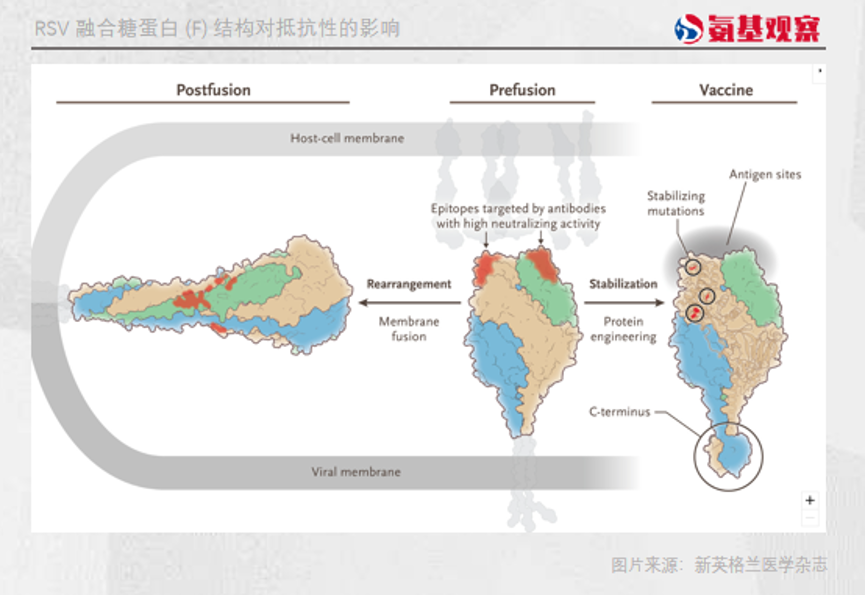
Since the post-F protein is more stable, the first generation of RSV vaccines basically chose the post-F protein as the antigen. For example, Novavax, a pioneer in the field of RSV vaccines, developed one of the earliest ResVax vaccines, using the post-F protein as its antigen.
Regrettably, in clinical trials, ResVax prevented RSV-associated lower respiratory tract infections in people over 60 years of age by -7.9%. That means ResVax not only doesn't prevent RSV, it can aggravate it.
Novavax hasn't given up, but its luck hasn't. In another clinical trial in pregnant women, ResVax prevented lower respiratory infection rates by 39.4 percent and hospitalization rates by 44 percent, both below the 50 percent threshold.
This isn't just about ResVax, either.
In five Phase III trials of RSV vaccines using post-F as an antigen, none increased neutralizing activity more than five-fold, according to a study in the top issue of the New England Journal of Medicine. Ultimately, the researchers found that the post-F conformation of the protein was less antigenic, not enough to trigger a strong enough protective effect.
Fortunately, as biotechnology continues to evolve, researchers are beginning to grasp strategies for stabilizing pre-F proteins. pre-F protein was selected as antigen in the above three successful RSV vaccines.
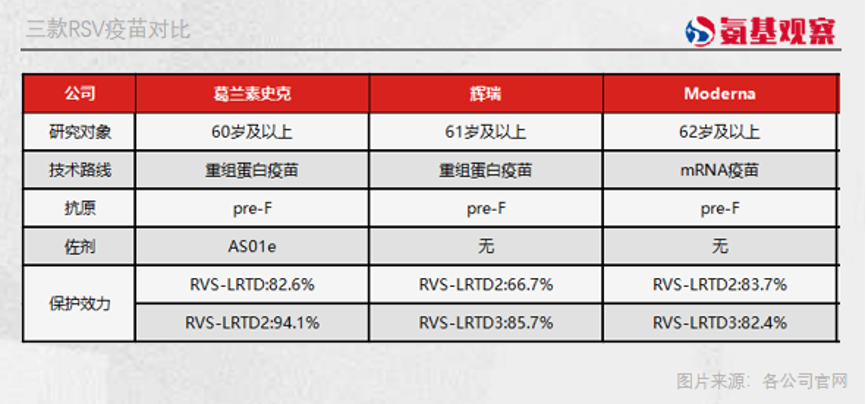
V vaccine antigen, which is derived from pre-F protein of RSV A and RSV B virus subtypes, is the only product using bivalent antigen among the three vaccines. Both GSK and Moderna's RSV vaccine response principles are based on DS-Cav1. DS-Cav1 is a pre-F antigen jointly designed by Chinese and American scientists in 2013.
The design of RSV vaccine based on DS-Cav1 gives people hope. However, the stability of DS-Cav1 does not seem to be as positive as expected during the stability evaluation of the recombinant protein. Therefore, pharmaceutical companies have to seek other pre-F structural design to solve the problem.
Glaxosmithkline's vaccine, based on the sequence of DS-Cav1, stabilizes the conformation or oligomerization of the protein by introducing cysteine residues in its pre-fusion conformation to form disulfide bonds. On the basis of DS-Cav1, Moderna added two site mutations, which added additional disulfide bonds between the monomers of DS-Cav1 trimer, making the trimer structure more stable.
It was the change in antigen from the post-F protein to the pre-F protein that saved the RSV vaccine from the abyss of failure.
02
The crucial adjuvant
Although both Pfizer's and GlaxoSmithKline's RSV vaccines chose pre-F protein as the antigen, they were both recombinant protein vaccines, and there was still a large gap in their effectiveness. Why is that?
The problem may be the adjuvant. For recombinant protein vaccines, it is not only the antigen but also the adjuvant that affects the effectiveness of the vaccine. Antigens determine the specificity and targeting of the induced immune response, and adjuvants determine the strength of the response.
Adding adjuvants to a vaccine formulation can enhance the effectiveness of the vaccine and reduce the antigen concentration and the number of immunizations required for protective effect.
In the case of GlaxoSmithKline's RSV vaccine, in clinical trials, GlaxoSmithKline evaluated the impact of adjuvant adjuvant AS01e and ASO1b on the safety and efficacy of RSV vaccine.
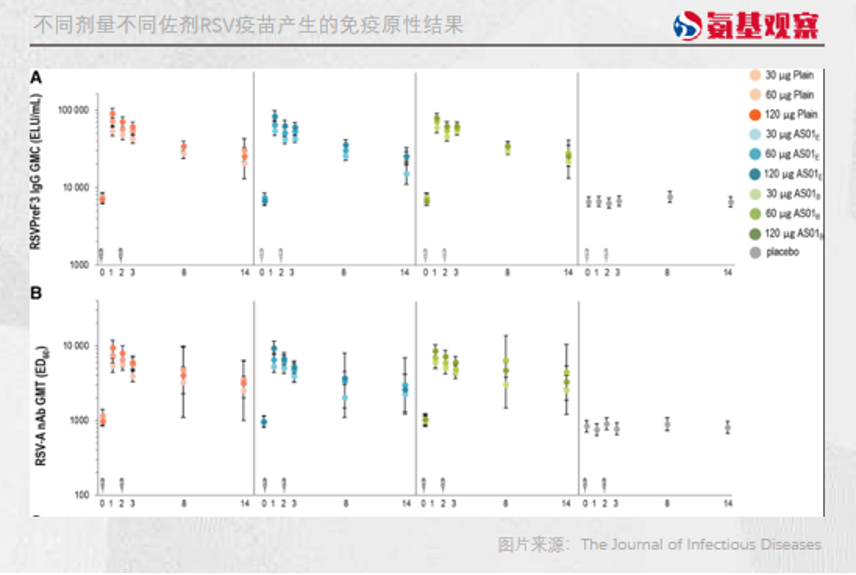
Results showed that the presence of any adjuvant significantly increased humoral and cellular immunity compared with no adjuvant. The immunogenicity of RSV vaccine with AS01b adjuvant was higher than that with AS01e. However, GlaxoSmithKline chose AS01e for its RSV vaccine because of the lower incidence of adverse reactions.
Consider Pfizer's RSV vaccine, which has also been tested in two clinical trials. Aluminum adjuvant Al(OH) 3 and CpG/Al(OH) 3 were added to RSV vaccine, respectively. However, neither adjuvant resulted in a stronger effect on RSV vaccine. Based on this result, Pfizer chose not to use adjuvants for its RSV vaccine.
Adjuvants are important for recombinant protein vaccines, as mentioned earlier, so why did they work so differently in the GSK and Pfizer trials? The reason for this gap may lie in their choice of adjuvants.
As we all know, the antigenic response of vaccines can be divided into Th1 and Th2. The Th1 response mainly leads to cell-mediated immune response, and the Th2 response is humoral immunity that induces neutralizing antibody response.
Traditional aluminum adjuvants usually induce only Th2 response, but this type of immune response alone does not provide high protective efficiency for vaccines.
Glaxosmithkline's AS01 adjuvant induces a powerful and specific helper CD4 + T cell response, as well as a rapid and sustained humoral and cellular response when bound to the protein, which naturally results in a better protective effect. This has been shown in its recombinant shingles vaccine, Shingrix. The 97.2 percent high protection rate allows the Shingrix to directly replace the Zostavax from Merck.
So why didn't Pfizer choose a better adjuvant? Perhaps because Pfizer intended to expand its RSV vaccine to pregnant women, it had to choose aluminum adjuvants with better safety.
RSV vaccines once again show the importance of novel adjuvants for recombinant protein vaccines.
03
A race for speed and effectiveness
It has not been easy to get this far with RSV vaccines.
Reviewing the history of RSV vaccine development, it can be said that it is a history of repeated battles and failures. It has taken more than 60 years to develop such a vaccine, and Pfizer, Novavax and GlaxoSmithKline have all stumbled in the field.
Novavax, in particular, was on the verge of bankruptcy due to a series of failed RSV vaccines. Fortunately, the RSV vaccine is now one step away from the market, after a flurry of research by pharmaceutical companies.
And the three RSV vaccines that hit the line at about the same time are bound to have a brutal head-to-head matchup. Who can have better safety, effectiveness, who has greater imagination space.
Overseas the big Three are fighting hand to hand, but at home it is a different story. At present, there are very few players of RSV vaccine in China. The fastest is BARS13, which is in the phase II clinical stage.
This also means that there is still a lot of imagination for a domestic RSV vaccine. After all, unlike overseas players who walk in the dark, overseas drug companies have pointed out the direction of RSV vaccine research and development for domestic drug companies.
The characteristics required for an effective RSV vaccine include a powerful adjuvant and a stable pre-F protein antigen.
They say that failure is the mother of success, and just as the novel coronavirus vaccine was developed so quickly, the RSV vaccine is also partly responsible. As for coronavirus, to some extent, the accumulation of failed RSV vaccine development also provides a lot of reference experience for the research and development of novel coronavirus vaccine.
For domestic vaccine companies, instead of breaking heads in the popular vaccine field, it is difficult to get a share of the pie, and it is also a good choice to build up strength in the difficult vaccine field of RSV.
Once in, of course, it will be another race for speed and effectiveness.

The chip maker went after the body parts
You May Interested In


High Quality β-Nicotinamide adenine dinucleotide CAS 53-84-9 NADwith ready stock and best price
$3/UNIT FOB


2026-10-18
Trade Alert
Delivering the latest product trends and industry news straight to your inbox.
(We'll never share your email address with a third-party.)

Related News
-
Global Bunker Fuel Deficit Widens, Raising the Risk of a Second Cost Shock for Chemical Shipping
-
When the Skin of Ships Gets More Expensive: A 30% Price Shock Is Quietly Rewriting the Cost Floor of Global Shipping
-
From Coffee Waste to Superfood Additive: EU Declares Pectin-Rich Arabica Extract Safe for Food Use
-
Australia Approves Lab-Grown “Milk Sugar” for Babies—A Breakthrough in Infant Nutrition
-
Guangxi Huayi Starts 300,000-Tonne VAM Unit: EVA Chain Keeps Expanding
-
Middle East Polyolefins Hit by Catalyst Constraints: PE/PP Recovery May Be Slower
-
The Last 10% Tariff Trap: A New Chapter in U.S.–China Negotiations on “Fentanyl Tariffs”
-
GM Crop Area Hits 216 Million Hectares: Trait-Driven Farming Expands
-
Snack Tests Put Red 40, Titanium Dioxide and BHT Back Under Pressure
-
SK Chemicals Partners with China’s Kelinle to Build Its Own Waste-Plastic Supply Network
Recommend Reading
-
![When SWIFT Goes On-Chain: A New 24/7 Order for Cross-Border Payments]()
When SWIFT Goes On-Chain: A New 24/7 Order for Cross-Border Payments
-
![China, U.S. and Australia Escalate Antidumping Scrutiny: Chemical Exports Face Rising Compliance Pressure]()
China, U.S. and Australia Escalate Antidumping Scrutiny: Chemical Exports Face Rising Compliance Pressure
-
![Canada Scraps PV Module Tariffs! Market Reopens, Demand for Supporting Chinese Chemical New Materials Set to Take Off]()
Canada Scraps PV Module Tariffs! Market Reopens, Demand for Supporting Chinese Chemical New Materials Set to Take Off
-
![German Chemical Sentiment Hits a Three-Year Low: Supply Disruption Amplifies Pressure on European Manufacturing]()
German Chemical Sentiment Hits a Three-Year Low: Supply Disruption Amplifies Pressure on European Manufacturing
-
![Sumitomo Reclaims Dunlop’s Throne in Southeast Asia—Full Brand Rights Snapped Up Across Malaysia, Singapore, and Brunei]()
Sumitomo Reclaims Dunlop’s Throne in Southeast Asia—Full Brand Rights Snapped Up Across Malaysia, Singapore, and Brunei
-
![Cost Benefits Support PTA Prices to Remain on an Upward Trend]()
Cost Benefits Support PTA Prices to Remain on an Upward Trend
-
![Business Society’s Diesel Market Outlook on September 9, 2026: Tending to Stronger Performance]()
Business Society’s Diesel Market Outlook on September 9, 2026: Tending to Stronger Performance
-
![Business Society’s PTA Market Outlook on August 19, 2026: Clearly Upward Trend]()
Business Society’s PTA Market Outlook on August 19, 2026: Clearly Upward Trend
-
![Business Society’s Ethanol Market Outlook on September 9, 2026: Tending to Be Bullish]()
Business Society’s Ethanol Market Outlook on September 9, 2026: Tending to Be Bullish
-
![Business Society’s Palm Oil Market Outlook on August 19, 2026: Clearly Upward Trend]()
Business Society’s Palm Oil Market Outlook on August 19, 2026: Clearly Upward Trend