What is the Balanced Equation for Citric Acid and Sodium Hydroxide?
This article talks about the citric acid and NaOH balanced equation, its significance, and related concepts. Let’s start learning.
To explore the reaction and citric Acid and NaOH balanced equation, and related theories, let’s first revisit the basics of both participants in this reaction along with some definitions.
Citric Acid (C6H8O7):
It is one of the most common organic acids and exists in two forms, monohydrate (with water) or anhydrous (without water). With the chemical formulae of C6H8O7 (three carboxylic acid functional groups) and is a triprotic acid which means that it gives away three protons (H⁺ ions) when in reaction state.
It has a monoclinic crystalline molecular structure and appears as a white crystalline solid. It odorless and sour taste and is readily found in citrus fruits. In industries, it is produced from a fermentation process that involves using microorganisms (such as Aspergillus Niger) to carry out the fermentation. It is a weak acid and creates H⁺ ions when in water with a pH value of 2.2 to 3.5 (10% solution).
Sodium Hydroxide (NaOH):
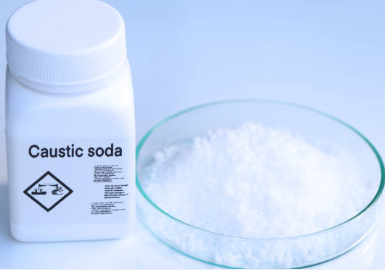
Also known as lye and caustic soda, NaOH or Sodium Hydroxide is a solid ionic inorganic compound that is known as a strong base and an alkali. In its simple molecular structure are only the sodium Na+ and hydroxide OH− and enlists itself as one of the simplest hydroxides. This base finds itself as a very important and commonly used compound and is crucial to many processes carried out in laboratory and commercial settings.
Sodium Hydroxide falls in the category of strong bases meaning it has a great tendency to donate hydroxide ions (OH⁻) in aqueous solutions. This base is typically produced from a quite well-known industrial synthesis process called the chloralkali process. Which involves electrolysis of sodium chloride (NaCl) to produce NaOH.
The reaction of NaOH and Citric Acid:
First off, this reaction is a classic example of a neutralization reaction in which an acid and base react to form salts plus water. In a neutralization reaction, a strong base reacts with a weak acid (and vice versa) to give away its salt along with water. In the neutralization of citric acid, sodium hydroxide or NaOH reacts with C6H8O7 to form sodium citrate Na3C6H5O7 along with water. The citric acid and NaOH balanced equation is stated as follows:
C6H8O7 + 3NaOH → 3H2O + Na3C6H5O7
Note that the reaction involves three molecules of NaOH to combine with one mole of citric acid. This reaction involves a series of proton donations from citric acid to a hydroxide ion from the three sodium hydroxide molecules. Since citric acid is a tricrotic acid, it can donate three protons, during the first donation, the protons are shifted from this acid to form water and the sodium salt of the citrate ion. Following this, the second and third protons are also given away in a similar way forming more water and sodium citrate. In the Citric Acid and NaOH Balanced Equation, we can see that three molecules of water are formed which can be explained by this series of proton donations from acetic acid.
Application of Citric Acid and NaOH Reaction:
Both are heavily used in the industry for various objectives in which pH adjustments and their use as buffering agents are more common. Both are used to adjust pH (in a certain range) in food and common beverages so that they are not spoiled by bacterial and other microbial activity. Many pharmaceutical formulations use both these agents along with the sodium citrate salt because of their buffering role in chemical production processes. Moreover, their pH adjustment application is also very helpful in water purification and filtration processes, cosmetic productions, and many more industrial sectors.
Conclusion:
From the citric acid and NaOH balanced equation stated and discussed in this article, we can conclude that three moles of sodium hydroxide are involved in this neutralization reaction which neutralizes a single mole of citric acid to give away a sodium salt and three moles of water in as the resultant chemicals. The reaction and the products coming from it find a long range of applications in the current industry.
Looking for chemical products? Let suppliers reach out to you!
You May Interested In


Glow70/KLOW80 99% China Peptides Warehouse Direct Delivery Lyophilized Powder in Stock
$169/UNIT FOB


2026-10-24
Trade Alert
Delivering the latest product trends and industry news straight to your inbox.
(We'll never share your email address with a third-party.)

Related News
-
Uses and Properties of Copper Acetate
-
A New Weapon Against Spider Mites: Canada Moves to Approve Novel Miticide for Greenhouse Growers
-
Understanding PCl5: Compound Name and Uses
-
Isoascorbic Acid: Uses and Safety
-
Barium Sulfide: Properties, Uses, and Safety
-
What is Amylum Starch? (Old Terminology & Modern Equivalent)
-
What is Element Stibium? (Antimony Facts & Uses)
-
Gellan Gum (E418): Vegan Thickener vs. Xanthan Gum in Food
-
Sodium Hydroxide Reactions: With Aluminum, Acids, and Metals
-
Paraffin Wax vs. Beeswax: Candles, Cosmetics, and Industrial Applications
Recommend Reading
-
![Lanolin: Benefits for Skin, Cosmetic Uses, and Allergy Risks]()
Lanolin: Benefits for Skin, Cosmetic Uses, and Allergy Risks
-
![Sodium Hydroxide (Caustic Soda): Soap Making, Cleaning, and pH Control Guide]()
Sodium Hydroxide (Caustic Soda): Soap Making, Cleaning, and pH Control Guide
-
![Potassium Hydroxide (KOH): Soap Making, Batteries, and Safety]()
Potassium Hydroxide (KOH): Soap Making, Batteries, and Safety
-
![Sulfuric Acid Reactions: With Sugar (Dehydration), Water, and Metals]()
Sulfuric Acid Reactions: With Sugar (Dehydration), Water, and Metals
-
![What is Serine? (Amino Acid Function & Sources)]()
What is Serine? (Amino Acid Function & Sources)
-
![Inventory Accumulation Expectations Remain, PTA Prices Continue to Fluctuate and Weaken]()
Inventory Accumulation Expectations Remain, PTA Prices Continue to Fluctuate and Weaken
-
![Understanding the Arsenate Symbol and Its Uses]()
Understanding the Arsenate Symbol and Its Uses
-
![Acetic Acid Market Prices Continue to Rise]()
Acetic Acid Market Prices Continue to Rise
-
![After Hitting Bottom in 2025, Melamine Strongly Rebounds in China; Can 2026 See a Demand-Driven Turnaround?]()
After Hitting Bottom in 2025, Melamine Strongly Rebounds in China; Can 2026 See a Demand-Driven Turnaround?
-
![This Week's Acetic Acid Market Shows Weakness and Decline (2.1-2.6)]()
This Week's Acetic Acid Market Shows Weakness and Decline (2.1-2.6)