March Ethylene Oxide Prices Soar to a Four-Year High in China
March 31st, News
In March 2026, the price of ethylene oxide surged to a new high in nearly four years in China.
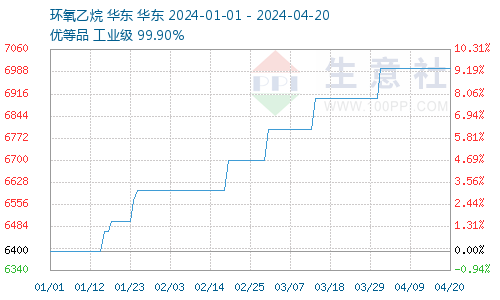
In 2026, the price of ethylene oxide rose significantly in March. According to the data, as of March 31, the average market price of ethylene oxide in China was 8,800 CNY/ton, a 60% increase from the beginning of the month when the average market price was 5,500 CNY/ton.
On March 31, 2026, the Chinese ethylene oxide (EO) market saw a significant increase, with prices rising across all regions, marking an accelerated trend for the entire month of March. According to the data from that day, the EO market in East China was quoted at 8,800 CNY/ton, an increase of 300 CNY/ton from the previous day; North China's listed price also reached 8,800 CNY/ton, with a price increase of 400 CNY/ton; South China's quotes ranged from 8,700-8,800 CNY/ton, with an increase of 300-400 CNY/ton; Central China had the highest listed price at 8,950 CNY/ton, with a price increase of 300 CNY/ton. The significant price increases in all regions pushed the EO price to its highest level in nearly four years. This sharp rise in prices was not accidental but rather the result of multiple factors converging and resonating, including cost, supply, demand, and market sentiment, with the soaring cost of upstream raw materials being the core driving force.
The rigid surge in costs is the fundamental reason for the significant increase in ethylene oxide prices, primarily due to the continuous rise in the prices of upstream ethylene and ethane. Recently, the escalation of geopolitical conflicts in the Middle East and the uncertainty surrounding the situation in Iran have led to disruptions in shipping through the Strait of Hormuz, which is a critical "throat" for the transportation of Middle Eastern crude oil to the global market. This directly triggered severe fluctuations in international crude oil prices, with Brent crude reaching as high as $108 per barrel, and Chinese crude oil futures prices also rising in tandem. The sharp rise in crude oil prices has directly impacted the downstream chemical raw material sector. As a core raw material for ethylene oxide production, ethylene prices have experienced an explosive increase, with the Northeast Asian ethylene spot price rising from about $800 per ton in early March to $1050 per ton on March 31, and the Chinese ethylene spot price exceeding 7700 CNY per ton. Since more than 60% of the production cost of ethylene oxide comes from ethylene, the rigid increase in raw material prices has directly led to a substantial increase in production costs for enterprises, with growing pressure on losses. At the point of March 31, enterprises collectively expressed their intention to raise prices, creating a situation where costs forced price hikes. Meanwhile, most ethylene oxide plants in China rely on imported ethane. Due to the impact of the geopolitical conflict, maritime freight and tariffs have increased significantly, with the cost of importing a single ton of ethane increasing by about 2000 yuan. Many small and medium-sized producers have been forced to reduce production due to cost inversion, further exacerbating the market's tight situation.
The continued tightening on the supply side has provided significant support for rising prices. Plant maintenance and low-load operations have led to a severe shortage of spot market resources. In March, China entered the regular maintenance season for ethylene oxide units, during which multiple units at several companies—including Satellites Chemical and Gulei Petrochemical—were successively shut down for maintenance. Although Gulei Petrochemical completed its maintenance ahead of schedule and is now ready to resume production, it will still be unable to alleviate the market supply gap in the short term. Moreover, due to shortages and high prices of ethylene feedstock, several ethylene oxide units have experienced unplanned shutdowns or operated at reduced loads. At the same time, China’s cracking units have also scaled back their operations, further contracting ethylene supply and directly limiting the output capacity of ethylene oxide, thereby sharply reducing market circulation volume. As of March 31, spot inventory levels in China’s ethylene oxide market were already at low levels. Some plants adopted strategies such as limiting order intake and temporarily suspending sales, artificially exacerbating market panic over the difficulty of securing supplies and laying the groundwork for price increases. It is worth noting that although China’s total ethylene oxide production capacity has exceeded 10 million tons, most of the newly added capacity is tied to the downstream production needs of the companies themselves, leaving limited volumes available for external release. Faced with sudden surges in demand, the supply side finds it difficult to respond quickly, further intensifying the tight supply situation.
The panic-driven restocking triggered by the peak season on the demand side has become a powerful driver behind rising prices. March marks the final stage of the "Golden March" for infrastructure projects, during which China's real estate and infrastructure initiatives have accelerated their resumption of work, directly fueling a concentrated surge in demand for polycarboxylate superplasticizers (polyether monomers). As polycarboxylate superplasticizers represent a key downstream application of ethylene oxide, they provide solid, rigid demand support. Meanwhile, the rapid development of the new energy industry has emerged as a new growth engine for ethylene oxide demand. The lithium-ion battery electrolyte solvent sector—particularly EC/DMC—continues to expand, steadily increasing the demand for ethylene oxide and further enhancing the overall resilience of market demand. Even more crucially, inventories throughout the upstream supply chain had been at historically low levels. Anticipating continued price hikes in mid-to-late March, downstream enterprises engaged in panic buying and rushed to replenish their stocks, creating a positive feedback loop of “price increase → frantic buying → further price hikes.” This cycle reached its peak on March 31, directly propelling prices to a sharp spike.
The leading players in the market, with their dominant control over supply and driven by heightened market sentiment, have further amplified the impact of this price hike. Industry leaders such as Sinopec, PetroChina, and Aoke Shares hold significant pricing power in the market. Under the combined pressure of rising costs and tight supply-demand dynamics, these companies collectively raised the listed prices of ethylene oxide sharply on March 31. The cumulative increase for March alone exceeded 2,600 CNY per ton. Meanwhile, some leading enterprises have taken measures such as temporarily suspending external quotations and giving priority to supplying existing customers, thereby intensifying the already tense market supply situation. In addition, market panic triggered by geopolitical conflicts has been compounded by speculative capital activities, continuously fueling investors’ expectations of further ethylene oxide price increases. This has, in turn, magnified the price hike effect, driving prices to accelerate their upward trajectory on March 31.
In summary, the sharp rise in ethylene oxide prices on March 31 marked a concentrated acceleration of the industry’s overall trend for the entire month of March. The fundamental driver behind this surge is the rigid increase in costs resulting from the soaring prices of upstream ethylene and ethane. Coupled with supply-side factors—such as plant maintenance and low operating rates leading to a shortage of spot supplies—and robust demand driven by the peak construction season and an explosive growth in new energy demand, plus the price-control efforts of leading companies and the boost from market panic, all these factors have jointly propelled ethylene oxide prices to a new high in nearly four years. In the short term, influenced by persistently high raw material prices and tight supply conditions, ethylene oxide prices are likely to remain volatile at elevated levels. Looking ahead in the long term, if geopolitical tensions in the Middle East ease, ethylene prices decline, or newly added production capacity gradually comes online, prices may gradually retreat. However, the continued strong demand from downstream sectors will still provide some support for prices.

You May Interested In


Glow70/KLOW80 99% China Peptides Warehouse Direct Delivery Lyophilized Powder in Stock
$169/UNIT FOB


2026-10-19
Trade Alert
Delivering the latest product trends and industry news straight to your inbox.
(We'll never share your email address with a third-party.)

Related News
-
Cost Pushes Combined with Moving Average Golden Cross: Acrylic Acid Market Strongly Holds Prices and Rises
-
September Maleic Anhydride Prices in China Continue to Rise
-
Cost-Driven Dichloromethane Prices Continue to Rise
-
Market Positives Concentrate, Acetic Acid Prices Rise Over 35% in a Month
-
Strong Demand Drives Up Activated Carbon Prices
-
Strong Cost Support Drives Acrylonitrile Market to Rebound After a Drop
-
Costs Rise, Aggregate MDI Market Stabilizes First, Then Rises
-
Focusing on Cost Reduction! Rubber Industry Chain Prices Overall Upward in Early September
-
In August, the BDO market in China fluctuated and rose
-
Import Supply Tight, Ethylene Glycol Spot Price Hits a 4-Year High in China
Recommend Reading
-
![High Supply Remains Firm, Weakness in ABS Market Persists at End of October in China]()
High Supply Remains Firm, Weakness in ABS Market Persists at End of October in China
-
![Cost Side Rebounds, Polyester Staple Fiber Prices Rise Slightly]()
Cost Side Rebounds, Polyester Staple Fiber Prices Rise Slightly
-
![October China Urea Market First Depressed Then Improved]()
October China Urea Market First Depressed Then Improved
-
![Weak demand leads to a fluctuating decline in phthalic anhydride prices this week in China]()
Weak demand leads to a fluctuating decline in phthalic anhydride prices this week in China
-
![Weak Demand Weighs on Butadiene Market]()
Weak Demand Weighs on Butadiene Market
-
![Tert Butylate: Properties and Applications]()
Tert Butylate: Properties and Applications
-
![China’s 15th Five-Year Plan Sets New Priorities for Pharmaceutical Innovation and Supply Chains]()
China’s 15th Five-Year Plan Sets New Priorities for Pharmaceutical Innovation and Supply Chains
-
![Premium Global Chemical Sourcing Requests (24-27Sep.,2026)]()
Premium Global Chemical Sourcing Requests (24-27Sep.,2026)
-
![Premium Global Chemical Sourcing Requests (26 - 29 Mar, 2026)]()
Premium Global Chemical Sourcing Requests (26 - 29 Mar, 2026)
-
![Potassium Hydroxide (KOH): Soap Making, Batteries, and Safety]()
Potassium Hydroxide (KOH): Soap Making, Batteries, and Safety