




Product
Supplier
Encyclopedia
Inquiry
Home > Industrial Coatings > Paint Solvent > Diacetone alcohol for Sale > Diacetone Alcohol123-42-2
Diacetone Alcohol123-42-2 buy - large image1
Diacetone Alcohol123-42-2 buy - image1
Diacetone Alcohol123-42-2 buy - image2
Diacetone Alcohol123-42-2 buy - image3
Diacetone Alcohol123-42-2 buy - image4
Diacetone Alcohol123-42-2 buy - image5
Diacetone Alcohol123-42-2 buy - image6

Diacetone Alcohol123-42-2

4 Inquiries

Unit Price:

$33-34/MT FOB

Get Latest Price
CAS No.:

123-42-2

Grade:

Industrial Grade

Content:

99.5%

Port:

上海

Brand:

OORENT

Packaging:

Vial/Bottle/Bag/Carton

Price valid (until):

2026-07-17

Company Type:
Trader
Location:
China
Qualification:
Main Products:

pharmaceutical intermediates,peptides,electronic chemicals

  • Product Description

  • Seller Information

  • Inquiry History

  • Description

    Product Detail

    Diacetone Alcohol Basic information
    Application
    Product Name: Diacetone Alcohol
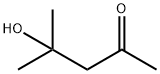
    Synonyms: (CH3)2C(OH)CH2C(O)CH3;2-Hydroxy-2-methyl-4-pentanone;2-Methyl-3-pentanol-4-one;2-Methylpentan-2-ol-4-one;2-Pentanone, 4-hydroxy-4-methyl-;TIMTEC-BB SBB009084;Diacetone Alcohol 〔4-Hydroxy-4-methyl-2-pentanone〕;Diaectone alcohol
    CAS: 123-42-2
    MF: C6H12O2
    MW: 116.16
    EINECS: 204-626-7
    Product Categories: Building Blocks;C3 to C6;Carbonyl Compounds;Chemical Synthesis;Ketones;Organic Building Blocks;Industrial/Fine Chemicals;Organic solvents
    Mol File: 123-42-2.mol
    Shop Diacetone Alcohol123-42-2-Detailed Image 1

    Diacetone Alcohol Chemical Properties
    Melting point  -42.8 °C
    Boiling point  166 °C(lit.)
    density  0.938 g/mL at 20 °C
    vapor density  4 (vs air)
    vapor pressure  <1 mm Hg ( 20 °C)
    refractive index  n20/D 1.423(lit.)
    Fp  132 °F
    storage temp.  Store below +30°C.
    solubility  Soluble in alcohol, ether (Weast, 1986), and many other solvents, particular ketones such as acetone and 2-butanone.
    pka 14.57±0.29(Predicted)
    form  Liquid
    color  Clear colorless
    Odor Mild, pleasant.
    explosive limit 1.8-6.9%(V)
    Water Solubility  MISCIBLE
    λmax 249nm(lit.)
    Merck  14,2964
    Concentration 0.1 mCi/ml
    BRN  1740440
    Solvent Ethanol
    Specific Activity 25-50 mCi/mmol
    Henry's Law Constant 3.8×101 mol/(m3Pa) at 25℃, Duchowicz et al. (2020)
    Exposure limits ACGIH:TLV-TWA 10 ppm
    OSHA:PEL-TWA 50 ppm (240 mg/m3)
    NIOSH:REL-TWA 50 ppm
    Dielectric constant 18.2(Ambient)
    Stability: Stable. Flammable. Incompatible with strong oxidizing agents, amines, ammonia, strong acids, strong bases, alkalies, aluminium.
    Cosmetics Ingredients Functions PERFUMING
    SOLVENT
    FRAGRANCE
    Cosmetic Ingredient Review (CIR) Diacetone Alcohol (123-42-2)
    InChI 1S/C6H12O2/c1-5(7)4-6(2,3)8/h8H,4H2,1-3H3
    InChIKey SWXVUIWOUIDPGS-UHFFFAOYSA-N
    SMILES CC(=O)CC(C)(C)O
    LogP -0.09 at 20℃
    Surface tension 29.44 mN/m at 303.15K
    CAS DataBase Reference 123-42-2(CAS DataBase Reference)
    NIST Chemistry Reference 4-Hydroxy-4-methylpentan-2-one(123-42-2)
    EPA Substance Registry System 4-Hydroxy-4-methyl-2-pentanone (123-42-2)

    Safety Information
    Hazard Codes  Xi
    Risk Statements  36-R36
    Safety Statements  24/25-S24/25
    RIDADR  UN 1148 3/PG II/III (DIACETONE ALCOHOL)
    OEB A
    OEL TWA: 50 ppm (240 mg/m3)
    WGK Germany  1
    RTECS  SA9100000
    9
    Autoignition Temperature 640 °C
    TSCA  TSCA listed
    HS Code  2914 40 10
    HazardClass  3
    PackingGroup  III
    Storage Class 3 - Flammable liquids
    Hazard Classifications Eye Irrit. 2
    Flam. Liq. 3
    Repr. 2
    STOT SE 3
    Hazardous Substances Data 123-42-2(Hazardous Substances Data)
    Toxicity LD50 orally in rats: 4.0 g/kg (Smyth)
    IDLH 1,800 ppm [10% LEL]
    MSDS Information
    Provider Language
    4-Hydroxy-4-methyl-2-pentanone English
    SigmaAldrich English
    ACROS English
    ALFA English

    Diacetone Alcohol Usage And Synthesis
    Application Diacetone alcohol is available in two grades: a commercial grade containing 15% acetone and an acetone-free grade. Both solvent grades of diacetone alcohol may acquire a yellow color on aging; both are good solvents for nitrocellulose, cellulose esters, and several other types of resins. The much slower evaporating diacetone alcohol is similar to acetone in its solvency. It is used in brushing-type cellulose ester lacquers to produce hard and brilliant gloss films. Diacetone alcohol is also used as lacquer thinner and in coating compositions for paper and textiles. Mesityl oxide, the unsaturated medium boiling point ketone that is prepared by the dehydration of diacetone alcohol, will darken and form a solid residue on aging.
    Description Diacetone alcohol is a colorless liquid with amild, minty odor. Odor threshold = 0.28 ppm. Molecularweight = 116.16; Specific gravity (H2O:1) = 0.94; Boilingpoint = 168℃; Freezing/Melting point = - 43.8℃; Vaporpressure = 1 mmHg at 20℃; Flash point = 64℃; 58℃(acetone free); 64℃ (commercial grade). Explosive limits:LEL = 1.8%; UEL = 6.9%. Hazard Identification (based onNFPA-704 M Rating System): Health 1, Flammability 2,Reactivity 0. Soluble in water.
    Chemical Properties colourless liquid
    Chemical Properties Diacetone alcohol is a colorless liquid. Mild, mint odor.
    Physical properties Clear, watery, flammable liquid with a mild, pleasant, characteristic odor similar to 2-butanone or the pentanones. Experimentally determined detection and recognition odor threshold concentrations were 1.3 mg/m3 (270 ppbv) and 5.2 mg/m3 (1.1 ppmv), respectively (Hellman and Small, 1974).
    Uses Solvent for cellulose acetate, nitrocellulose, celluloid, fats, oils, waxes, resins. As a preservative in pharmaceutical preparations. In some antifreeze solutions and in hydraulic fluids.
    Uses 4-Hydroxy-4-methyl-2-pentanone is used asa solvent for nitrocellulose, cellulose acetate,resins, fats, oils, and waxes; and in hydraulicfluids and antifreeze solutions..
    Uses Solvent for pigments, cellulose, resins, oils, fats, and hydrocarbons; hydraulic brake fluid; antifreeze
    Production Methods 4-Hydroxy-4-methyl-2-pentanone is manufactured through the action of barium hydroxide, potassium hydroxide, or calcium hydroxide on acetone. Commercial materials may contain up to 15%acetone.
    Definition ChEBI: A beta-hydroxy ketone formed by hydroxylation of 4-methylpentan-2-one at the 4-position. It has been isolated from Achnatherum robustum.
    Synthesis Reference(s) Organic Syntheses, Coll. Vol. 1, p. 199, 1941
    Tetrahedron Letters, 16, p. 4027, 1975 DOI: 10.1016/S0040-4039(00)91227-9
    General Description A clear colorless liquid with a pleasant odor. Flash point below 141°F. Less dense than water. Vapors heavier than air.
    Air & Water Reactions Highly flammable. Soluble in water.
    Reactivity Profile Acetyl bromide reacts violently with alcohols or water, [Merck 11th ed., 1989]. Mixtures of alcohols with concentrated sulfuric acid and strong hydrogen peroxide can cause explosions. Example: An explosion will occur if dimethylbenzylcarbinol is added to 90% hydrogen peroxide then acidified with concentrated sulfuric acid. Mixtures of ethyl alcohol with concentrated hydrogen peroxide form powerful explosives. Mixtures of hydrogen peroxide and 1-phenyl-2-methyl propyl alcohol tend to explode if acidified with 70% sulfuric acid, [Chem. Eng. News 45(43):73(1967); J, Org. Chem. 28:1893(1963)]. Alkyl hypochlorites are violently explosive. They are readily obtained by reacting hypochlorous acid and alcohols either in aqueous solution or mixed aqueous-carbon tetrachloride solutions. Chlorine plus alcohols would similarly yield alkyl hypochlorites. They decompose in the cold and explode on exposure to sunlight or heat. Tertiary hypochlorites are less unstable than secondary or primary hypochlorites, [NFPA 491 M, 1991]. Base-catalysed reactions of isocyanates with alcohols should be carried out in inert solvents. Such reactions in the absence of solvents often occur with explosive violence, [Wischmeyer(1969)].
    Health Hazard Vapor is irritating to the mucous membrane of the eye and respiratory tract. Inhalation can cause dizziness, nausea, some anesthesia. Very high concentrations have a narcotic effect. The liquid is not highly irritating to the skin but can cause dermatitis.
    Health Hazard 4-Hydroxy-4-methyl-2-pentanone is a mildirritant and a strong narcotic. It can causeirritation in the eyes, nose, throat, and skin.The effect on humans, however, is mild at100 ppm concentration.
    Animal experiments indicated that it couldproduce sleep after a period of restlessnessand excitement. The symptoms of its toxicity are a marked decrease in breathing andblood pressure, and relaxation of the muscles. Ingestion of this compound in highdoses can damage corneal tissue and liver.The oral toxicity in rats was very low, witha LD50 value of 4000 mg/kg..
    Fire Hazard HIGHLY FLAMMABLE: Will be easily ignited by heat, sparks or flames. Vapors may form explosive mixtures with air. Vapors may travel to source of ignition and flash back. Most vapors are heavier than air. They will spread along ground and collect in low or confined areas (sewers, basements, tanks). Vapor explosion hazard indoors, outdoors or in sewers. Runoff to sewer may create fire or explosion hazard. Containers may explode when heated. Many liquids are lighter than water.
    Chemical Reactivity Reactivity with Water : No reaction; Reactivity with Common Materials: No reaction; Stability During Transport: Stable; Neutralizing Agents for Acids and Caustics: Not pertinent; Polymerization: Not pertinent; Inhibitor of Polymerization: Not pertinent.
    Safety Profile Moderately toxic by ingestion and intraperitoneal routes. Mddly toxic by skin contact. Human systemic effects by inhalation: headache, nausea or vomiting, eye and pulmonary changes. A skin, mucous membrane, and severe eye irritant. Can cause anemia and damage to liver and hdneys. Narcotic in high concentration. Flammable liquid when exposed to heat or flame; can react with oxidzing materials. Explosive in the form of vapor when exposed to heat or flame. To fight fire, use alcohol foam, foam, CO2, dry chemical. When heated to decomposition it emits acrid smoke and irritating fumes. See also KETONES.
    Potential Exposure It is used as a solvent for pigments, cellulose esters; oils and fats. It is used in hydraulic brake fluids and in antifreeze formulations.
    First aid If this chemical gets into the eyes, remove anycontact lenses at once and irrigate immediately for at least15 min, occasionally lifting upper and lower lids. Seek medical attention immediately. If this chemical contacts theskin, remove contaminated clothing and wash immediatelywith soap and water. Seek medical attention immediately. Ifthis chemical has been inhaled, remove from exposure,begin rescue breathing (using universal precautions, including resuscitation mask) if breathing has stopped and CPR ifheart action has stopped. Transfer promptly to a medicalfacility. When this chemical has been swallowed, get medical attention. Give large quantities of water and inducevomiting. Do not make an unconscious person vomit.
    Carcinogenicity Occupational exposure to 4-hydroxy-4-methyl-2- pentanone is most likely to be by inhalation and skin contact. It presents a low degree of hazard if good work practices are observed. Appropriate protective clothing and eye protection should be made available as prolonged exposure may defat the skin and cause dermatitis. The occurrence of eye, nose, and throat irritation and a recognizable odor at low concentrations should protect against overexposure to 4-hydroxy-4- methyl-2-pentanone.
    Environmental fate Biological. Using the BOD technique to measure biodegradation, the mean 5-d BOD value (mM BOD/mM diacetone alcohol) and ThOD were 3.67 and 45.9%, respectively (Vaishnav et al., 1987).
    Photolytic. Grosjean (1997) reported a rate constant of 4.0 x 10⁻¹² cm3/moleculesec at 298 K for the reaction of OH radicals in the atmosphere. Based on a OH concentration of 1.0 x 10⁶ molecule/cm3, the reported half-life of diacetone alcohol is 2.0 d (Grosjean, 1997).
    storage Color Code—Red: Flammability Hazard: Store in aflammable liquid storage area or approved cabinet away fromignition sources and corrosive and reactive materials. Prior toworking with this chemical you should be trained on its properhandling and storage. Before entering confined space wherethis chemical may be present, check to make sure that anexplosive concentration does not exist. Diacetone alcohol mustbe stored to avoid contact with strong oxidizers (such as chlorine, bromine, and fluorine) or strong alkalis (such as sodiumhydroxide or potassium hydroxide) since violent reactionsoccur. Store in tightly closed containers in a cool, wellventilated area away from heat. Sources of ignition, such assmoking and open flames, are prohibited where diacetone alcohol is used, handled, or stored in a manner that could create apotential fire or explosion hazard. Metal containers involvingthe transfer of 5 gallons or more of diacetone alcohol shouldbe grounded and bonded. Drums must be equipped with selfclosing valves, pressure vacuum bungs, and flame arresters.
    Shipping UN1148 Diacetone alcohol, Hazard Class: 3; Labels: 3-Flammable liquid.
    Purification Methods The pentanone loses water when heated. It can be dried with CaSO4, then fractionally distilled under reduced pressure. [Beilstein 1 IV 403.]
    Incompatibilities Vapor may form explosive mixture with air. Incompatible with oxidizers (chlorates, nitrates, perox- ides, permanganates, perchlorates, chlorine, bromine, fluo- rine, etc.); contact may cause fires or explosions. Keep away from alkaline materials, strong bases, strong acids, oxoacids, and epoxides.
    Toxics Screening Level The final Initial Threshold Screening Level (ITSL) for diacetone alchohol is 2375 μg/m3 based on an 8-hour averaging time.
    Waste Disposal Dissolve or mix the material with a combustible solvent and burn in a chemical incinera- tor equipped with an afterburner and scrubber. All federal, state, and local environmental regulations must be observed.

    Shop 3-Chloro-1-propene107-05-1-Detailed Image 2 Shop 3-Chloro-1-propene107-05-1-Detailed Image 3 Shop 3-Chloro-1-propene107-05-1-Detailed Image 4 Shop 3-Chloro-1-propene107-05-1-Detailed Image 5 Shop 3-Chloro-1-propene107-05-1-Detailed Image 6 Shop 3-Chloro-1-propene107-05-1-Detailed Image 7


    Basic Info
    Product Name:

    Diacetone alcohol

    Other Name:

    2-Pentanone,4-hydroxy-4-methyl-;4-Hydroxy-4-methyl-2-pentanone;Diacetone alcohol;Diketone alcohol;4-Hydroxy-2-keto-4-methylpentane;2-Methyl-2-pentanol-4-one;Tyranton;Acetonyldimethylcarbinol;2-Methyl-4-oxo-2-pentanol;Pyranton A;4-Methyl-4-hydroxy-2-pentanone;2-Hydroxy-2-methyl-4-pentanone;4-Hydroxy-4-methyl-2-oxopentane;NSC 9005;2-Methyl-4-oxopentan-2-ol

    CAS No.:

    123-42-2

    Molecular Formula:

    C6H12O2

    InChIKeys:

    InChIKey=SWXVUIWOUIDPGS-UHFFFAOYSA-N

    Molecular Weight:

    116.15800

    Exact Mass:

    116.16

    EC Number:

    204-626-7

    UNII:

    Q7WP157PTD

    ICSC Number:

    0647

    NSC Number:

    9005

    UN Number:

    1148

    DSSTox ID:

    DTXSID6024917

    Color/Form:

    COLORLESS LIQUID|Colorless liquid.|Faint, minty odor.

    HScode:

    2914130000

    Categories:

    Paint Solvent

    Characteristics
    PSA:

    37.30000

    XLogP3:

    0.73640

    Appearance:

    Diacetone alcohol appears as a clear colorless liquid with a pleasant odor. Flash point below 141°F. Less dense than water. Vapors heavier than air.

    Density:

    0.9382 g/cm3 @ Temp: 20 °C

    Melting Point:

    -44 °C

    Boiling Point:

    22.0 °C @ Press: 1.0 Torr

    Flash Point:

    58ºC

    Refractive Index:

    1.4223-1.4243

    Water Solubility:

    Miscible

    Storage Conditions:

    Store in a tightly closed container. Store in a cool, dry, well-ventilated area away from incompatible substances.

    Vapor Pressure:

    <1 mm Hg ( 20 °C)

    Vapor Density:

    4 (vs air)

    Flammability characteristics:

    Class II Combustible Liquid: Fl.P. at or above 100°F and below 140°F.

    Explosive limit:

    vol% in air: 1.8.9

    Odor:

    FAINT PLEASANT ODOR

    OH:

    4.00e-12 cm3/molecule*sec

    Experimental Properties:

    CONVERSION FACTORS: 1 PPM= 4.75 MG/CU M; 1 MG/L= 216.5 PPM|It forms a constant boiling mixture with water at 99.6 °C containing about 13% diacetone alcohol

    Air and Water Reactions:

    Highly flammable. Soluble in water.

    Reactive Group:

    Alcohols and Polyols

    Reactivity Alerts:

    Highly Flammable

    Reactivity Profile:

    Acetyl bromide reacts violently with alcohols or water, [Merck 11th ed., 1989]. Mixtures of alcohols with concentrated sulfuric acid and strong hydrogen peroxide can cause explosions. Example: An explosion will occur if dimethylbenzylcarbinol is added to 90% hydrogen peroxide then acidified with concentrated sulfuric acid. Mixtures of ethyl alcohol with concentrated hydrogen peroxide form powerful explosives. Mixtures of hydrogen peroxide and 1-phenyl-2-methyl propyl alcohol tend to explode if acidified with 70% sulfuric acid, [Chem. Eng. News 45(43):73(1967); J, Org. Chem. 28:1893(1963)]. Alkyl hypochlorites are violently explosive. They are readily obtained by reacting hypochlorous acid and alcohols either in aqueous solution or mixed aqueous-carbon tetrachloride solutions. Chlorine plus alcohols would similarly yield alkyl hypochlorites. They decompose in the cold and explode on exposure to sunlight or heat. Tertiary hypochlorites are less unstable than secondary or primary hypochlorites, [NFPA 491 M, 1991]. Base-catalysed reactions of isocyanates with alcohols should be carried out in inert solvents. Such reactions in the absence of solvents often occur with explosive violence, [Wischmeyer(1969)].

    Autoignition Temperature:

    1118 °F (USCG, 1999)|ACETONE-FREE 603 °C (1118 °F); COMMERCIAL 643 °C (1190 °F)|640 °C

    Heat of Combustion:

    -13000 Btu/lb= -7250 cal/g= -303X10+5 J/kg (est)

    Flammable Limits:

    1.8% LOWER & 6.9% UPPER|Class II Combustible Liquid: Fl.P. at or above 100°F and below 140°F.

    Heat of Vaporization:

    11718.8 GCAL/GMOL

    Critical Temperature & Pressure:

    CRITICAL TEMPERATURE: 633 °F, 334 °C, 607 DEG K; CRITICAL PRESSURE: 380 PSIA= 36 ATM= 3.6 MN/SQ M

    Hazard Identification

    Classification of the substance or mixture

    Eye irritation, Category 2

    GHS label elements, including precautionary statements

    Pictogram(s)

    Signal word

    Warning

    Hazard statement(s)

    H319 Causes serious eye irritation

    Precautionary statement(s)
    Prevention

    P264 Wash ... thoroughly after handling.

    P280 Wear protective gloves/protective clothing/eye protection/face protection/hearing protection/...

    Response

    P305+P351+P338 IF IN EYES: Rinse cautiously with water for several minutes. Remove contact lenses, if present and easy to do. Continue rinsing.

    Storage

    none

    Disposal

    none

    Other hazards which do not result in classification

    no data available

    Handling and Storage

    Precautions for safe handling

    NO open flames, NO sparks and NO smoking. Above 58°C use a closed system, ventilation and explosion-proof electrical equipment. Use non-sparking handtools. Handling in a well ventilated place. Wear suitable protective clothing. Avoid contact with skin and eyes. Avoid formation of dust and aerosols. Use non-sparking tools. Prevent fire caused by electrostatic discharge steam.

    Conditions for safe storage, including any incompatibilities

    Fireproof. Separated from acids, bases, amines and oxidants.... MATERIALS WHICH ARE TOXIC AS STORED OR WHICH CAN DECOMPOSE INTO TOXIC COMPONENTS ... SHOULD BE STORED IN A COOL WELL-VENTILATED PLACE, OUT OF THE DIRECT RAYS OF THE SUN, AWAY FROM AREAS OF HIGH FIRE HAZARD, AND SHOULD BE PERIODICALLY INSPECTED ... INCOMPATIBLE MATERIALS SHOULD BE ISOLATED .

  • Seller Information
    Business Type:

    Trader

    Main Products:

    pharmaceutical intermediates,peptides,electronic chemicals

    Location:

    Room 102, 1st Floor, East Office Building, No. 45 Pengwan Road, Qianwan Bonded Port Area, Qingdao Zone, China (Shandong) Pilot Free Trade Zone

    Payment Terms:

    100% TT in advance

    Average lead Time:

    10

    Total Annual Revenue:

    $10 million-$25 million

    Total Employees:

    51-100

    Year of Establishment:

    2024

    A reliable supplier is like insurance.

    We are mainly specilized in supply of pharmaceutical intermediates, electronic chemicals,food additives, and other fine chemical products.
    Integrity is the foundation, quality is life. We would like to work together with you to build a greener and brighter future.

    Website: orientchem.cc
    Email: scarlett@orientchem.cc
    WhatsApp: +86 17753254221

  • Inquiry History
    4 Inquiries
    Country Product Purchase Quantity Date Posted
    South Korea

    Diacetone alcohol

    8 MT Apr 14, 2026
    India

    Diacetone Alcohol

    15 MT Dec 18, 2024
    India

    DI-ACETONE

    1.00 20' Fcl Oct 26, 2023
    Brazil

    DIACETONE ALCOHOL

    16 TON Sep 21, 2023
    Post an enquiry for this product
pic ×

Scan the QR Code to Share

All products displayed on this website are only for non-medical purposes such as industrial applications or scientific research, and cannot be used for clinical diagnosis or treatment of humans or animals. They are not medicinal or edible.

According to relevant laws and regulations and the regulations of this website, units or individuals who purchase hazardous materials should obtain valid qualifications and qualification conditions.

The information shown above is provided by the enterprise itself, and the authenticity, accuracy and legitimacy of the content are the responsibility of the publishing company. ECHEMI does not bear any guarantee responsibility for this. Please be aware that risks in internet transactions objectively exist.

Feedback & Suggestions
Send Message

Thank you for your feedback. If you require further assistance, please contact us by email at info@echemi.com or call us at +86-532-55729510.