




The Competition Pattern Is Greatly Optimized, And The Main Routes Are Cleared
The low ocean freight prices in the past decade were essentially brought about by the continuous price war started by the large shipping companies represented by Maersk, and the trunk lines have been the first to clear the industry, and the shipping companies operating under the three alliances will pursue reasonable returns. Tracing the 20-year history of container shipping development, we find that 2013 was a key year affecting the whole cycle of container shipping, during which 2.16 million TEU of capacity was signed, accounting for 13% of capacity at that time, which deviated from the previous cycle rule.
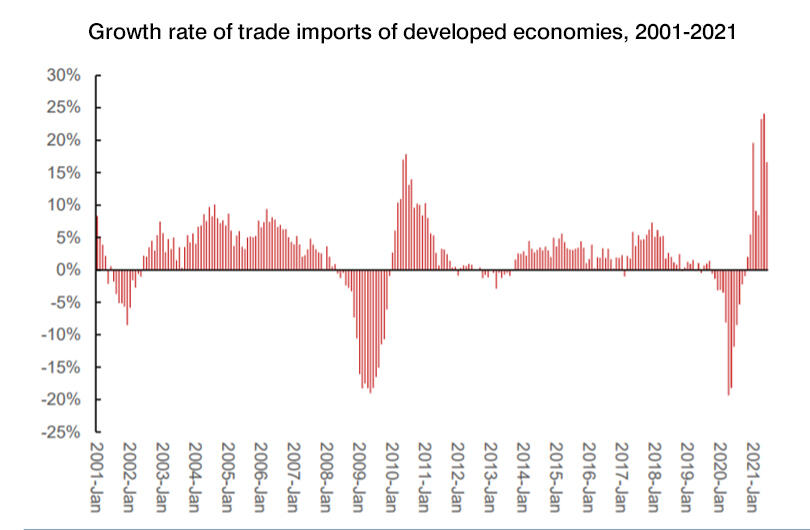
Growth rate of trade imports of developed economie
The rebound in 2010 and 2011 was catalyzed by the economic stimulus of various countries, and the market mistakenly believed that the cycle was not over, but in 2013 the market's judgment of the overall industry situation became clear, and new orders sprang up. The delivery of Maersk 3E class vessels in 2013 started the arms race for 10,000 container ships, resulting in a long-term overcapacity.
The market share of Top 5 reached 67% and 72% in major routes, which greatly optimized the industry structure. At the same time, the container shipping industry started to operate as an alliance.
In January 2015, Maersk Line and MSC formed the 2M Alliance. On May 13, Hapag-Lloyd, Hanjin Shipping, Yang Ming Shipping, MITSUBISHI, Nippon Yusen and Kawasaki Kisen Kaisha announced the formation of THE Alliance; on December 11, 2M and Hyundai Merchant Marine announced a strategic cooperation agreement, under which the two companies will cooperate in various ways, including slot swap and slot purchase; in February 2017, 2M reached an agreement with Hamburg Süd, under which Hamburg Süd can share vessels with 2M.
The alliance covers Asia-Europe, transatlantic and transpacific routes, and Asia-Middle East routes. All alliances operate for a period of 10 years. The extreme consolidation of the container liner industry is a dream come true for all industries, as the three alliances now control more than 80% of the world's container capacity and shipping companies are finally free from the low ocean freight rates and chronic losses of the past decade. During the outbreak in early 2020, the alliances implemented an aggressive capacity control strategy in a coordinated manner and prevented a sharp drop in ocean freight rates, including through "gap sailing. The three alliances will continue to maintain the current supply-side market, and it will be difficult for freight rates to return to their pre-outbreak lows.

You May Interested In


High Quality β-Nicotinamide adenine dinucleotide CAS 53-84-9 NADwith ready stock and best price
$3/UNIT FOB


2026-10-16
Trade Alert
Delivering the latest product trends and industry news straight to your inbox.
(We'll never share your email address with a third-party.)

Related News
-
Blockade And Control Aggravate Port Congestion! Shipping Company Announces Port Jump And Adjustment of Shipping Schedule
-
When Will The Sea Freight Price Peak?
-
44 Voyages Cancelled in Four Weeks, The Multi-ship Company Announced to Jump to The Port
-
Shipping Issues Continues To Affect Global Trade In The Post-Pandemic Era
-
Outbreak Extends Supply Chain Repair Time, But Has Limited Impact
-
End-To-End Services Of Shipping Companies
-
Demand: Global Trade Volume Growth Rate Of 6.7% In 2022 With Strong Customer Shipment Demand
-
Supply: Port Congestion Is Difficult To Relieve, And Labor Shortage Is Serious
-
New Alliance boost for strategic port equipment procurement
-
A.P.Moller - Maersk announces changes in Ocean & Logistics
Recommend Reading
-
![Middle East Crude Exports Rebound Sharply in September as Saudi Arabia Returns to Market at 5.4 Million bpd]()
Middle East Crude Exports Rebound Sharply in September as Saudi Arabia Returns to Market at 5.4 Million bpd
-
![U.S. 10% Temporary Tariff Expires, New Section 301 Tariffs Not Yet Implemented]()
U.S. 10% Temporary Tariff Expires, New Section 301 Tariffs Not Yet Implemented
-
![Hormuz Reopening Signal: 155 Tankers Still Waiting]()
Hormuz Reopening Signal: 155 Tankers Still Waiting
-
![Coal Price Surge Coupled with El Niño Drives Urea Up by RMB 100/Ton in a Single Day]()
Coal Price Surge Coupled with El Niño Drives Urea Up by RMB 100/Ton in a Single Day
-
![China’s Chemical Time Bomb Just Got a Legal Fuse: The New Law That Could Save Thousands of Lives]()
China’s Chemical Time Bomb Just Got a Legal Fuse: The New Law That Could Save Thousands of Lives
-
![Tert Butylate: Properties and Applications]()
Tert Butylate: Properties and Applications
-
![High Supply Remains Firm, Weakness in ABS Market Persists at End of October in China]()
High Supply Remains Firm, Weakness in ABS Market Persists at End of October in China
-
![Cost Side Rebounds, Polyester Staple Fiber Prices Rise Slightly]()
Cost Side Rebounds, Polyester Staple Fiber Prices Rise Slightly
-
![Weak Demand Weighs on Butadiene Market]()
Weak Demand Weighs on Butadiene Market
-
![Supply and Demand Bearish, Toluene Market Declines]()
Supply and Demand Bearish, Toluene Market Declines






- Hot Searches
- trisodium phosphate where to buy
- retatrutide wholesale
- calcined alumina powder
- polylactic acid cost
- ferric chloride market
- sulfanilamide powder
- where can you buy sarms
- pharmaceutical chemicals suppliers
- buying testosterone enanthate
- butane prices
- retatrutide for sale online usa
- buy reta online