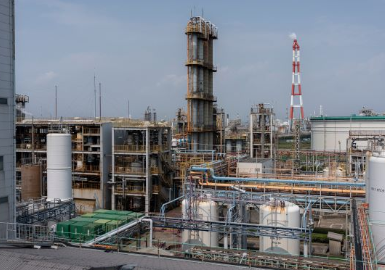
With the rapid development of the polycarbonate industry, the competition for bisphenol A raw materials has intensified!
Bisphenol A (BPA) is the main raw material for the production of polycarbonate and epoxy resin. Interfacial polycondensation phosgene method, melt transesterification method and non-phosgene melt transesterification method and other different polycarbonate process routes, bisphenol A is an indispensable raw material among them. In recent years, with the successive commissioning of multiple 10,000-ton polycarbonate projects by domestic enterprises, China's polycarbonate (PC) industry has entered a period of rapid development and has become the main driving force for the development of the bisphenol A industry.
China is a big producer of bisphenol A, but in recent years, due to the lack of new equipment put into production, the current production capacity is still maintained at about 1.4 million tons per year. These equipment are mainly distributed in eastern coastal areas such as Jiangsu, Shanghai, Beijing, Zhejiang, and Shandong. According to data from ASIACHEM's "China Bisphenol A Annual Report 2021", China's Bisphenol A will have 1.14 million tons of new capacity in 2021. In 2021, China's bisphenol A production will reach nearly 2 million tons, an increase of about 30%.
The driving force of BPA demand growth
Bisphenol A is mainly used to produce polycarbonate and Epoxy Resin. In addition, it can also be used to produce polysulfone resins, unsaturated resins and other polymer materials, as well as related products in the fields of pesticides and medicine. According to data from ASIACHEM Consulting, polycarbonate accounts for 52% of the total consumption of bisphenol A, and epoxy resin accounts for 45% of the total consumption. It is expected that the average annual growth rate of China's apparent consumption of bisphenol A will maintain from 2021 to 2025. More than 10%.
1. The rapid development of the PC industry drives the demand for bisphenol A raw materials
In recent years, China's polycarbonate (PC) industry has risen rapidly and has become the world's largest PC production site, and it will also be the world's most promising market and project investment site. In the context of increasing domestic supply, the import volume of polycarbonate remains high. In 2020, China imported 1.63 million tons of polycarbonate and exported 251,000 tons of polycarbonate. In the future, there is a lot of room for import substitution.
According to data from ASIACHEM's "China Polycarbonate Technology and Market Annual Report 2021", there are about 20 projects in progress in China with a total production capacity of about 3.7 million tons per year. In the next few years, China's polycarbonate production capacity is expected to be released intensively. It is estimated that by 2023, nearly 2.4 million tons/year of production capacity will be released. By then, China's total polycarbonate production capacity will be close to 3.6 million tons/year.
In the next few years, the rapid development of the PC industry will drive the demand for bisphenol A raw materials. Raw materials such as bisphenol A, Phenol/Acetone, and dimethyl carbonate will all benefit from the development of the PC industry. The downstream consumption of PCs will be mainly concentrated in the fields of electronics, automobiles, sheet films, packaging materials, etc. With the development of high-end products, the consumption of PCs in the medical industry and LED lighting will also grow rapidly. In addition, in the context of carbon neutrality, the recycling of PC has also received more attention.
2. Bisphenol A production enterprises are equipped with downstream equipment, with limited external sales
Among the domestic polycarbonate projects that have been put into production, except for Covestro, Lihua Yiweiyuan, Sinopec Mitsubishi Chemical and Jiaxing Teijin who have built supporting bisphenol A devices or specialized sources of supply, other production companies mostly purchase bisphenol A from outside. The raw materials meet the production requirements. Domestic bisphenol A production enterprises are basically equipped with downstream equipment and limited external sales. This has led to the continued tight supply of bisphenol A. In 2021, China's bisphenol A import volume will remain at a high level, above 600,000 tons.
BPA is in short supply and the price is high
Since 2021, the domestic supply of bisphenol A has exceeded demand, and the market price has risen wildly. From 12,700 CNY/ton at the beginning of the year, it rose to 30,000 CNY/ton in mid-April, setting a new high in the past 10 years. In the same period, the PC market price was 28,000 CNY/ton, forming an upside-down situation. The profitability of PC manufacturers has been severely affected. In mid-June 2021, the reference price of bisphenol A in East China is 22,000-23,000 CNY/ton, still maintaining a high level.
Substantial expansion of PC production capacity and close advancement of bisphenol A projects
In 2021, the PC production capacity of one of the main downstream products of bisphenol A will continue to expand significantly, and the other mainstream downstream epoxy resin will also have multiple sets of production capacity released during the year. Domestic Huayi Qinzhou, Gulf Chemical, Cangzhou Dahua, Nanya Plastics, Pingmei Shenma, Daqing Petrochemical and other domestic bisphenol A projects are proceeding closely. In addition, Luxi Chemical intends to invest in the construction of a 1.2 million tons/year bisphenol A project.
—200,000 tons of bisphenol A in Huayi Qinzhou
—Gulf Chemical's 240,000-ton/year Bisphenol A project
—Cangzhou Dahua 200,000 Tons of Bisphenol A Project
—Pingmei Shenma 130,000 tons/year bisphenol A project
— Nanya Plastics 170,000 tons of Bisphenol A Phase II project
In addition, the 240,000-ton/year bisphenol project of Jiangsu Ruiheng New Material Technology Co., Ltd., wholly-owned by Jiangsu Yangnong Chemical Group Company, a subsidiary of Sinochem Group, is also in progress.

You May Interested In


Glow70/KLOW80 99% China Peptides Warehouse Direct Delivery Lyophilized Powder in Stock
$169/UNIT FOB


2026-10-17
Trade Alert
Delivering the latest product trends and industry news straight to your inbox.
(We'll never share your email address with a third-party.)

Related News
-
Three Major Indian Chemical Investments Target China's PC Exports
-
Japan Extends Bisphenol A Anti-Dumping Probe, Prolonging Uncertainty for Korean and Taiwanese Suppliers
-
Raw Materials Strengthen; PC Prices Show Volatility with a Rise at Late January
-
Pre-holiday inventory buildup sluggish; PCs operate at low levels through late December
-
Market Trends and Outlook for Key Chemicals in China
-
Chemical Market Update: BPA and Epoxy Resin Trends in Focus
-
Market Insights: Recent Trends in China's Chemical Industry
-
Recent Trends in Chemical Markets: Bisphenol A, Phenol, Acetone, Epichlorohydrin, and Epoxy Resin
-
Analysis and Outlook of the Domestic Chemical Market
-
Chemical Raw Materials Market Weekly Report: Comprehensive Analysis of Bisphenol A and Epichlorohydrin Market Trends
Recommend Reading
-
![thyssenkrupp nucera Wins Order for Hongniu Lanzhou Caustic Soda Project, Contract in Double-Digit Million Euro Range]()
thyssenkrupp nucera Wins Order for Hongniu Lanzhou Caustic Soda Project, Contract in Double-Digit Million Euro Range
-
![Evonik Inaugurates New Speciality Alumina Plant in Japan, Bolstering Regional Growth Strategy]()
Evonik Inaugurates New Speciality Alumina Plant in Japan, Bolstering Regional Growth Strategy
-
![AkzoNobel–Axalta $25 Billion Merger Nears EU Clearance With Vehicle Refinish Divestment]()
AkzoNobel–Axalta $25 Billion Merger Nears EU Clearance With Vehicle Refinish Divestment
-
![Wanhua Chemical Announces 2026 Investment Plan: RMB 27.3 Billion for Projects Plus RMB 2.22 Billion for Equity Investments]()
Wanhua Chemical Announces 2026 Investment Plan: RMB 27.3 Billion for Projects Plus RMB 2.22 Billion for Equity Investments
-
![Korea’s Petrochemical Pivot: Industry Embraces Historic Restructuring to Slash Overcapacity]()
Korea’s Petrochemical Pivot: Industry Embraces Historic Restructuring to Slash Overcapacity
-
![Ethyl Acetate Market Shows Weak Performance]()
Ethyl Acetate Market Shows Weak Performance
-
![Business Society’s Market Outlook for Propylene Oxide on August 26, 2026: Volatile]()
Business Society’s Market Outlook for Propylene Oxide on August 26, 2026: Volatile
-
![Lithium carbonate strongly rebounds in August, continuing to show peak season trends in September]()
Lithium carbonate strongly rebounds in August, continuing to show peak season trends in September
-
![Business Society October 8, 2026 Phthalic Anhydride Trend Analysis: Strongly Bullish]()
Business Society October 8, 2026 Phthalic Anhydride Trend Analysis: Strongly Bullish
-
![Negative Factors Suppress Adipic Acid Prices in China]()
Negative Factors Suppress Adipic Acid Prices in China